Internationally acclaimed contemporary Kurdish artist Hayv Kahraman presents her latest solo exhibition, What Cannot Be Said Will Be Wept, at Pilar Corrias Gallery in London. On view from June 5 to September 5, 2026, the exhibition brings together the artist’s recent works, exploring the interconnected themes of the body, migration, exile, ecological destruction, memory, and mourning. Displaced from her homeland as a child and raised as a Kurdish-Iraqi refugee, Kahraman places the rupture between humanity and the natural world at the center of her artistic inquiry.
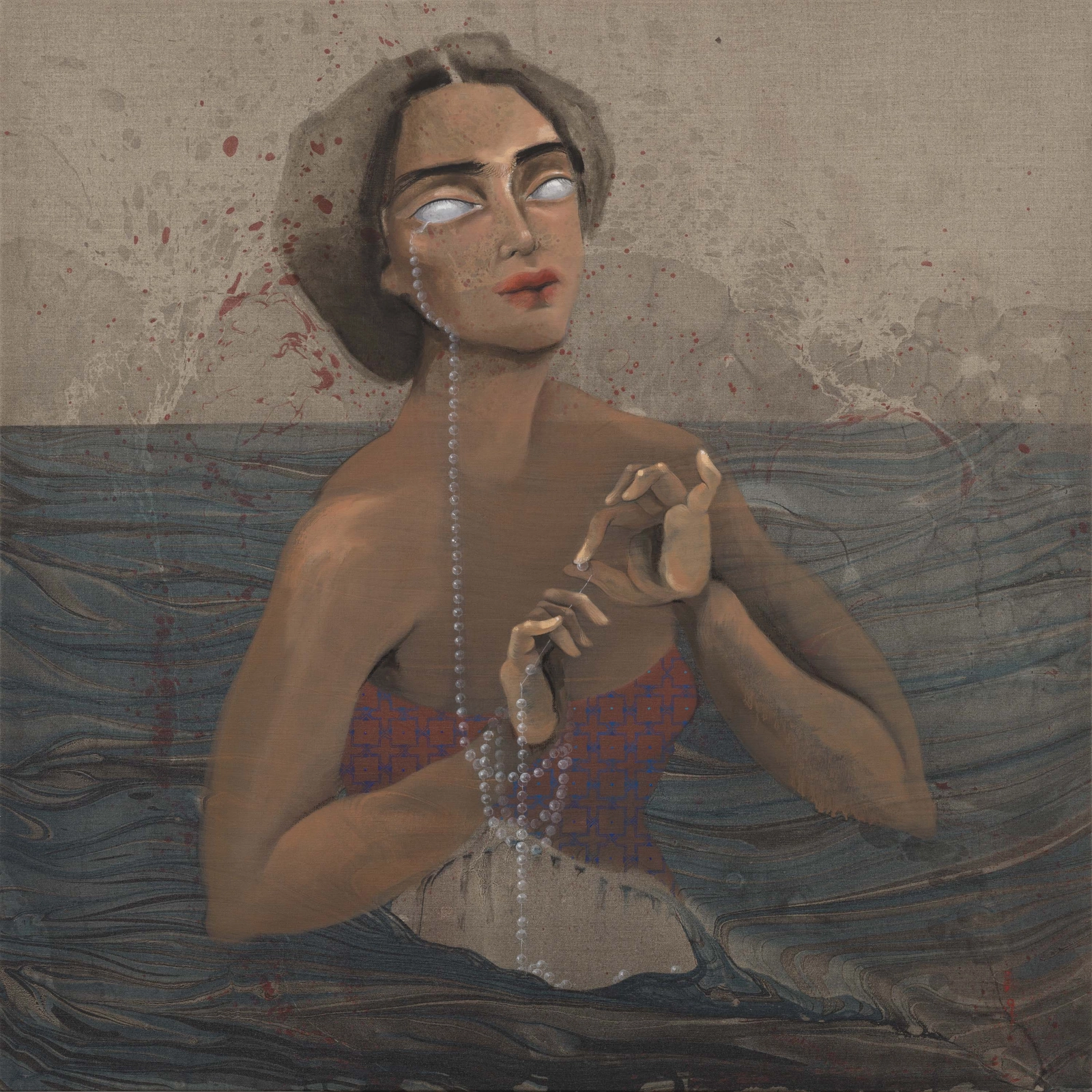
Figure Threading Tear Beads, 2026. Oil and acrylic on linen 88.9 x 88.9 cm 35 x 35 in
Kahraman’s new exhibition draws upon two major turning points in her personal life. The first is the forced migration she experienced in childhood, and the second is the loss of her home during the devastating Los Angeles wildfires of 2025. Rather than viewing these experiences as separate events, the artist understands them as consequences of broader systems that disconnect people from the places they inhabit, from their relationship with nature, and from cultural memory itself. In the exhibition text, Kahraman argues that the most enduring effect of modernity and colonialism is “separation,” emphasizing how people have been alienated not only from their homelands but also from their environments, ancestral knowledge, and longstanding relationships with the natural world. This sense of estrangement forms the foundation of the visual language that runs throughout the exhibition. The works presented in What Cannot Be Said Will Be Wept do not depart from Kahraman’s longstanding investigations into the body, memory, and identity; rather, they extend these inquiries onto a new pictorial terrain. The artist’s characteristic female figures remain central to this visual universe, recognizable through their porcelain-like skin, arched eyebrows, whitened eyes, and garments adorned with motifs drawn from diverse cultural traditions. References to Persian miniature painting, Abbasid manuscripts, and the textile cultures of the Middle East move beyond decorative embellishment to become carriers of bodily experience, identity, and cultural memory. Yet here, these figures enter into new relationships with fluid, marbled surfaces, pearl-like tears, and spaces whose boundaries constantly dissolve. The body is thus reimagined not as a closed and self-contained entity, but as a site of fluidity, transformation, and permeability. Throughout the exhibition, ebru (paper marbling) functions not merely as an aesthetic reference but as a generative element within the paintings themselves, becoming a material expression of memory, mourning, and continual change.
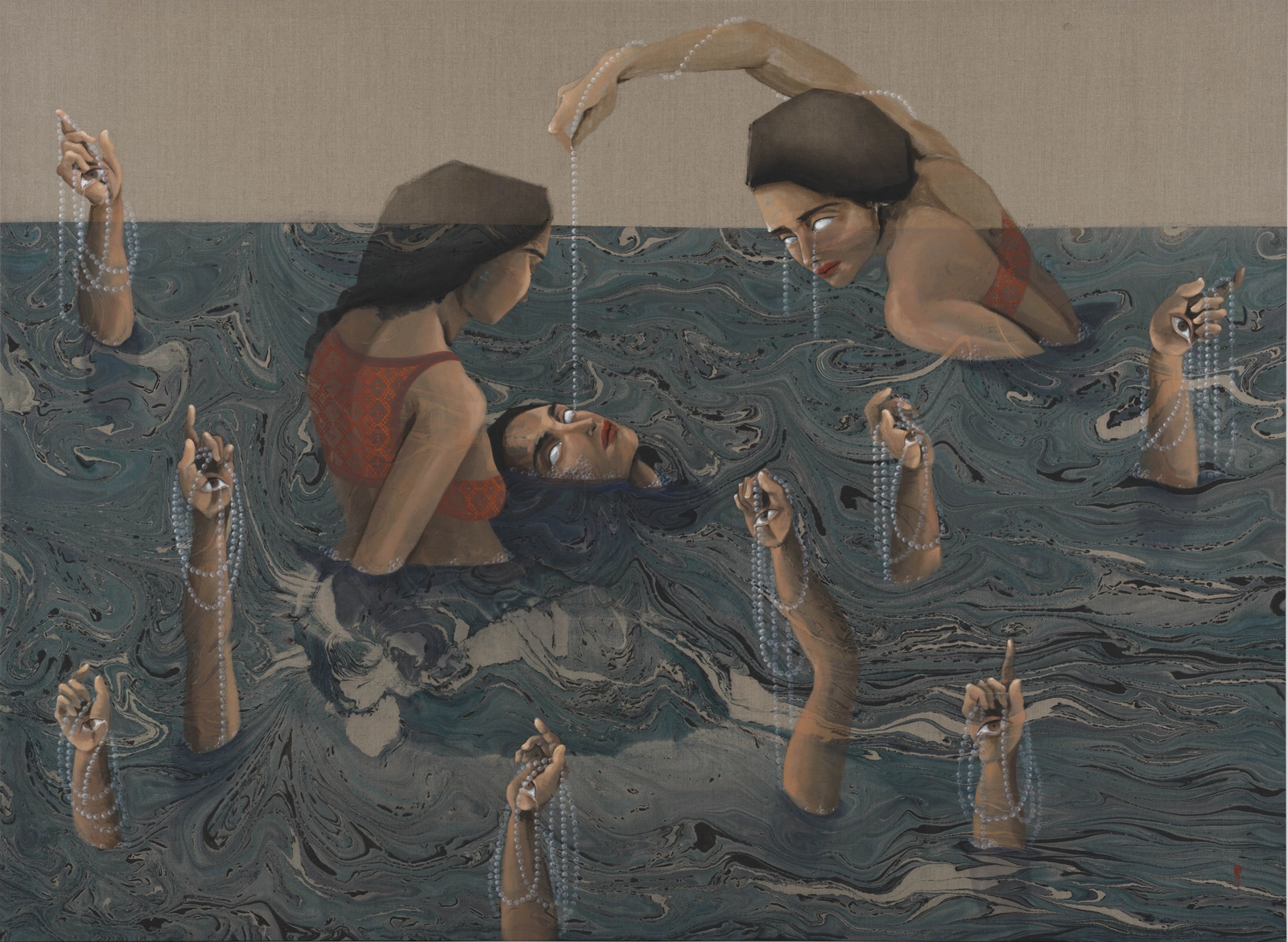
 Eyes in Waters, 2026. Oil and acrylic on linen 139.7 x 190.5 cm 55 x 75 in
One of the most striking aspects of the exhibition is the direct incorporation of water into the process of painting itself. In some works, Kahraman employs the technique of ebru (paper marbling), bringing the canvas into contact with the surface of water and allowing the paint to develop its own movement in dialogue with it. This delicate balance between control and chance lies at the heart of the artist’s compositional approach. The spontaneous flows generated through ebru, which serve as the visual source of the fluid surfaces seen throughout the paintings, become a conceptual model for understanding the workings of memory and transformation. A passage from the press text accompanying What Cannot Be Said Will Be Wept offers a powerful summary of this approach: “In a burning world, I turn my face to water: to seas, rivers, tears. I pursue gestures and rituals, seeking ways to establish a ceremonial relationship with my ecology. Painting transforms into a space of devotion; a practice where relationality is carefully cultivated, and grief finds its place and takes shape. The materiality of the ebru created by immersing the canvas in water evokes a sense of ceremony; it becomes a space where the soul can rise to the surface. Through the act of submersion, a gradual healing begins.” For Kahraman, painting thus becomes far more than a technical process of image-making. It is transformed into a ritual act through which grief acquires form, memory is reorganized, and the possibility of healing slowly emerges. As the artist suggests, certain forms of pain exceed the limits of language and can only be expressed through the body, through tears, and through silence. Mourning here is not simply an expression of loss.
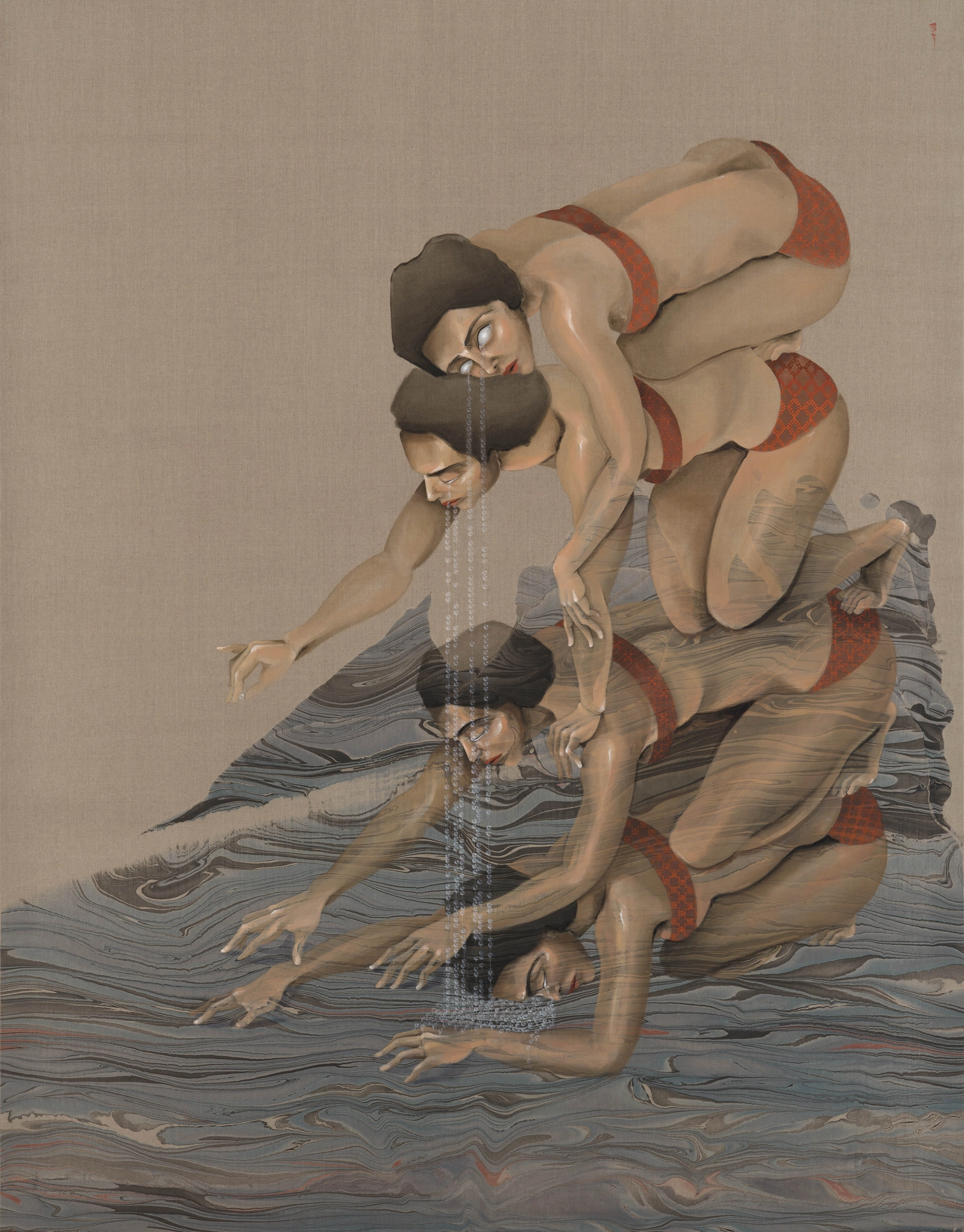
Four Figures Kneeling, 2026. Oil and acrylic on linen 231.1 x 180.3 cm 91 x 71 in
Recurring motifs such as teardrops and the fluid surfaces produced through ebru function as more than aesthetic devices. They become powerful metaphors for the interdependence of life and the relational nature of existence itself. Equally significant are the exhibition’s references to Sufi thought. The image of a drop of water merging into the ocean and relinquishing its singularity serves as a potent metaphor for the dissolution of the self within a greater order of being. This idea also evokes the water-centered cultural memory of Mesopotamia. In a geography shaped by the Tigris and Euphrates, water has long symbolized life, memory, transformation, and continuity. Kahraman reinterprets this cultural inheritance through the language of contemporary art. The artist’s approach to ecological destruction constitutes another defining dimension of the exhibition. In this context, she understands the climate crisis as a historical process deeply intertwined with warfare, colonialism, and capitalist domination. For Kahraman, personal suffering and planetary devastation cannot be separated from one another. Accordingly, the paintings are not conceived as representational depictions of nature, but rather as investigations into the material and ontological relationship between human beings and the earth.
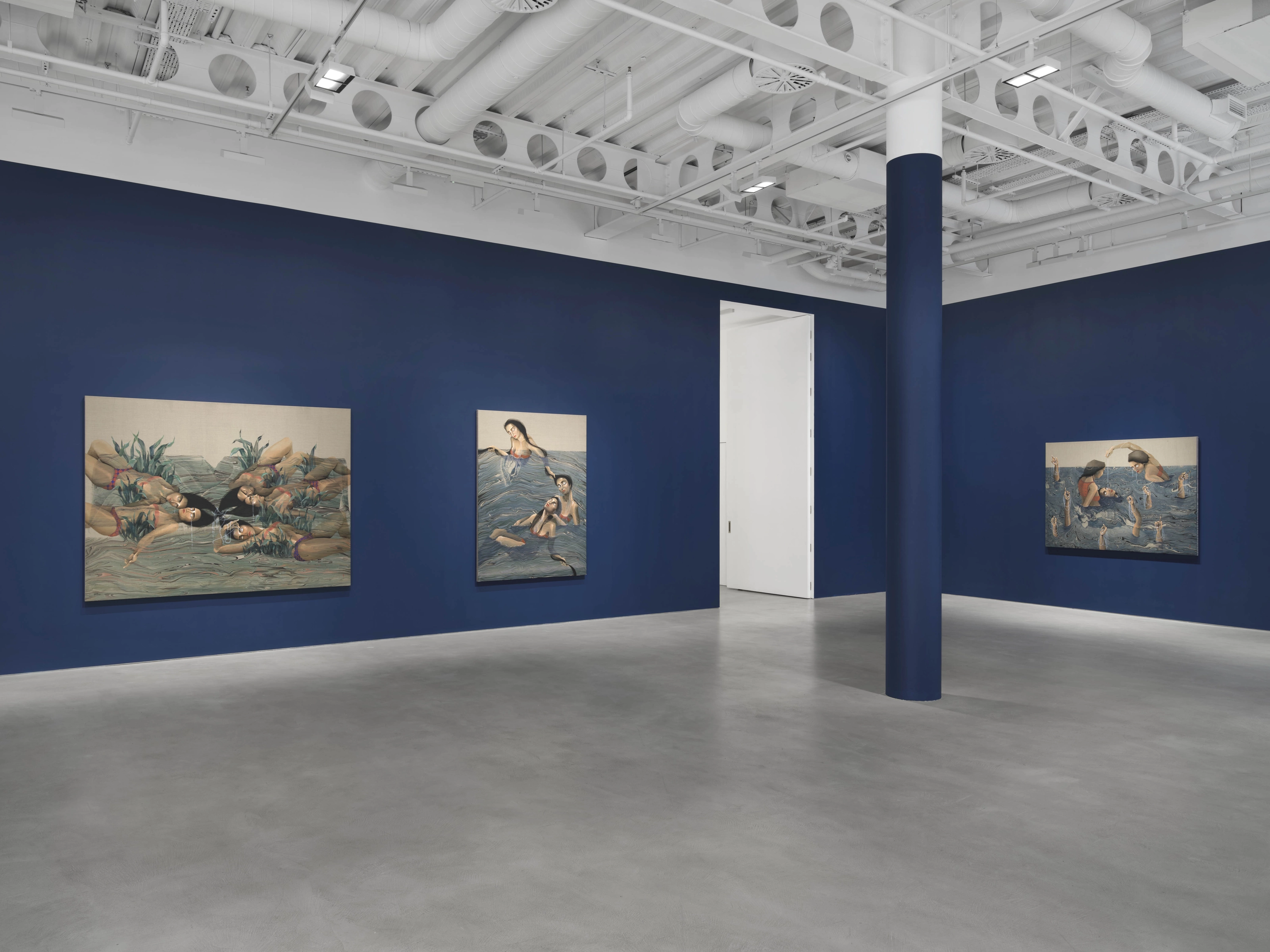 Exhibition View, Pilar Corrias Gallery, London
In summary, Hayv Kahraman’s London exhibition What Cannot Be Said Will Be Wept reveals a new phase in the visual inquiry she has developed over many years around the intertwined themes of the body, migration, and memory. Here, the female body is reconsidered through water, ebru, tears, and ritual within a broader ecological and relational understanding of existence, bringing personal mourning and planetary vulnerability onto the same pictorial plane. In doing so, Kahraman invites viewers to think about diverse forms of violence—from forced displacement to the climate crisis—as manifestations of a shared historical rupture. At the same time, she reminds us that painting remains a powerful site for thinking through memory, mourning, and the possibility of healing.
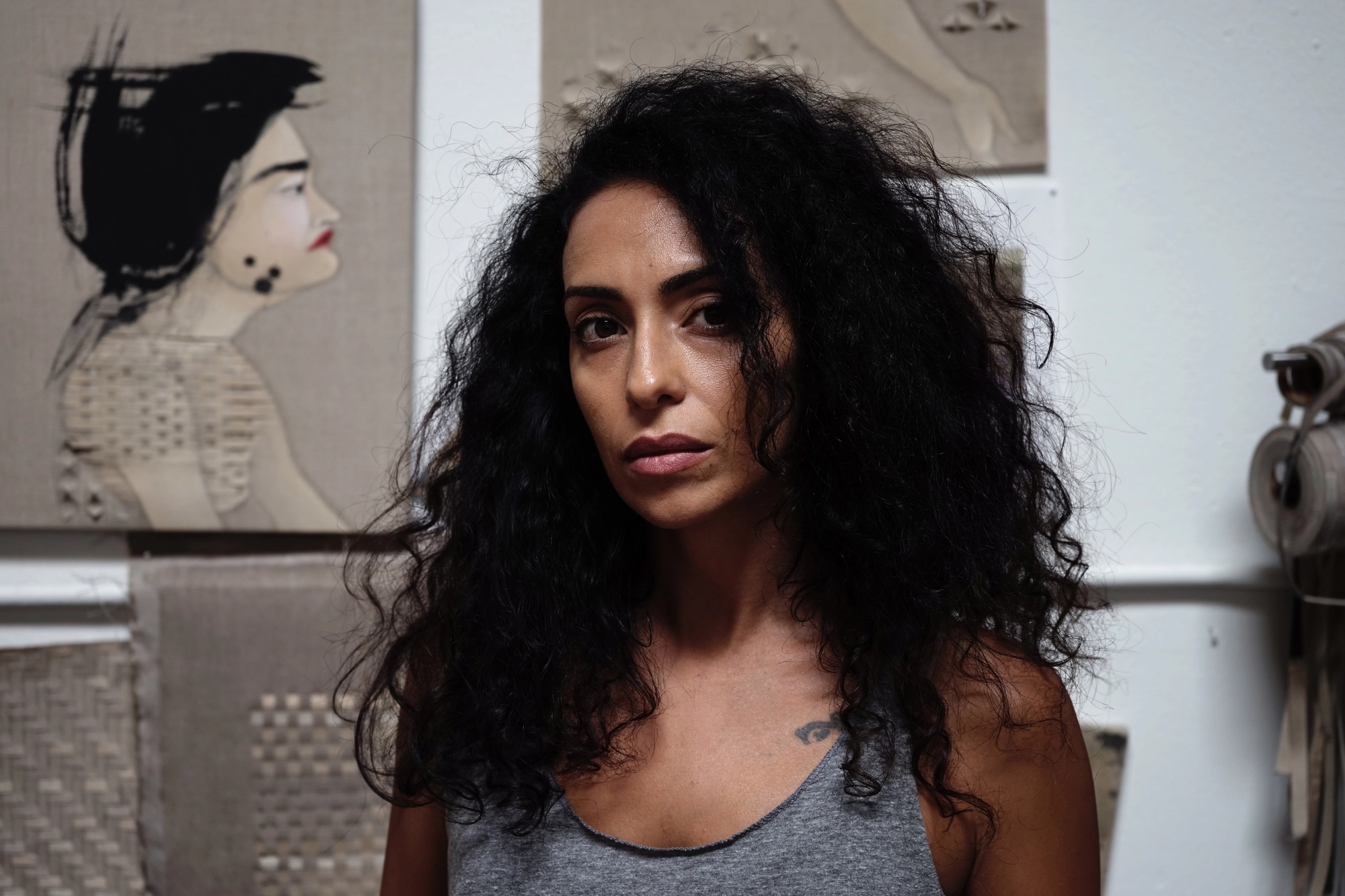
Hayv Kahraman: Born in Baghdad in 1981, Hayv Kahraman left Iraq with her family during the 1990s and initially sought refuge in Sweden. She later relocated to the United States and currently lives and works in Los Angeles.
Kahraman’s artistic practice is shaped by themes of forced migration, diaspora, the female body, identity, colonialism, memory, and biopolitics. Working across painting, drawing, sculpture, and installation, she has developed a distinctive visual language that brings Mesopotamian cultural heritage into dialogue with contemporary art.
Her work is held in major international museums and collections, including the British Museum (London), the Los Angeles County Museum of Art (LACMA), the Museum of Contemporary Art San Diego, the Pérez Art Museum Miami, Mathaf: Arab Museum of Modern Art (Doha), the Barjeel Art Foundation (Sharjah), and the Birmingham Museum of Art.
In recent years, Kahraman has presented solo exhibitions at leading institutions including the Frye Art Museum (Seattle), the Institute of Contemporary Art San Francisco, the Moody Center for the Arts at Rice University, The Mosaic Rooms (London), and Kunsthalle Düsseldorf. Today, she is widely regarded as one of the most prominent Kurdish contemporary artists working on the international stage.
info@firezz.com


Comments
00