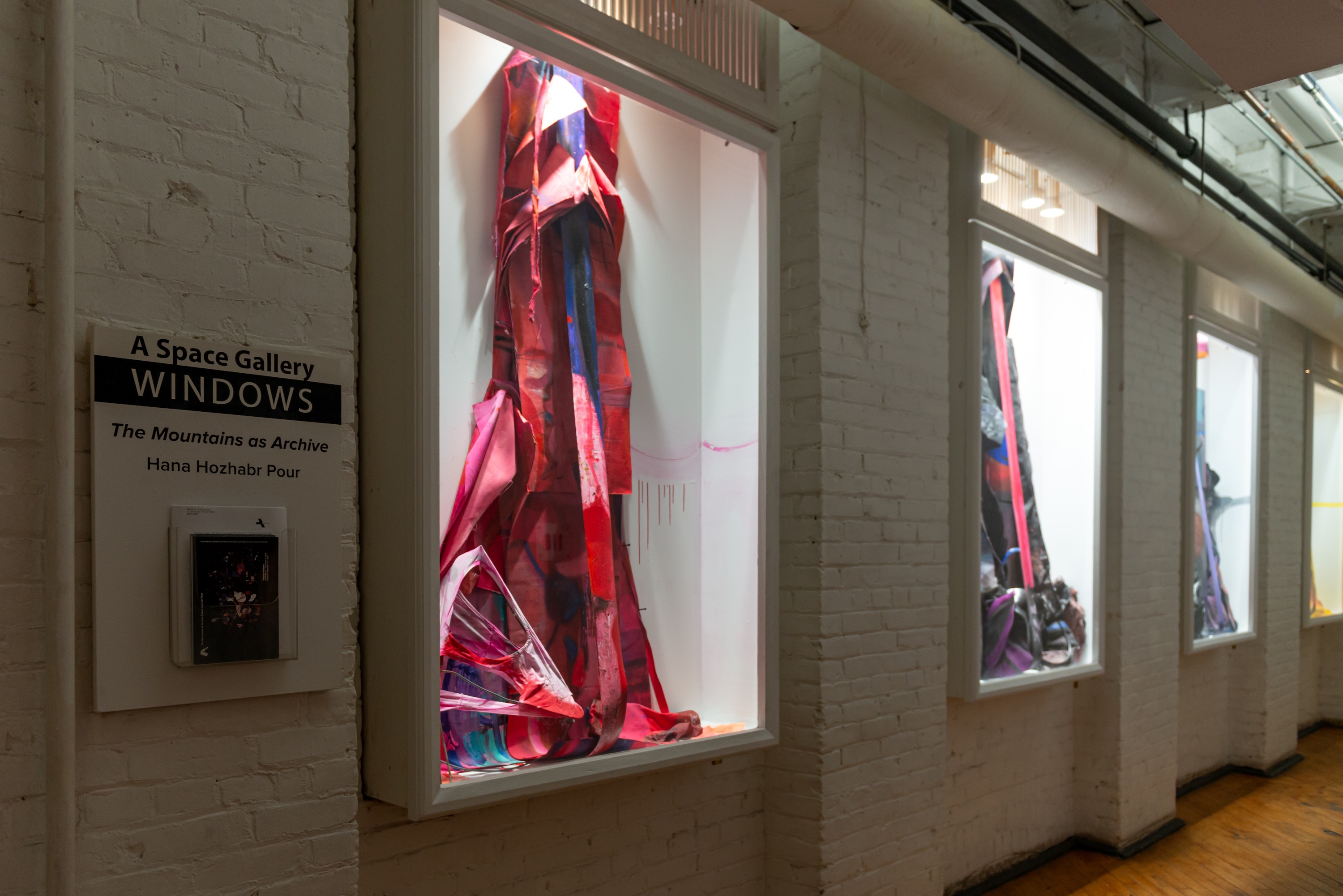
A Space Gallery in Toronto is hosting Hana Hozhabr Pour’s exhibition, The Mountains as Archive, in its A Space Windows exhibition space from September 18 to November 14, 2026. Curated by Vicky Moufawad-Paul, the gallery’s Director of Curating and Programming, the exhibition transforms the four-window space into more than a surface for displaying paintings. Moufawad-Paul, whose practice focuses on self-determination, counter-archives, and experiences excluded from dominant historical narratives in Southwest Asia, constructs the exhibition’s conceptual framework around the relationship between the geography of Kurdistan, collective memory, and the limits of written archives. Hozhabr Pour explores the relationship between visibility and disappearance through layers of superimposed canvas and forms that are concealed and re-emerge. In the exhibition text, the mountains of Kurdistan are described as “repositories for songs, voices, and histories that have never been recorded or have been erased from written archives.” Mountains and trees are approached as spaces where testimonies, movements, perceptions, and memories passed down through generations can continue to exist outside written records. This approach is extended through the idea of a “living archive” that carries experiences of resistance. In this way, the exhibition explores how memory persists not only in documents, but also in bodies, geography, and the material layers of painting.
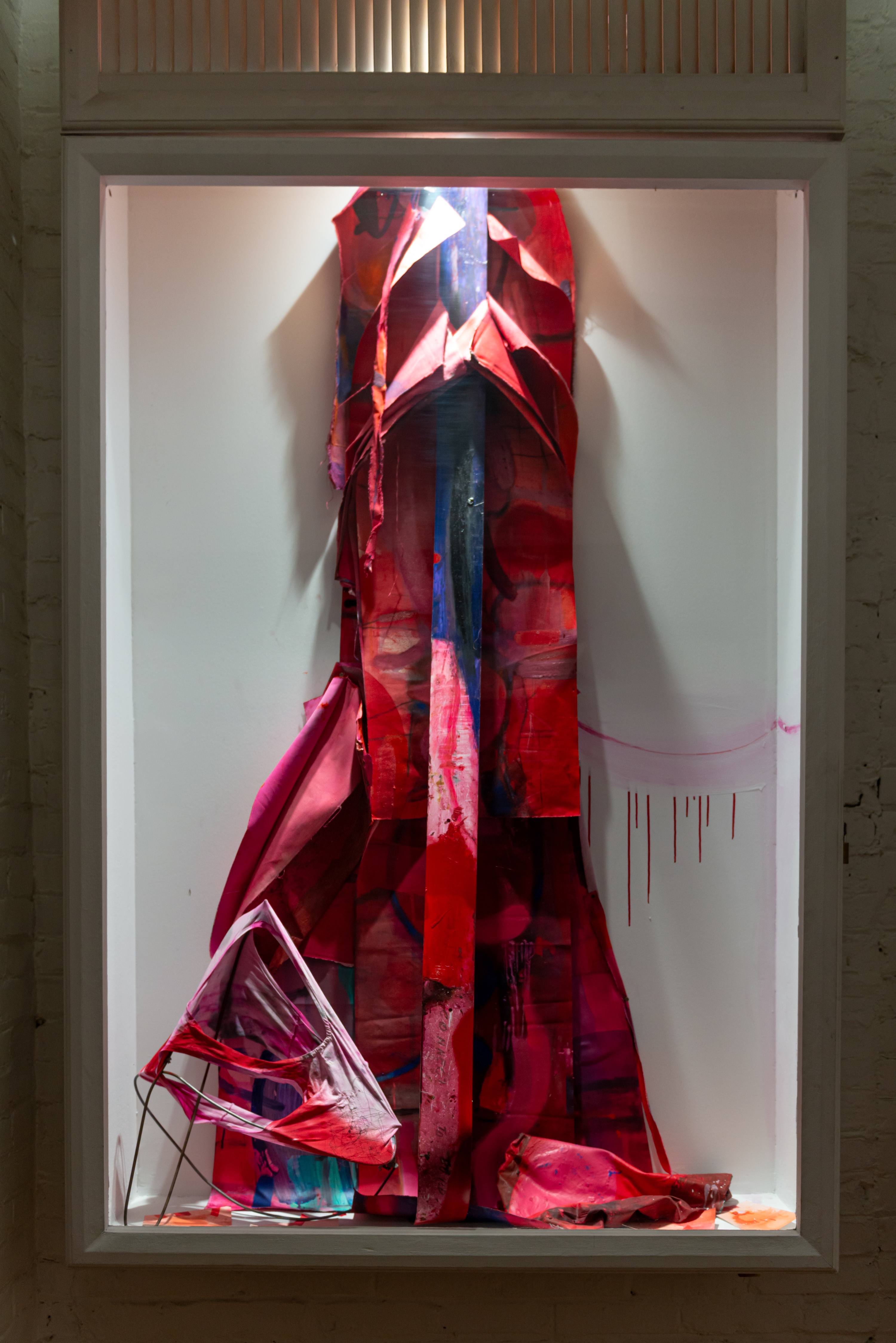
Hana Hozhabr Pour, The Mountains As Archive, found canvases, acrylic sheets, sewn canvas, acrylic and oil paint, 2026. Image courtesy of A Space Gallery, Toronto.
Hana Hozhabr Pour’s exhibition, The Mountains as Archive, curated by Vicky Moufawad-Paul at A Space Gallery in Toronto, addresses the relationship between memory, geography, and human ways of seeing through an installation integrated with the gallery’s architecture. Moufawad-Paul’s curatorial approach, which focuses on counter-archives and experiences excluded from dominant historical narratives, also finds expression in the spatial arrangement of the exhibition. Spanning the gallery’s four-window A Space Windows exhibition space, the installation transforms the window frames, wall surfaces, and the visual relationship with the outside into components of the composition. Rather than perceiving the work from a single vantage point and as an uninterrupted image, the viewer experiences it by establishing connections between the fragments visible through different windows. In this way, the boundaries between inside and outside, the exhibited surface and everyday life, and the visible and the concealed are reconfigured. Approaching the mountains of Kurdistan as carriers of songs, voices, and histories that remain outside written archives, the exhibition explores the idea of the archive through the material structure of painting and the exhibition space.
A mountain form rising along the wall emerges through the layering of canvases of varying sizes. However, this form is not based on a recognizable image of a mountain or the representation of a specific natural phenomenon. The mountain becomes visible through the accumulation of canvas fragments, the overlapping of surfaces, the convergence of colors, and the relationships created by the gaps that open up between them. The resulting structure is neither a miniature of a mountain in nature nor a landscape painting; it is a plastic mountain constructed through the coming together of different materials, colors, and surfaces. Rather than depicting the mountain’s outlines, Hozhabr Pour’s intervention investigates the conditions under which it can take shape and become visible. For this reason, the image of the mountain is not completed within a predetermined contour; it is constructed through the physical arrangement of the canvases and the viewer’s gaze. The relationship between the form of the mountain and the conditions of human vision constitutes one of the work’s central concerns: the image before us is not merely an object standing in plain sight, but a form that we make whole by establishing relationships between its different parts.
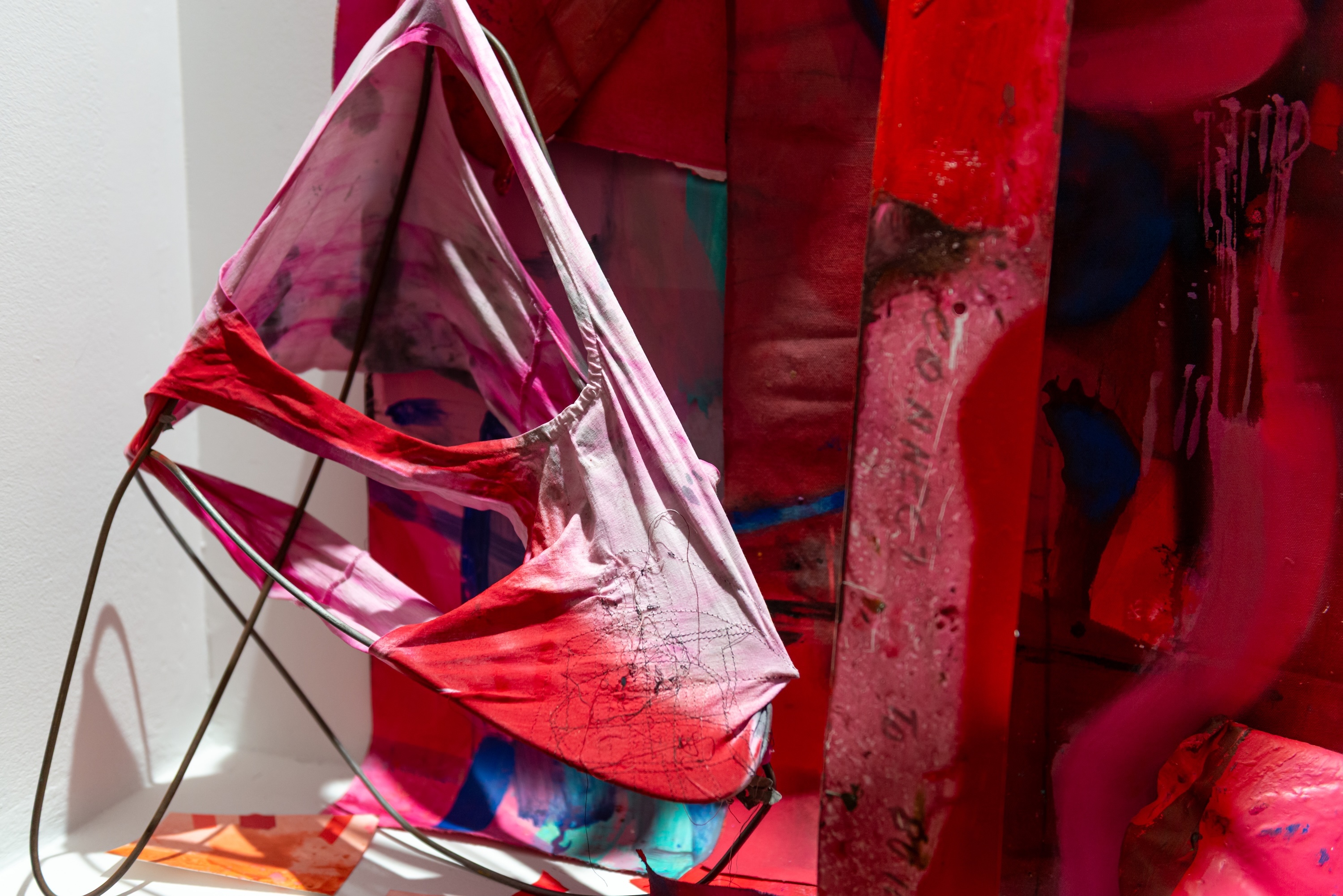
Hana Hozhabr Pour, The Mountains As Archive, found canvases, acrylic sheets, sewn canvas, acrylic and oil paint, 2026. Image courtesy of A Space Gallery, Toronto.
At this point, the four windows of A Space Windows take on historical and political connotations beyond the spatial arrangement of the installation. The four windows can be read in relation to the geography of Kurdistan, divided into four parts, and the different conditions this division has created in the social lives of Kurds. Rather than fixing each window as a direct counterpart to a specific part, this relationship opens up a way of considering how a shared image of the mountain can acquire different meanings within a divided geography. The experiences of Kurds living under different political borders also shape how the mountains are imagined and made visible. Under certain historical conditions, the mountain appears as a site bearing the traces of fire and destruction, while under others, it becomes a space of life, resistance, and the possibility of re-emergence. Hozhabr Pour’s construction of the mountains through the accumulation of canvases does not bring these different experiences together under a single landscape or an unchanging symbol. The image of the mountain takes shape within the tension between fragmentation and coming together, concealment and visibility. The arrangement created by the four windows also opens up a space for considering this tension on both spatial and visual levels.
Colors are among the fundamental elements that establish the conditions of the mountain’s visibility. Yellow, red, and blue appear separately across different surfaces, while their relationships with one another create new possibilities of color; black, too, acquires meaning within this arrangement through its relationship with the other colors. The colors do not function as descriptive details added to the surface of the mountain. Rather than depicting a particular tree, rock, or specific effect of light, they establish visual relationships that allow the fragments to come together, separate, and overlap. In this way, rather than reproducing a familiar natural appearance through color, the mountain takes shape through the distribution and encounter of colors. The coming together of yellow, red, and blue in varying intensities can also evoke the temporal cycle of the four seasons. In this reading, the seasons are not represented through separate landscapes; instead, they become a sense of time that can be understood through the shifting, blending, and separation of colors. For this reason, the form of the mountain does not remain fixed: the relationship between colors and surfaces continually reconfigures how it is perceived.
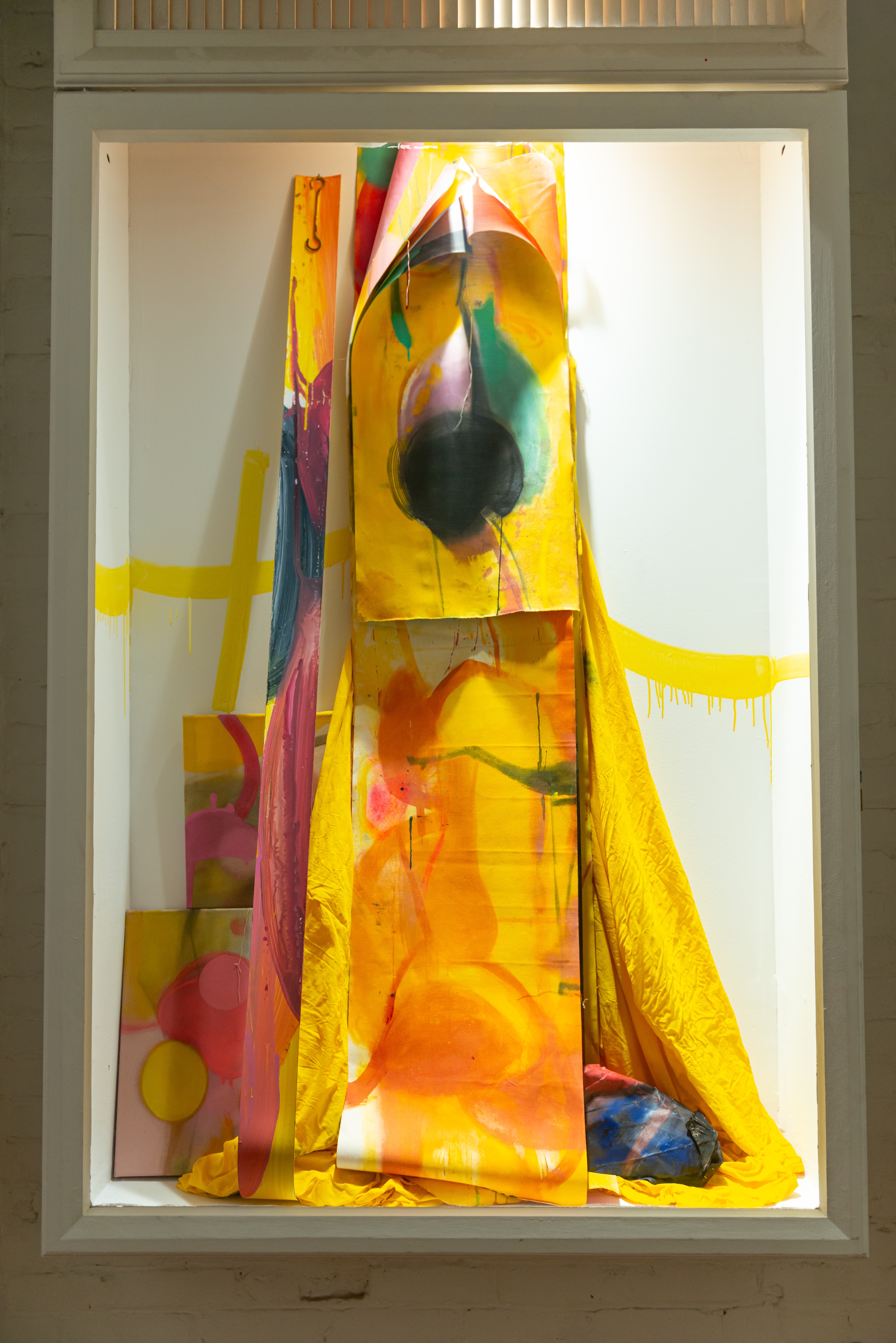
Hana Hozhabr Pour, The Mountains As Archive, found canvases, acrylic sheets, sewn canvas, acrylic and oil paint, 2026. Image courtesy of A Space Gallery, Toronto.
The physical presence of the canvases brings these relationships between colors into the space. The canvases do not remain merely flat surfaces onto which the image is painted; through their dimensions, textures, weights, and positions in relation to one another, they create the volume of the installation. The gaps between the overlapping surfaces interrupt the silhouette of the mountain while simultaneously contributing to the formation of its shape. The fragments do not merge into a seamless and uninterrupted whole; the mountain rises through the juxtaposition and overlapping of different surfaces. For this reason, the collage-like quality of the work does not derive solely from the arrangement of colors and forms on the pictorial surface. The logic of collage also extends to the material presence of the canvas and its placement within the space. The mountain ceases to be an image represented on a single surface and becomes a structure formed through the physical coming together of its fragments.
The window frames determine how this structure is perceived. While each window makes one part of the installation visible, it also limits its relationship to the composition as a whole. The viewer constructs the form of the mountain by mentally bringing together the fragments visible through different windows; the light from outside and everyday life also become part of the perceptual conditions of the exhibition space. In this arrangement, the space does not remain a neutral environment in which the work is displayed. The windows, wall, light, gaps, and exterior space become part of the process through which the mountain becomes visible. Hozhabr Pour’s work thus makes the boundary between painting and installation more permeable: the mountain emerges not only on the painted surfaces, but also through the relationship these surfaces establish with their architectural surroundings.
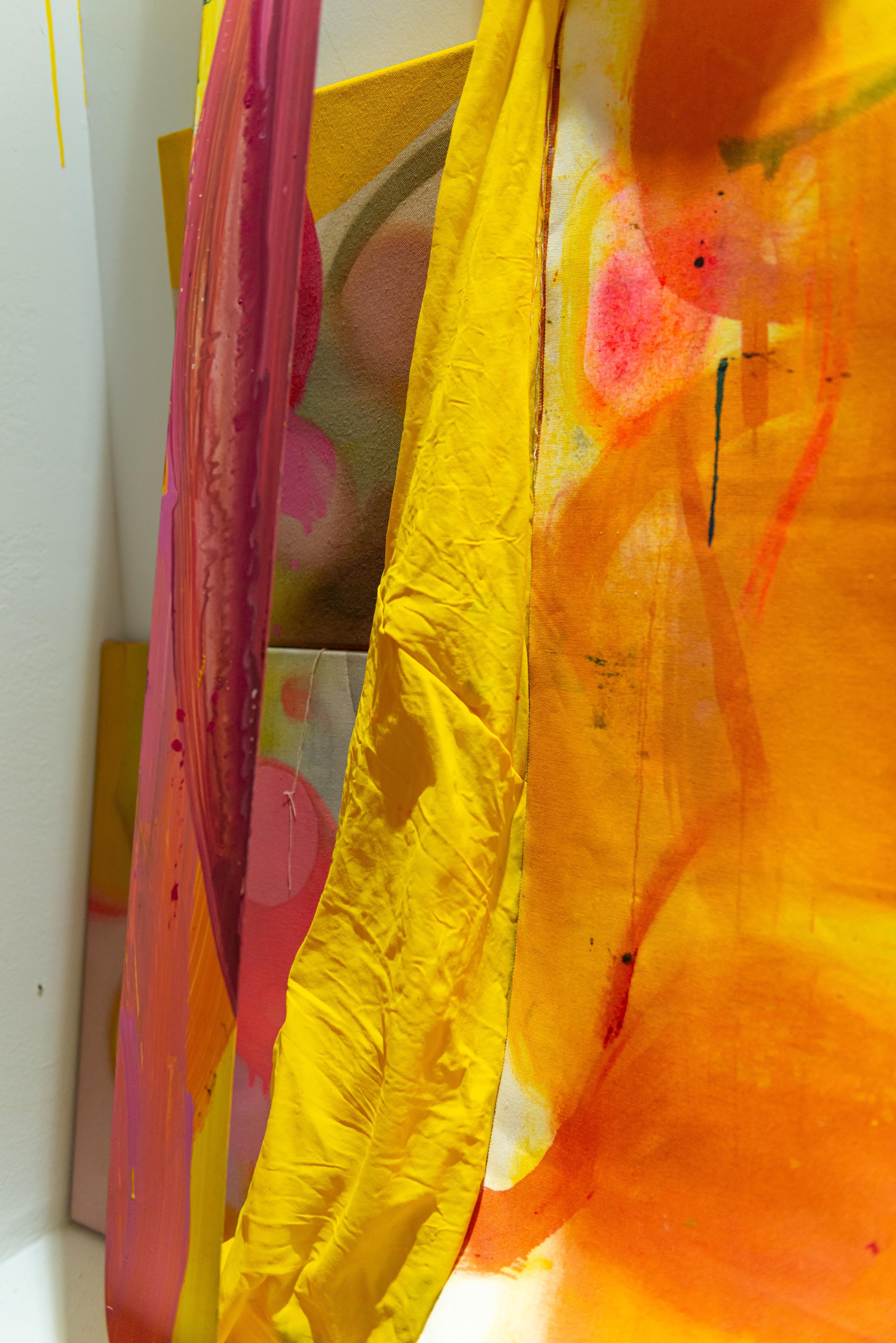
Hana Hozhabr Pour, The Mountains As Archive, found canvases, acrylic sheets, sewn canvas, acrylic and oil paint, 2026. Image courtesy of A Space Gallery, Toronto.
The title The Mountains as Archive connects this formal exploration to questions of memory and history. The exhibition’s conceptual text describes the mountains as repositories for “songs, voices, and histories that have never been recorded or have been erased from written archives.” Trees and mountains are approached as spaces where testimonies, movements, perceptions, and memories can continue to exist across generations outside written records. In this approach, the mountain is more than a passive natural formation bearing the traces of the past. It becomes an image that opens up a way of considering the conditions through which experiences that have not been written down or have been excluded from dominant historical narratives can be transmitted. The structure Hozhabr Pour creates by layering fragments of canvas also offers a formal response to how the archive might be conceived. The fragments come together, but they do not form a complete and uninterrupted surface; the gaps and divisions between them remain part of the structure. Wholeness is formed through the coexistence of different traces without reducing them to one another.
In this context, the mountain’s transformation into an archive cannot be explained solely through the association of historical experiences with a particular geography. The exhibition also questions how an image is constructed, when it becomes visible, and under what conditions it can be perceived. The canvases spanning the four windows, the colors shifting into one another, and the physical overlapping of surfaces make it possible to think of memory not as something contained within a single image, but as a relationship formed between different fragments. The reading developed through the divided geography of Kurdistan also gains significance here: the image of the mountain can carry the traces of different social and political conditions, becoming visible in different ways as a site of fire, destruction, resistance, and light. Hozhabr Pour’s distinctive approach lies in constructing the image of the mountain through the relationships between canvas, color, architecture, and the gaze, rather than directly depicting these meanings. In this way, the mountain becomes an archive that is both remembered and reshaped with each act of looking.
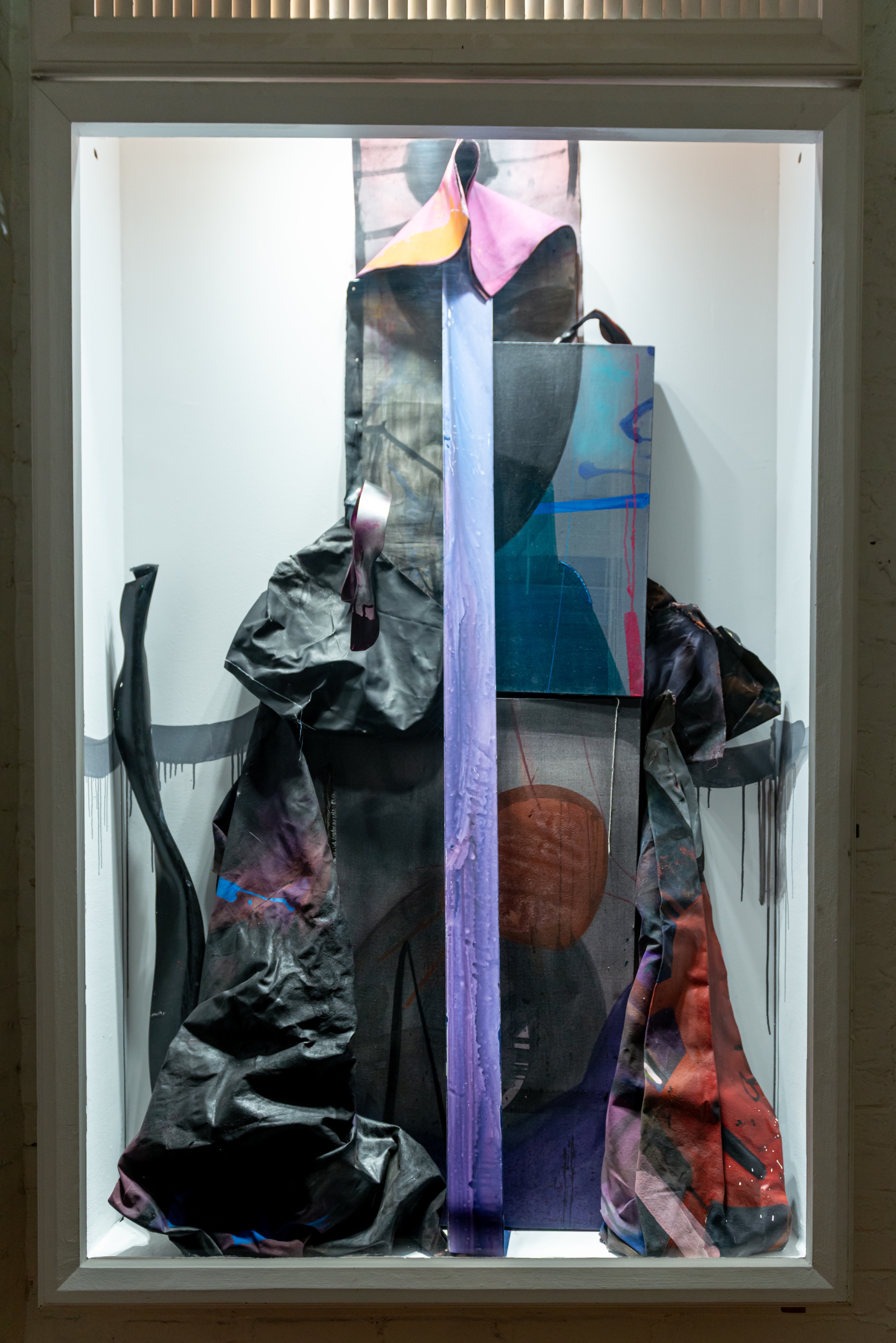
Hana Hozhabr Pour, The Mountains As Archive, found canvases, acrylic sheets, sewn canvas, acrylic and oil paint, 2026. Image courtesy of A Space Gallery, Toronto.
This approach can also be traced in the artist’s previous works, such as Against Forgetting (2022) and Resisting Forced Isolation (2025). Particularly in Resisting Forced Isolation, Tagha Dar, or the “Lonely Tree,” located on Mount Awyer in the city of Sîne in Rojhilat Kurdistan, is one of the key images through which the artist establishes a relationship between memory and geography. Here, the tree is not treated merely as a natural element standing alone. It becomes a witness to the geography in which it stands. Standing alone on the mountain, the tree emerges as a figure bearing the traces of human life, loss, ecological change, and remembrance.
The Mountains as Archive extends this line of thought to a broader geography. The mountains of Kurdistan cease to function as a backdrop to historical events. Instead, they are approached as a space in which human experiences, voices, and memories accumulate. In this way, rather than considering Kurdish history solely through written documents, the artist opens up another way of reading it through the body, landscape, sound, and material surfaces.
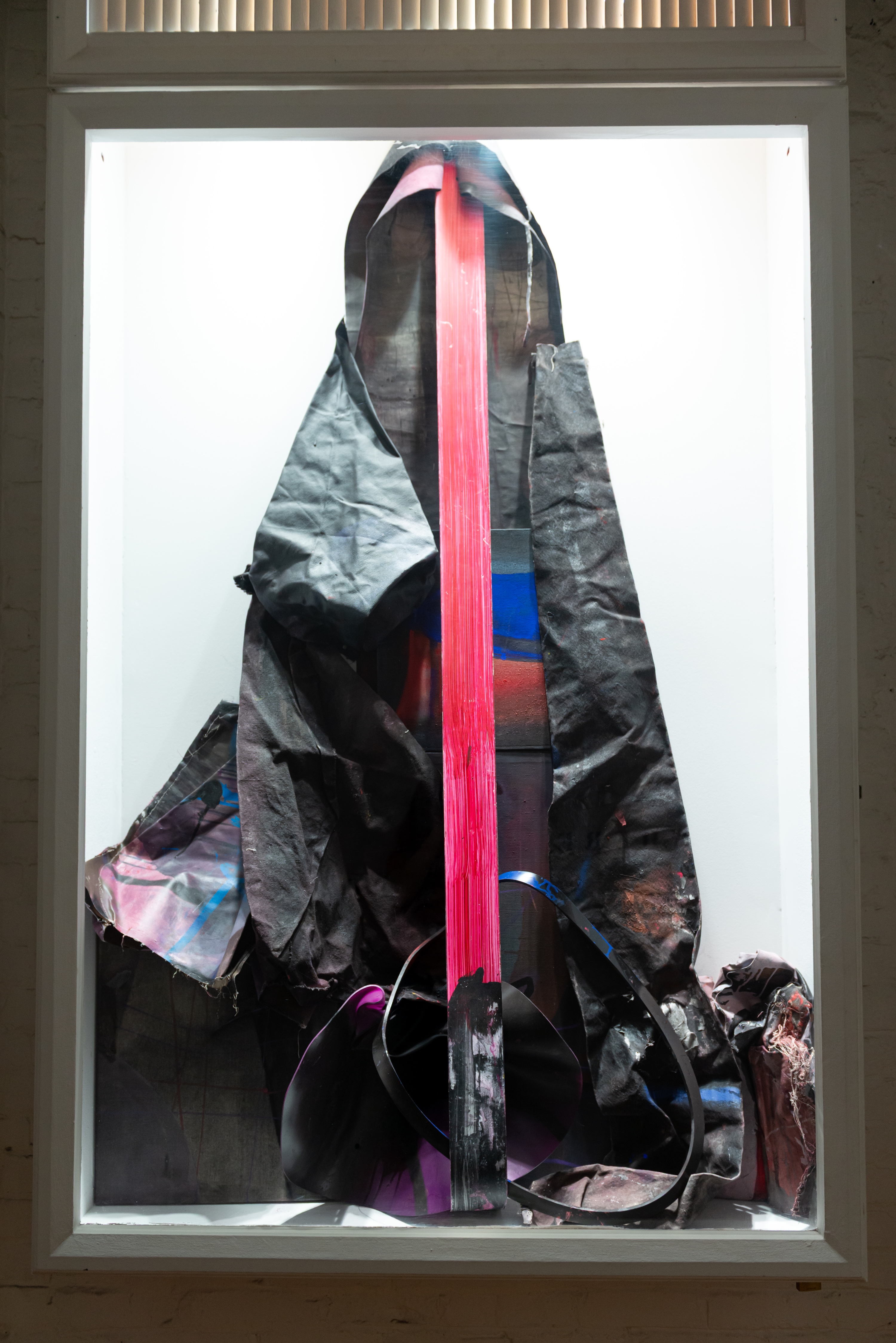
Hana Hozhabr Pour, The Mountains As Archive, found canvases, acrylic sheets, sewn canvas, acrylic and oil paint, 2026. Image courtesy of A Space Gallery, Toronto.
The artist’s engagement with the body also complements this line of thought. Hozhabr Pour approaches the female body as a “living archive.” Experiences such as birth, labor, care, loss, movement, and resistance are carried through the body. In this way, the body ceases to be an object of representation and becomes a space where history and memory are recorded, transformed, and transmitted. The relationship between the mountain and the body also gains significance here. Just as the mountain bears the traces of experiences that have not been written down, the body carries the traces of personal and collective memory.
One of the key points through which the exhibition engages with the Kurdish experience is the slogan “Jin, Jiyan, Azadî.” The gallery’s exhibition text emphasizes the slogan’s connection to the resistance of Kurdish women. The slogan and the protests that followed the death of Jina Mahsa Amini in 2022 also hold an important place in Hozhabr Pour’s previous works. Here, the artist is not simply concerned with producing a visual record of a political event. Instead, she explores how memory is carried, which histories remain visible, and which are at risk of being erased.
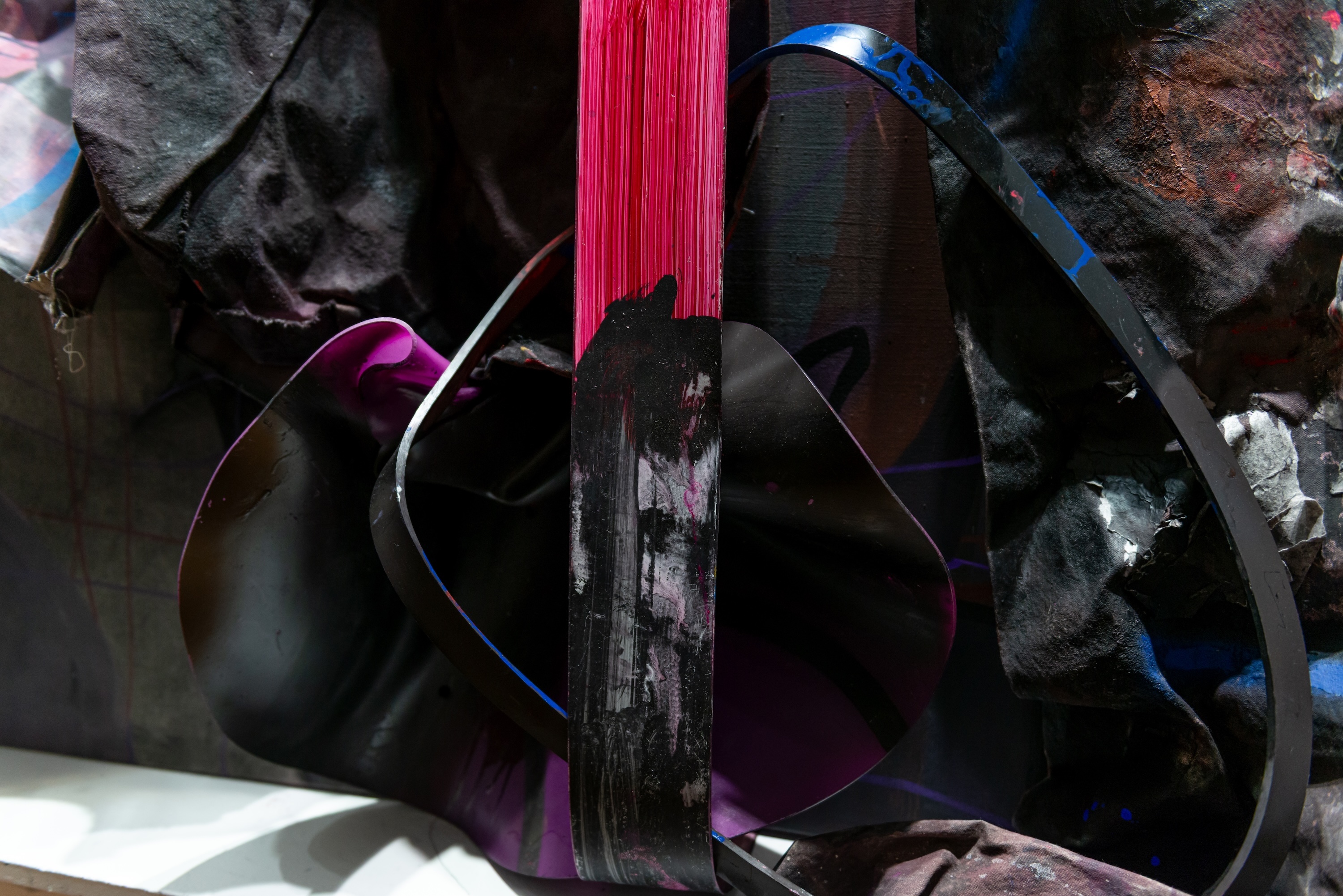
Hana Hozhabr Pour, The Mountains As Archive, found canvases, acrylic sheets, sewn canvas, acrylic and oil paint, 2026. Image courtesy of A Space Gallery, Toronto.
Here, the concept of the archive itself is also reconsidered. Does the fact that an experience is not transformed into a document mean that it is erased from memory? Where is a voice preserved when it remains outside written history? Can a geography carry the past of the people who live upon it? Rather than offering ready-made answers to these questions, Hozhabr Pour’s exhibition brings them to the surface of the painting.
In the artist’s paintings, the past does not appear as a completed history. It persists as a trace that remains between layers, at times invisible and at times emerging onto the surface. For this reason, the exhibition establishes a strong parallel between the image of the mountain and the surface of the painting. Just as the traces carried by the mountain are not entirely visible, the layers beneath the surface of the painting do not fully reveal themselves. In both cases, memory exists within an incomplete and fragmented structure.
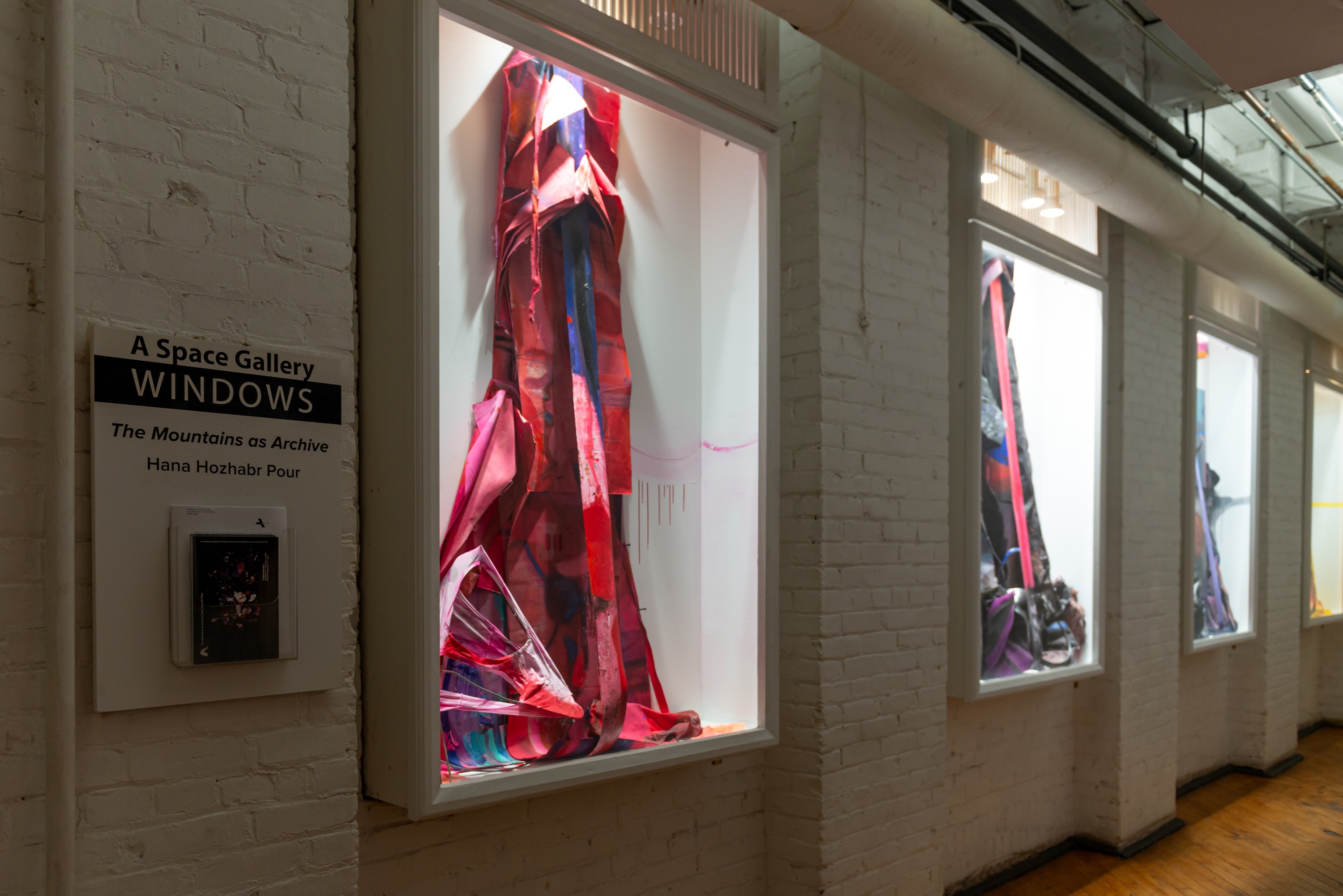
Hana Hozhabr Pour, The Mountains As Archive, found canvases, acrylic sheets, sewn canvas, acrylic and oil paint, 2026. Image courtesy of A Space Gallery, Toronto.
For this reason, Hozhabr Pour’s exhibition cannot be read merely as an exhibition of paintings about the mountains of Kurdistan. The exhibition questions the relationship between geography and memory and the means through which history is recorded. It invites us to reconsider experiences that remain outside written archives through the body, nature, and art. Here, the mountain is not simply a silent space that preserves the past; on the contrary, it emerges as a living archive in which memory continues, is transmitted, and is reconstructed.
The Mountains as Archive is on view at A Space Gallery’s A Space Windows in Toronto until November 14, 2026. The exhibition offers an important point of entry into how the relationship between geography and memory is constructed in Hana Hozhabr Pour’s painting practice. By transforming the mountains of Kurdistan from a represented landscape into a carrier of memory, the artist explores the possibilities of another reading of history through the relationship between what is visible on the surface of the painting and what remains beneath it.


Comments
00