
Mahmut Celayir’s artistic journey unfolds through a distinctive pictorial language shaped by nature, geography, memory, and belonging. The landscapes bearing traces of Bingöl’s geography, particularly Kur Village, where the artist was born and raised, become a space in his work where personal memory intersects with cultural memory. In Celayir’s paintings, nature emerges as a bearer of lived experience, memories, and the relationship with the past. Evoking the tones of the earth, the shifting qualities of light, and the textures of the surface, these paintings do not treat geography merely as a visual backdrop, but as a space in which memory takes form. Here, color becomes a means of remembering rather than description. This approach gives Celayir’s painting practice a distinctive position within the artistic context of his generation.
Celayir’s move to Germany in the 1980s marked a significant turning point in his artistic career. His engagement with the European art scene, the different artistic approaches he encountered, and the cultural environment in which he lived all contributed to the development of his pictorial language. These years also coincided with a period in which Kurdish artists living in Europe were developing their own artistic approaches and pursuing different directions. Alongside Bahram Hajou and Walid Siti, both among the first generation of contemporary Kurdish artists, Mahmut Celayir’s work opens up an important space for considering this generation’s place within art history.
Looking at the history of contemporary Kurdish art, there is still much to discuss regarding the conditions under which these artistic practices emerged, the relationships artists established with one another and with the geographies in which they lived, and the ways in which their artistic approaches took shape. Their positions within art history, the contexts of artistic production in Europe, and the relationships between different generations constitute key areas of this discussion.
In this interview, taking Mahmut Celayir’s artistic journey as a starting point, we will discuss his approach to painting, his relationship with nature and geography, the impact of his years in Germany on his art, and the development of his artistic vision. Through his own experiences, we will consider how a generation of artists took shape, the conditions that shaped their trajectories, and how this experience might be understood in retrospect today.
Editorial Collective– The concept of “minor literature,” developed by Gilles Deleuze and Félix Guattari through their reading of Kafka, points to the ways in which a minority articulates its own voice within a major language or culture. According to them, such a voice is never merely individual; it is always directly political and carries a collective intensity (Deleuze and Guattari, 2001, pp. 25–26). When we extend this concept to the visual arts, a question arises as to how Kurdish artists who moved to Europe or studied there in the 1970s and 1980s, including a generation represented by Bahram Hajou, Walid Siti, and yourself, developed their own visual languages within a “major” art world. The relationship these artistic practices established with the center was not merely a formal one; it was also a matter of political positioning.
Do you think the work of this generation in Europe, and particularly in Germany, drew on a “minor” position in the sense described by Deleuze and Guattari? In other words, did it develop by refracting the experience of a minority through a major language or aesthetic and pushing against its boundaries, or did it establish an aesthetic ground of its own, entirely outside such a center-periphery dichotomy? Did this “minor” position also affect how you positioned yourself within the art scene in Germany? Which exhibitions and circles did you choose to be part of, and which did you deliberately distance yourself from?
Mahmut Celayir– I first went to Germany in 1986. At the time, I had already made a name for myself through the exhibitions I had held and the awards I had received in Turkey, and I was working with well-established galleries. However, the oppressive political atmosphere that followed the military coup and the sense of being isolated from the rest of the world made me, like many other intellectuals and artists, deeply uncomfortable. Beyond this, my curiosity about artistic developments in Europe drew me to Germany. Of course, when you encounter such a developed society with an immense visual culture behind it, before determining your own position, you first look at what is happening around you and try to understand it. I can say that, at first, I had difficulty making sense of the contemporary works I encountered in exhibitions and museums. Despite having studied art in Turkey, I realized that we had been unable to move beyond certain boundaries. This, of course, was also a question of how one viewed the world. Over time, through these observations, you begin to realize that your perspective has changed and that, so to speak, you have internalized a kind of visual discipline. I must say that this marked a turning point for me.
In Berlin’s Charlottenburg district, there is a small museum called the Romantik Museum, where works by the German Romantics are exhibited. I was particularly influenced by the works of Caspar David Friedrich there, perhaps because I sensed a certain affinity with my own paintings. At the time, I had only a limited residence permit in Germany. With the support of a German friend, I submitted a project to the Berlin Senate. I stated that I was a landscape painter from Kurdistan and that I needed a long-term residence permit in order to study the German Romantics. The Senate approved my project and granted me a one-year residence permit. During this period, when I encountered Anselm Kiefer’s monumental paintings of the earth for the first time at Kunsthalle Tübingen, I came to understand more clearly the contemporary reflections of German Romanticism.
To return to your question, I can say that my work in Germany did indeed draw on this “minor” position you describe. In other words, I tried to reconstruct my own aesthetic language while remaining open to the experiences and developments I encountered there, and, of course, by critically confronting them. In Germany, I became much more aware of the significance and distinctiveness of my own material. With this awareness, I realized that the political and collective dimensions underlying my work had become more pronounced, and that I needed to move toward a new language built upon them. What mattered most to me was staying away from the ghettos in which many artists coming from Turkey found themselves confined, and instead becoming part of German society and engaging in the same struggle as German artists. My involvement for fifteen years in a studio-building project called “Nord-Op 49,” established by German artists, gave me the opportunity to do so.
E.C.– According to Maurice Halbwachs’s concept of “collective memory,” individual memory is never truly isolated but is always shaped within a community, a place, and a particular time; a person can remember the past only through the social frameworks in which they live (Halbwachs, 2017, pp. 19–20). Drawing on Halbwachs’s line of thought, Pierre Nora developed the concept of “sites of memory” (lieux de mémoire), arguing that in the modern world, where living memory has dissolved, certain places, objects, rituals, and images become symbolic sites through which a society maintains its relationship with its past (Nora, 2025, pp. 21–24). In this sense, do Kur Village and the geography of Bingöl, which recur throughout your paintings, function as a “site of memory” that carries the shared memory of a community, or is this something more personal, belonging solely to your individual memory? When you paint, what is more decisive for you: remembering that geography as it actually is, or bringing into the painting a geography that memory has transformed over time and reconstructed through the passing years?
M.C.– Kur Village and its surrounding geography, which I have persistently returned to in my work, are, above all, a place of existence for me in every sense. It is a place that has enabled me to establish points of contact and channels of dialogue with nature. Through the images I create from the material I gather there, I am able to develop an artistic position. In this sense, it does function as a “site of memory.” It is a source that allows me to give aesthetic form to my relationship with my own past and to communicate it outwardly. At first, my artistic efforts were concerned with the personal experiences and longings contained within my individual memory. Over time, through a process of questioning, I came to realize that my individual memory was merging into a collective memory, which in turn led me toward new forms of expression.
Momentary glimpses of the landscape can provide the initial impulse for a new painting. But they are not enough. For me, the landscape itself is, above all, a field of visual inquiry, a space for discovering new forms and gaining new experiences. What truly interests me is what lies beyond the visible. In a sense, I pursue the traces of time, what it leaves behind, and what endures. At the same time, I try to build a bridge between the tradition of landscape painting and the spirit of the time.
E.C.– Looking back at the period when you settled in Germany in the 1980s, we can speak of an experience that required you to establish a relationship both with the geography you had left behind and with the new artistic environment in which you found yourself. Homi K. Bhabha’s concept of the “third space” points precisely to this kind of “in-between” condition. For Bhabha, this in-betweenness is not a lack, but rather a space in which new cultural forms can emerge (Bhabha, 2017, p. 23). Did you feel that you occupied such an “in-between” position during those years? Did the sense of belonging neither entirely to the geography you had left behind nor to the European art scene in which you found yourself affect your approach to painting? If so, how did this manifest itself in your work?
M.C.– Homi Bhabha’s concept of the “third space,” which you mention in your question, corresponds very closely to my experience in Germany. You encounter a new world that extends beyond what you know, along with a striking contemporary aesthetic, and you have to find your own place within it with everything you have brought with you. As I mentioned in my response to your first question, you initially enter a process of trying to understand what is happening around you. In this process, as your perspective changes, you also have to reposition yourself. So I must say that I did feel “in-between,” but at the same time, I saw this state of being in-between as an opportunity. I realized that arriving with a different body of material gave me access to certain possibilities through a distinctiveness that some German artists did not have. The essential challenge, of course, was to develop a new language through this material within the new artistic environment I was engaging with, and to find my place within it. The exhibitions I took part in together with German artists, as well as my engagement with museums, gradually reinforced this language. Above all, I made a sharp turn away from the explicit representations of geography and topography in my paintings before Germany and began to focus instead on the texture of this land, which I knew so well, the cycles of life within it, and the traces of our experience upon the land. This led me to engage more directly with the formal concerns of painting and with materials associated with collage. Rather than creating a particular atmosphere, I became more interested in the dynamism and movement of the surface, as well as in textural depth. This led me toward a more spontaneous and sensory process of painting. Over time, as a result of my ongoing relationship with this land, this direction also led me toward more abstract and freer forms of expression.
E.C.– In his book on Francis Bacon, Gilles Deleuze argues that painting does not have to represent something or tell a story, but can convey a “sensation” directly onto the canvas (Deleuze, 2009, p. 14). When you paint, is your primary concern to depict a place you have seen or remember, or to bring directly onto the canvas the sensation, the bodily trace, that place has left within you? How do your technical choices come into play in your search for this “sensation”? Does a thick, textured surface of paint, or one built up through thin, translucent layers, bring you closer to this direct effect? Are you consciously aware of a distinction between the two while working, or does this distinction only emerge once the painting is complete?
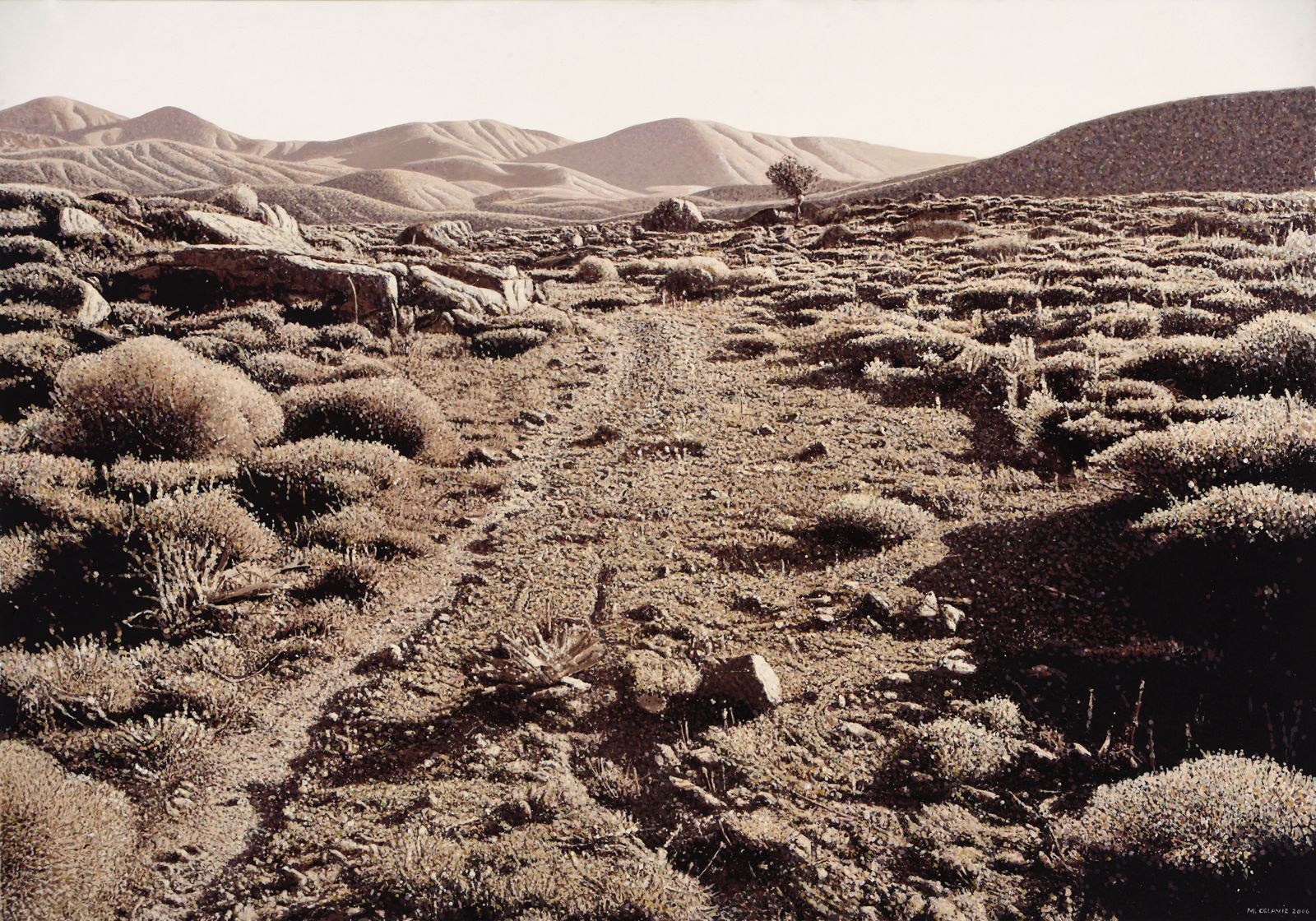 Kral Yolu, acrylic on canvas, 140 × 200 cm, 2006
M.C.– In my early works, I sought to depict places within my own geography with which I shared an experience or a memory, often through contrasts of light and shadow. Yet rather than telling a story, these paintings conveyed a way of being within nature that extended across time. My approach began to change with the turning point I experienced during my years in Germany. This attitude may still be present to some extent in the realist imagery of my King’s Road and Self-Portrait series. I find storytelling in painting very problematic. I believe that such an approach distances us from the fundamental dynamics of painting itself, from its concerns with form and language. For me, the fundamental task of art should be concerned not so much with what it conveys, but with how it conveys it. It has been many years since I stopped sitting in a chair and painting only with my fingertips. I could say that I paint with my whole body, standing and moving back and forth as I work. In this way, I feel that I am able to transfer the body’s energy and vital force onto the canvas. At the beginning, there is a kind of release, a pouring out of what is inside me, with all its positive and negative aspects. It is a process of searching, with a great deal of freedom. Bringing as much as possible into play and making numerous interventions on the canvas gives the work greater possibilities for development. In fact, it is an act of disruption. This is followed by a process of elimination, through which the painting gradually begins to mature. I can say that I am always searching for a spark of life in painting, and once I find it, I try to sustain that vital force by creating layers through textures and different materials.
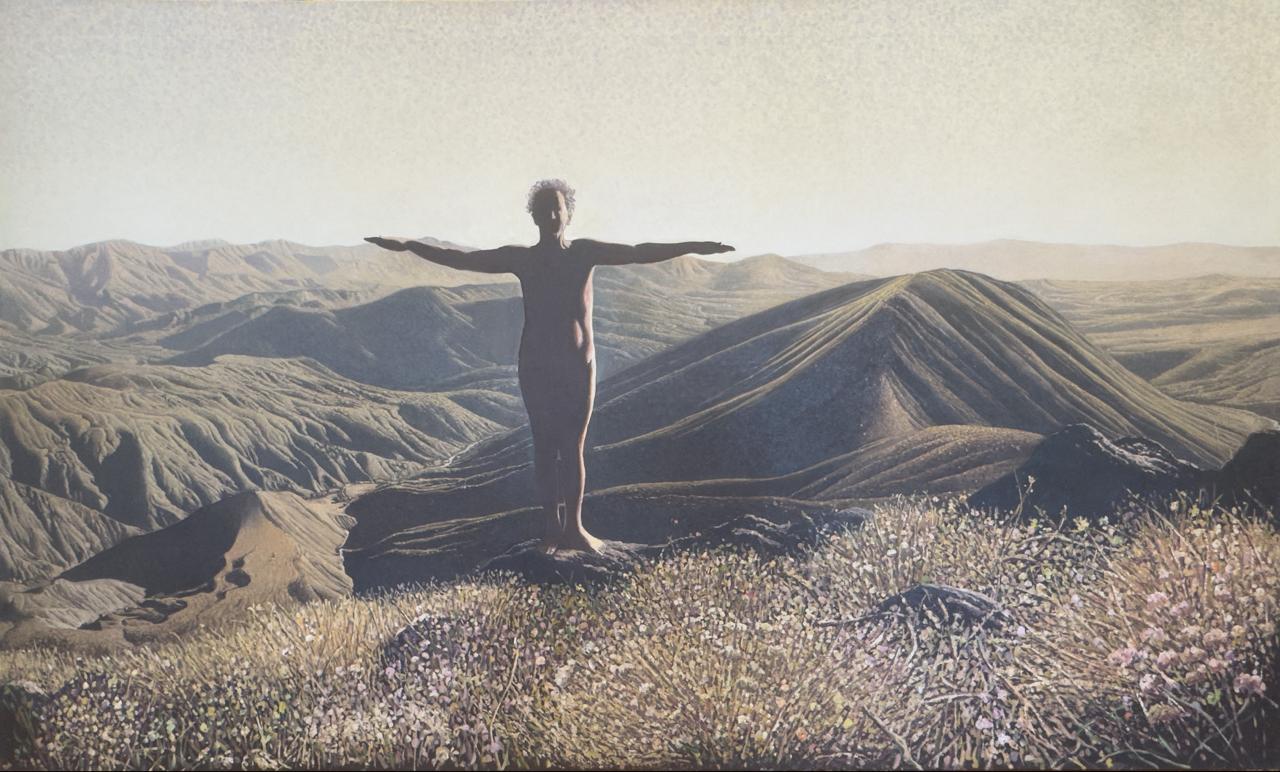 Otoportre, Oil on canvas, 150 × 250 cm, 2015
E.C.– According to Martin Heidegger, who considers the concept of “place” not merely as a physical location but in terms of how one “dwells” there and experiences a sense of belonging, what makes a space a “place” is not its measurable coordinates, but the relationship one establishes with that space through seeing, remembering, and being there (Sharr, 2017, p. 16); thus, the same geography can become an entirely different place depending on this relationship. How do light, color, and space establish this relationship in your paintings? Do you construct depth according to the rules of classical perspective, or through layers of color, tonal transitions, and the balance between empty and filled space? Over the years, as you have returned there, to your village, has the role of this light in your paintings changed?
M.C.– First there was light. Then darkness attacked the light, and the universe came into being through the chaos of this conflict. This is how texts concerning the Zoroastrian faith begin. In the mountains of Bingöl, I follow the light by tracing vast shadows. I spend hours immersed in the atmosphere created by this light, which has an extraordinary clarity due to the high altitude of the region. I usually make my journeys in the late afternoon, as the shadows lengthen toward evening, and everything begins with these journeys. As the shadows grow, mysterious spaces multiply. This is why I always structure my work around the interplay of light and shadow. What interests me is the dynamism and movement created by the tension between the two. I try to fill empty space with a translucent light in which fleeting colors emerge. In my work, color generally appears as patches that contribute to the painting’s sense of movement. The primary elements are forms and shapes that create a certain flow between light and darkness. I also try to create depth through the shifting interplay of vibrant, moving forms and patches of color. Here, of course, I can say that I construct depth using the color values associated with classical perspective. But I should emphasize that I have always avoided an academic approach to representation. With every return to the village over the years, I experience the excitement of rediscovering this place. Each time, the captivating power of the light leads me toward new questions and experiences. These periods of searching can sometimes be exhausting and can bring moments of despair. Yet the journeys I make each day, followed by observation and reflection, can create space for a new beginning the following day. The role of light in my paintings therefore changes along with the continual renewal of my artistic language.
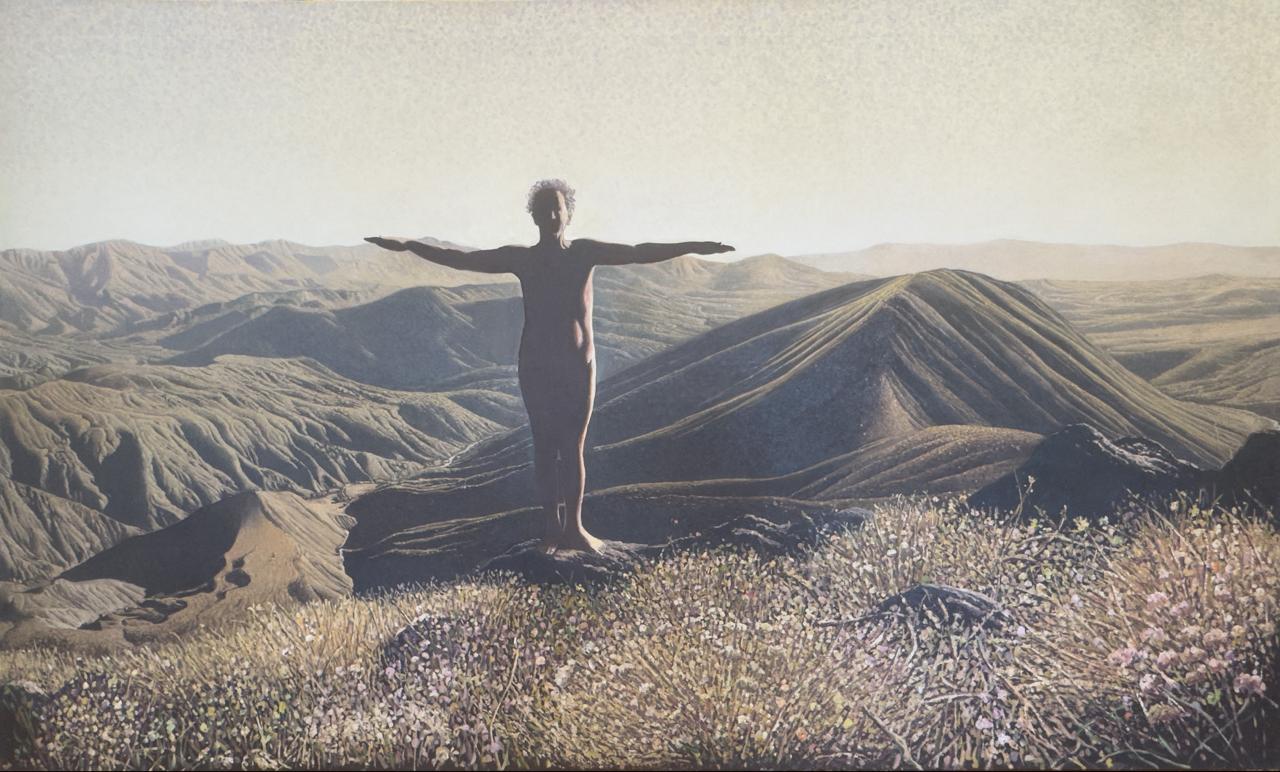
E.C.– Two seemingly contrasting pictorial languages coexist in your work: on the one hand, a hyperrealist approach to landscape that remains attentive to detail, texture, surface, and line, while maintaining a rigorous sense of perspective; landscapes in which a nude human figure sometimes appears within nature. On the other hand, there are colorful yet somber abstract forms that break entirely with this realism. For you, are these two languages different layers of the same painting, or are they two separate and independent explorations? What kind of transition takes place between the moment when perspective and detail are carefully constructed and the moment when form dissolves into abstraction? Do you consciously draw a boundary between them, or have realism and abstraction always been intertwined in your work? What place does the nude human figure you bring onto the canvas in a hyperrealist landscape occupy between these two worlds? Is it part of nature, or a fragile presence alien to it?
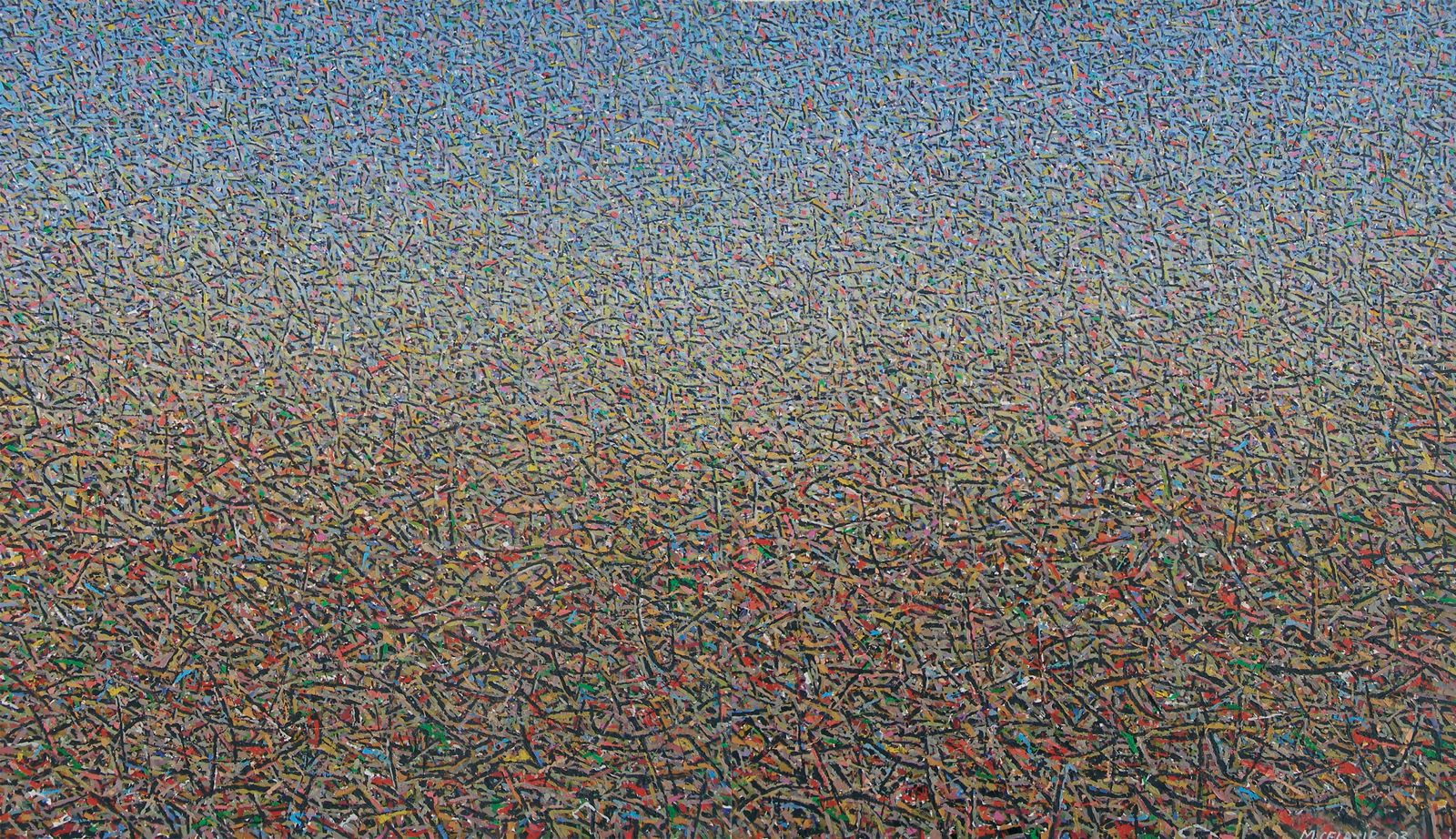 Yaz Manzarası -3 Dyptichon, oil on canvas, 150 × 250 cm, 2002
M.C.– My tendency to move at times toward realist expression and at others toward abstraction and more dynamic forms of expression stems from the same concern, the same search. Realism and abstraction have been intertwined in my work from the very beginning. Abstract and realist elements are present throughout all my work. In fact, at least in my own work, it is difficult to distinguish between the two. Abstract movement allows a realist painting to breathe and creates a certain flow that already exists in nature. The closer you move toward detail, the more you feel the need for abstraction. I have never hesitated to exhibit works in both languages in the same exhibition. I have always seen them as paintings that complement one another. In truth, I have never made hyperrealist paintings. I have always added something of myself. In the paintings in which I bring a nude human figure onto the canvas, the figure itself is the most realist element. The sky, by contrast, is covered with closely related strokes of color that could be described as abstract. The mountains and the earth are also painted in sepia tones that evoke a melancholic sense of memory. The aim is to create a dynamic, somewhat melancholic and weary surface. In other words, rather than depicting nature as it is, I am interested in conveying a particular emotional and mental state. I first felt the need for abstraction while painting the earth and sky in my early realist works. Particularly when working with the layered weight of the earth, the realist details I could identify were no longer enough for me. There was so much more in the earth I encountered while wandering through the mountains of Bingöl. There was far greater depth, far more pain, and far more life. I am still trying to articulate this, accompanied by a persistent sense of insufficiency. I experienced the same concern when painting the sky. You cannot describe this elusive, translucent, ever-changing space with a single shade of blue. What affected me most in Caspar David Friedrich’s paintings were these expanses of sky. This became the starting point for my Sommerliche Landschaft (Yaz Manzarası) series. These paintings, in which I sought to convey the energy of the open sky through linear textures and transitions of color, were my first abstract works. The Bilder der Erde(Yeryüzü Resimleri) series, which could likewise be described as abstract, would become a continuation of this exploration. In this way, I arrived at a point of confronting the two immense fundamental realities that surround us: the earth and the sky. Everything moves and disappears between these two realms, leaving traces behind.
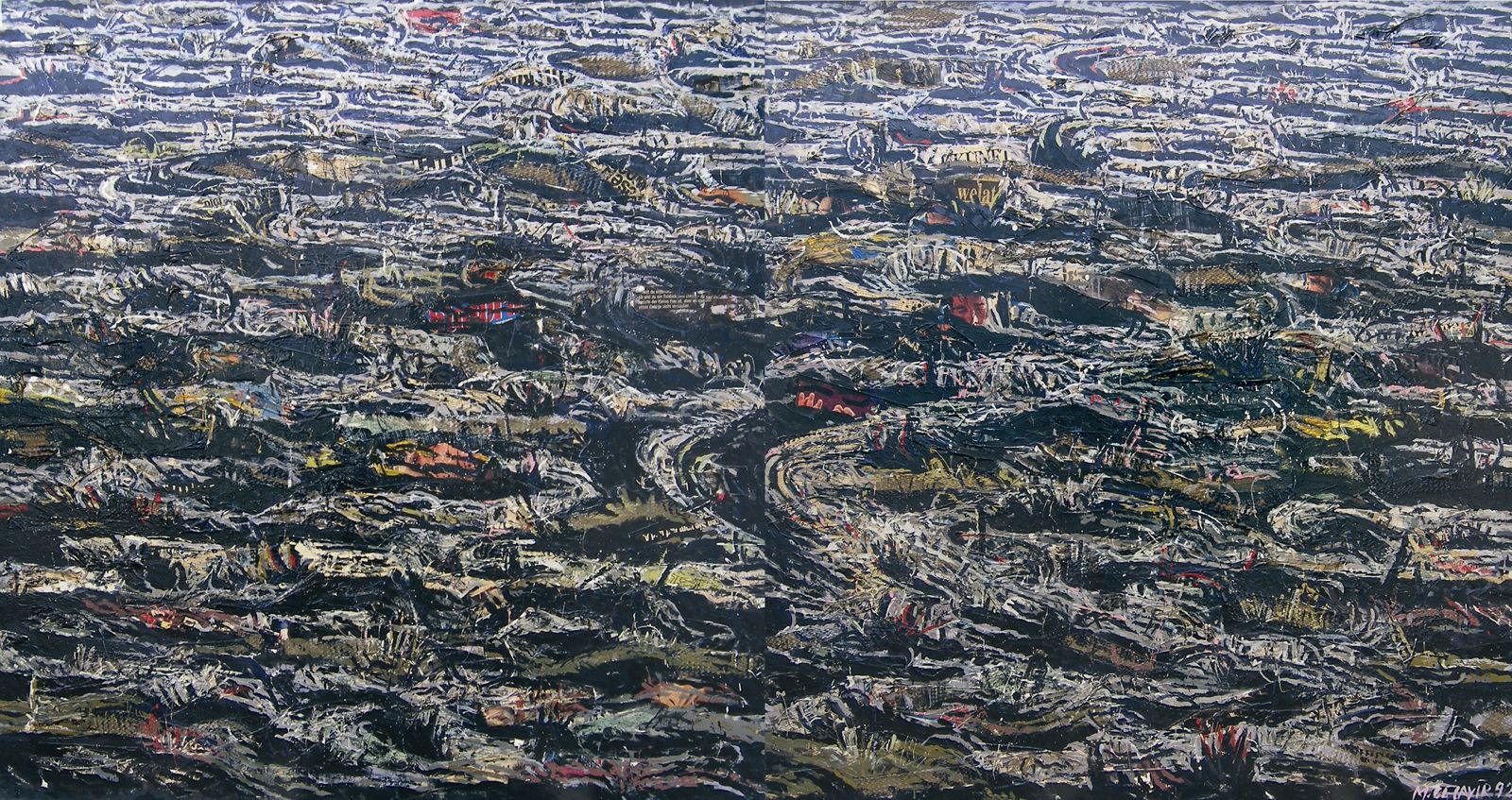 Welat (from the Yeryüzü series), cardboard, paper and oil on canvas, 150 × 300 cm, 1992
E.C.– We would like to dedicate our final question to the Kozmik Bahçe series. You began the series with a single painting in 2020, added two more works in 2026, and today the series consists of eight works. There are other significant works of yours that we could discuss, but this series marks a shift in your line, style, and approach to the surface. It seems to occupy a point of transition between abstraction and realism, which we discussed in the previous question. For this reason, we would like to focus on the two most recent paintings in the Kozmik Bahçe series, both made in 2026.
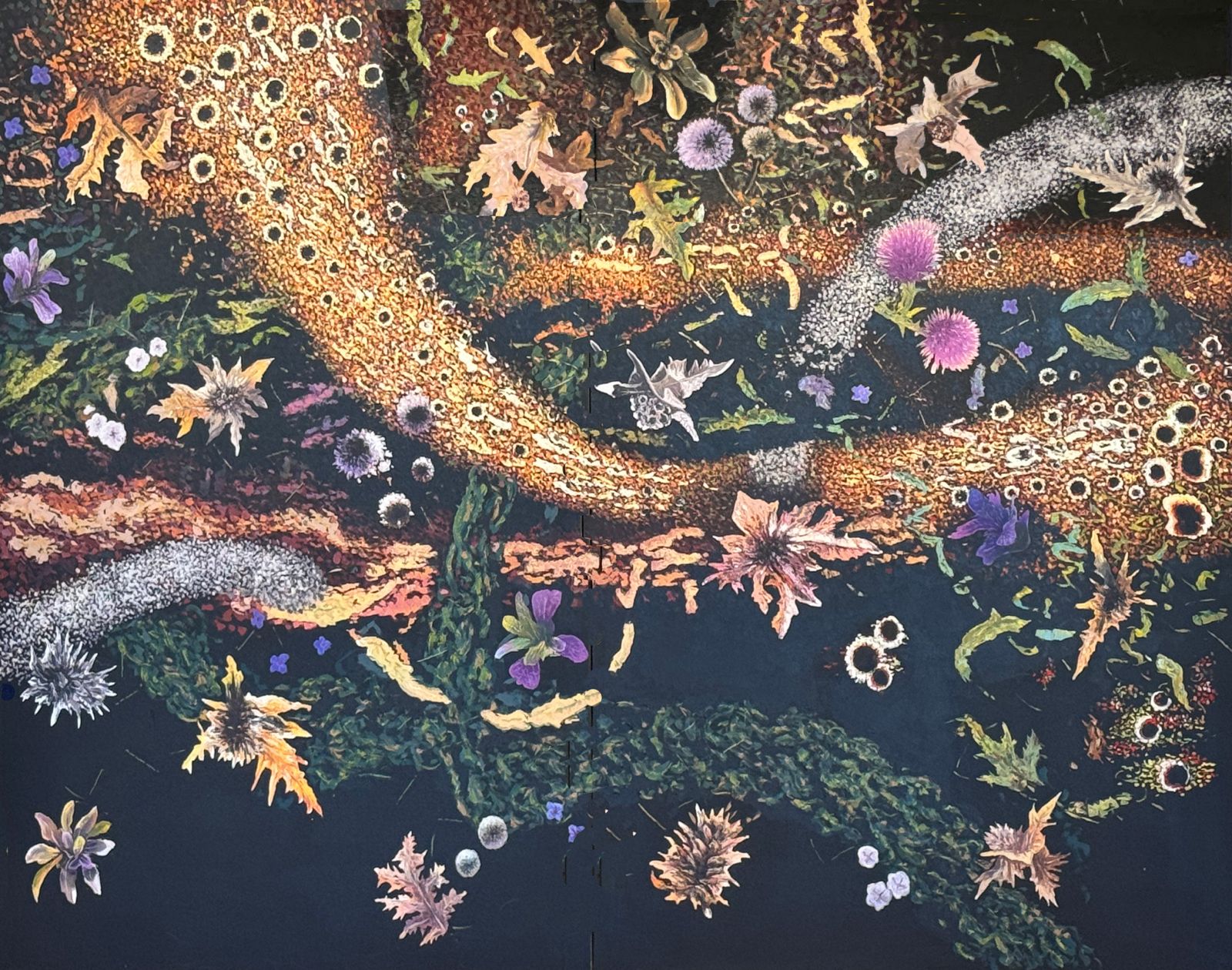 Kozmik Bahçe- 7, oil on canvas, 220 × 300 cm, 2026
In the first painting (Kozmik Bahçe- 7), there are curving forms reminiscent of octopus arms and suckers. The composition extends horizontally, like a rhizome in the Deleuzian sense. There is neither a fixed perspective nor a center; the eye cannot settle on a single point. Amber and gray-white bands create a horizontal rather than vertical flow. They can be read simultaneously as a river, a snake, a geological vein, or the arm of a galaxy. The granular texture of these bands, with their dots, rings, and forms reminiscent of seeds, cells, and stars, connects the micro and macro scales. There is no hierarchy; everything carries equal weight across the same surface. Light does not come from a single source. Amber, purple, and pink patches emerge from the dark blue ground as though glowing from within. This contrast between warm and cool tones makes the painting evoke both a night sky and a subterranean landscape. Steppe and mountain plants such as thistles, oak leaves, irises, and violets evoke a specific geography, yet this geography seems remembered rather than mapped.
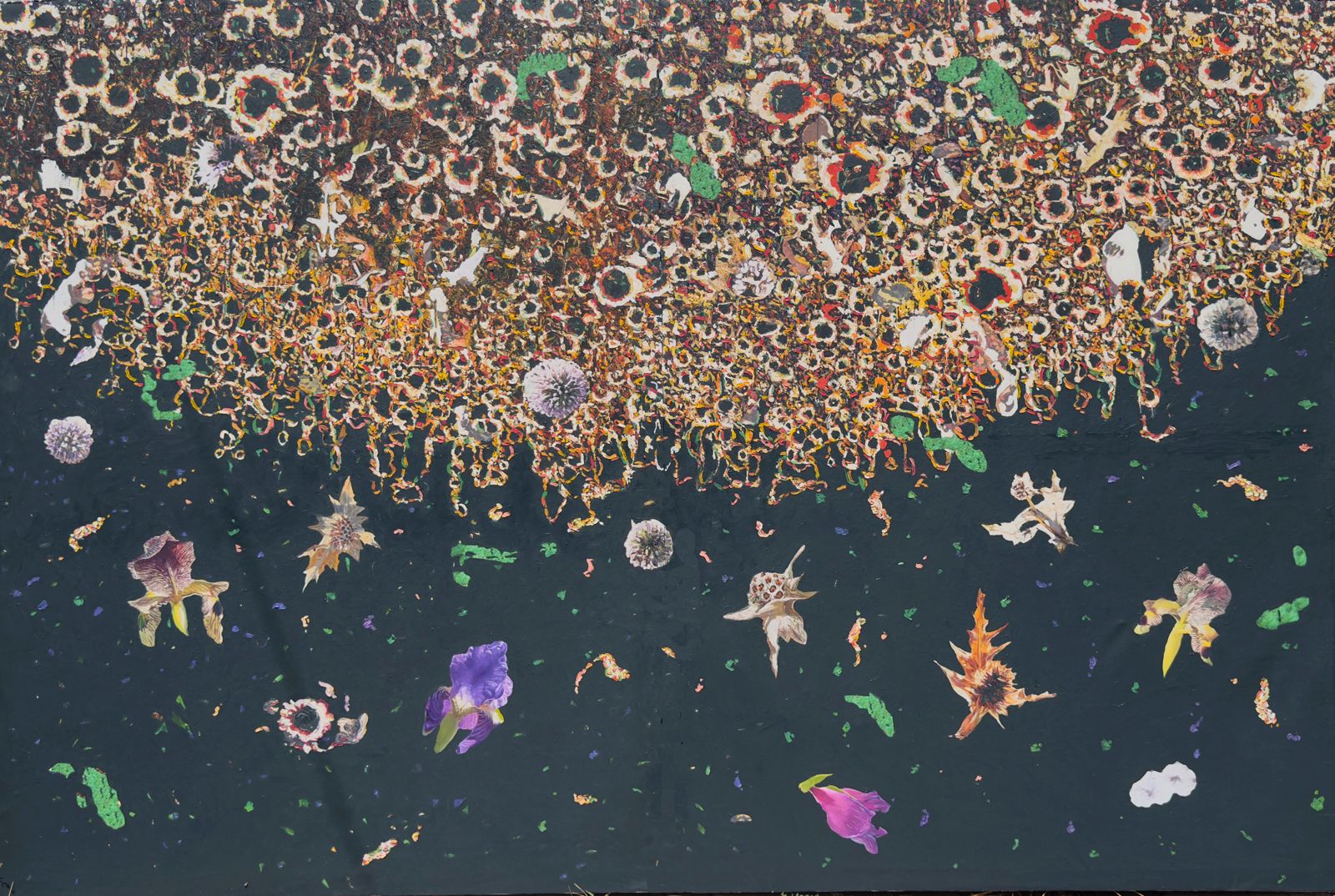 Kozmik Bahçe- 8, oil on canvas, 220 × 300 cm, 2026
In the second painting (Kozmik Bahçe- 8), spiral lines composed of tiny circular forms, a more restricted color palette, a predominantly black ground, and golden shades of yellow dominate. On the one hand, the painting evokes the depths of the ocean: organisms suspended in space and something attempting to hide in the depths. On the other hand, it suggests the vastness of outer space and an inverted planet, with objects breaking away from it and drifting like fragments of meteors. The dense cluster of flowers and seeds in the upper half of the canvas gradually disperses as it descends, merging into the dark navy and black expanse below. This creates a sense of falling or dispersal governed not by gravity, but by a kind of cosmic drift. Earthy, orange, and crimson tones act almost as sources of light against the dark ground, as though the light were emanating from the flowers themselves. Green and purple patches, including iris-like forms, interrupt the warm mass. The surface evokes a collage or herbarium, with dried plants, cut fragments, curling contours, and a woven-like rhythm. The detail is at times hyperrealist, yet the overall effect approaches abstraction. In this sense, Kozmik Bahçe seems to mark a transition from organic forms toward a broader cosmic whole. According to Gaston Bachelard, bounded and intimate images such as the garden, the house, and the sky can, through the imagination, open onto a wider, even cosmic realm. How did Kozmik Bahçe emerge for you? What kind of relationship do you see between the “garden” and the “cosmic”? Is one an extension of the other, or is there a contradiction or threshold between them? Do you think this series marks a departure from your earlier paintings? Finally, will new paintings be added to the Kozmik Bahçe series over time, or will the series remain limited to these eight works?
M.C.– Your observations and interpretations of some of the paintings in the Kozmik Bahçe series are very perceptive. In particular, the “Seed–Cell–Star” analogies describe the works very well. In this sense, it is gratifying for me to see that my work has been understood. The phenomena of the cosmos and the void have always fascinated me. While wandering at altitudes of around two thousand meters in the Bingöl landscape, alongside the richness of the plants and textures on the ground, my gaze was always drawn toward the vast, enveloping expanse of the sky. I was continually preoccupied with the idea of expressing the fundamental elements of our existence, of our very being, and of finding, at least in painting, the artistic means through which this could be conveyed. Looking back at my earlier work, I realized that I had always been moving in this direction: waves of energy and movement with no center of gravity, spreading across the entire field; fields of tension created between depth and surface; and organic forms dispersing like atomic particles. I wanted to take this language further, toward a somewhat mystical aim: to disperse within a cosmos the organic forms I had accumulated through memory and experience, to dissolve my own world into the cosmos, or to become one with it. In seeking to bring the micro and the macro together, I found myself once again turning to new questions about nature, light, and the universe, primarily through aesthetic concerns.
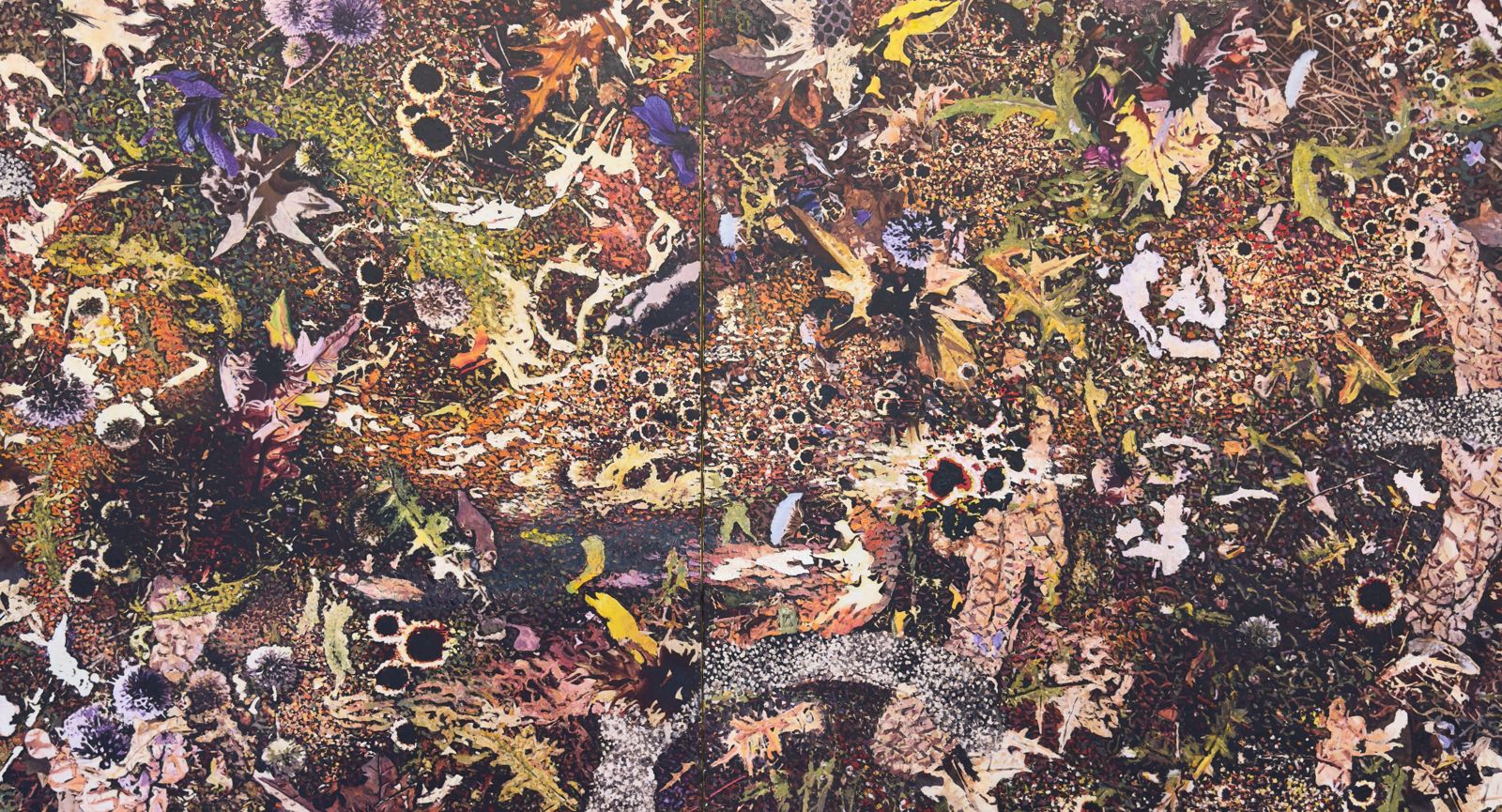
Kozmik Bahçe-6, oil on canvas, 200 × 340 cm, 2025
The garden, in a sense, represents the microcosm in which I exist. There is, of course, no contradiction between the garden and the cosmos; rather, they should be understood as complementary. In these paintings, we also sense a tension between light and darkness, at times dissolving through subtle nuances and at others taking on harder, more defined forms. Just as expressed in Zoroastrian sacred texts, we also experience within our own bodies this dualistic conflict that exists in the universe. In many of Andrei Tarkovsky’s films, such as Solarisand Ayna, this theme of becoming one with the universe or the cosmos is particularly striking. With these paintings, I feel that I have moved into a different territory, and there are many more paintings I want to make in this direction. The series will continue. At the same time, I see these works as a culmination of the paintings I have made up to this point. Much like the growth and generative force of life itself, I am continually nourished by new images within this language. In a sense, I am renewed with each painting, and that makes me happy.
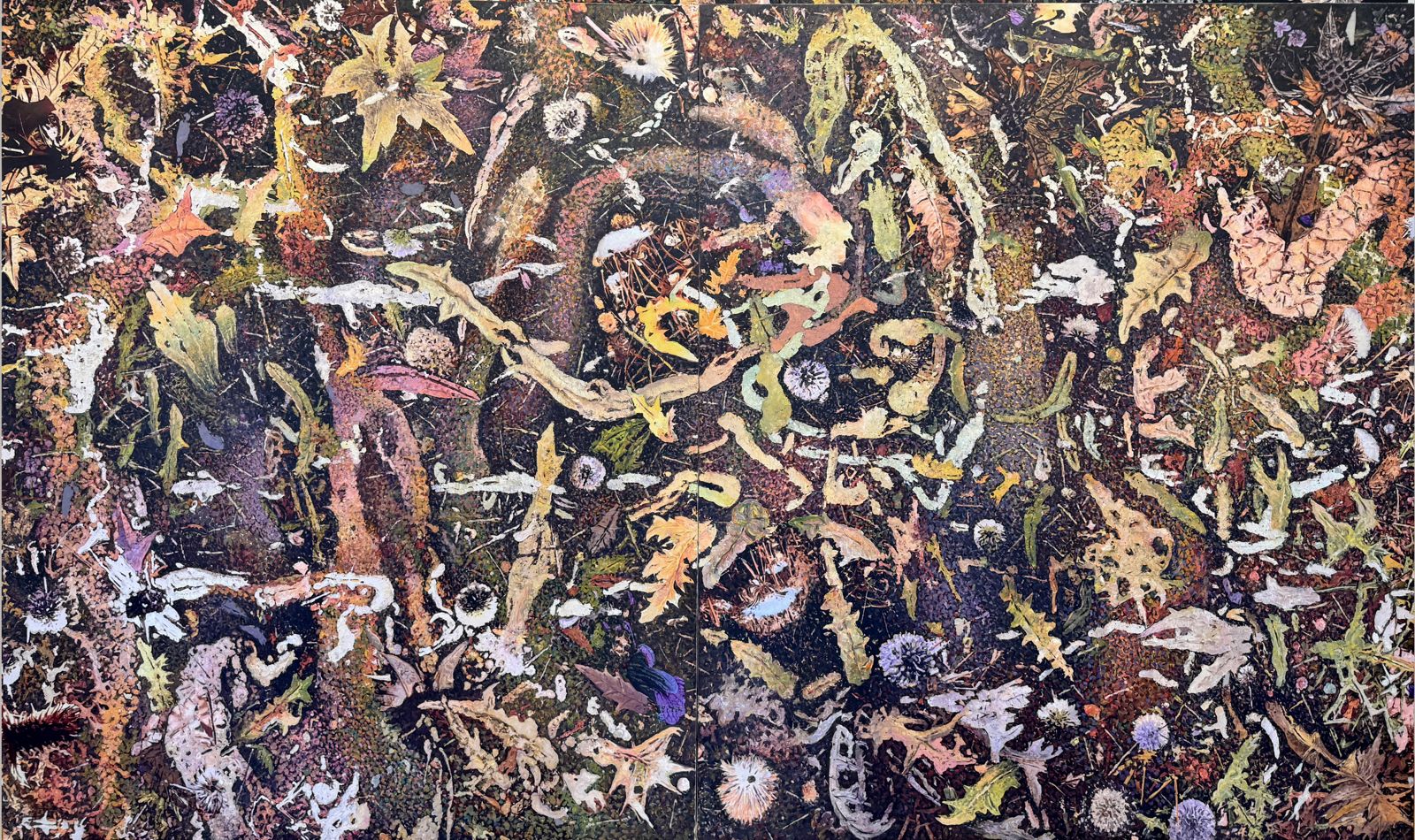
Kozmik Bahçe-5, oil on canvas, 200 × 340 cm, 2025
Notes:
Bhabha, Homi K., The Location of Culture [Kültürel Konumlanış], trans. Tahir Uluç, Istanbul: İnsan Yayınları, 2017.
Deleuze, Gilles, Francis Bacon: The Logic of Sensation [Francis Bacon – Duyumsamanın Mantığı], trans. Can Batukan and Ece Erbay, Istanbul: Norgunk Yayınları, 2009.
Deleuze, Gilles and Félix Guattari, Kafka: Toward a Minor Literature [Kafka – Minör Bir Edebiyat İçin], trans. Özgür Uçkan and Işık Ergüden, Istanbul: Yapı Kredi Yayınları, 2001.
Halbwachs, Maurice, On Collective Memory [Kolektif Hafıza], trans. Banu Barış, Ankara: Heretik Yayınları, 2017.
Nora, Pierre, Realms of Memory [Hafıza Mekânları], trans. Mehmet Emin Özcan, Istanbul: Doğu Batı Yayınları, 2025.
Sharr, Adam, Heidegger’s Hut [Heidegger’in Kulübesi], trans. Engin Yurt, Istanbul: Dergâh Yayınları, 2017.

Comments
00