
Myths, as narratives inherited from the dark layers of humanity's collective memory, do not merely reflect the past. They reproduce gender, power, and forms of representation across generations. Therefore, as archetypal elements, they shape today's power relations and social imaginaries of the future as much as they reflect the past. Consequently, myths should be read as dynamic cultural spaces where social norms, gender regimes, and power relations are reproduced. Like semi-living beings hidden in the depths of our minds, they appear in different forms in every era. The myths of Medusa and Shahmaran offer two powerful mythological figures for discussing patriarchal representational regimes that operate through the control, punishment, and instrumentalization of the female body. This article re-evaluates these figures from a feminist art criticism perspective and discusses the political consequences of their reintroduction into contemporary art through the discourse of healing.
Medusa's serpent hair and Shahmaran's half-woman, half-serpent body are two powerful images in mythological narratives that position the female body on the boundary between human and non-human. However, these two figures are allegorical expressions of the forms of representation that control, punish, and give meaning to the female body through the body politics of patriarchal power. Today, Medusa and Shahmaran, circulating as decorative images, continue to carry a suppressed historical violence and an invisible narrative of murder behind their aestheticized surfaces. In contrast, contemporary feminist readings consider the bodies of these figures, positioned between human and non-human, not as a deficiency, but as a political possibility that questions established regimes of representation. This approach makes it possible to re-evaluate Medusa and Shahmaran in the context of historical violence and resistance, beyond the increasingly prevalent discourse of healing in contemporary art. Therefore, these figures should be read not as frozen legacies of the past, but as dynamic narratives that reveal the transformative potential of societies. The wounded mythologies of Medusa and Shahmaran not only make visible the historical continuity of patriarchal violence; they also offer critical possibilities that make this violence visible and open up established forms of representation to questioning.
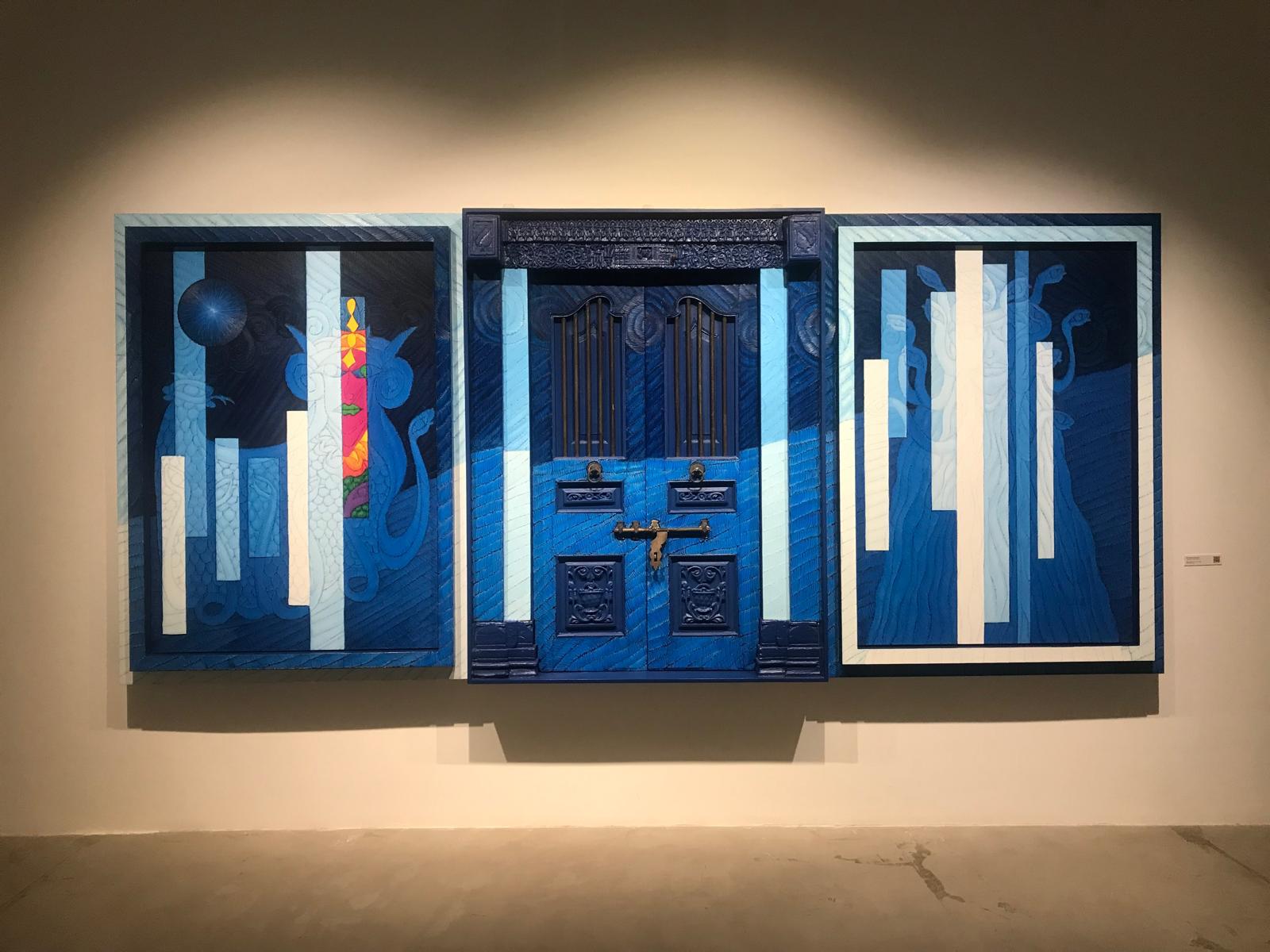
Door of Healt and Wellness, Mixed Media (2024) 265x485x30
Ahmet Güneştekin's works, Healers of Two Shores and Gate of Health, Well-being, bring together Medusa and Şahmeran within a shared discourse of healing, establishing a conceptual relationship between these two figures. However, this approach, instead of making visible the different historical and political contexts in which these mythological characters emerged, recirculates them within a conciliatory and universalizing representation. Thus, the historical experience of violence and the potential for resistance embodied by Medusa and Şahmeran are relegated to the background; while the meanings produced by the patriarchal representational regime are reproduced. Therefore, rather than analyzing Güneştekin's works in detail, this study will address how the figures of Medusa and Şahmeran can be rethought in different ways from the perspective of feminist art practice, based on the discussion ground they open up. The solution proposed in this article lies not in representations that reduce mythological figures to a conciliatory and utilitarian discourse of healing, but in critical artistic approaches that make visible their repressed histories, political subjectivities, and transformative potentials.
Reinterpreting Mythological Figures: Medusa and Shahmaran
Medusa, in Greek mythology, is a figure who transforms from a beautiful creature into a terrifying being, turning people to stone with her gaze. While this transformation is described as a curse in the myth, modern interpretations have become a metaphor for female power and the transformative power of trauma. Shahmaran, on the other hand, is a half-human, half-serpent being in Anatolian and Mesopotamian myths, representing wisdom and healing. The queen of serpents, living seven layers deep underground, is also a beautiful woman. The story, which begins with Cemshab's arrival in the cave, ends in betrayal. Shahmaran is killed by men, and it is believed that her dead body provides healing. In this narrative, healing, poison, and wisdom coexist. The serpent image symbolizes the coexistence of poison and antidote in almost all mythologies. It is associated with the earth and the wisdom of the underworld. Just like the "The Rod of Asclepius", the symbol of medicine, Shahmaran carries death and healing in the same body. Medusa is also a mortal woman. Ancient texts say that medicinal herbs sprang from Medusa's blood, and that when her head was cut off, the winged horse Pegasus and the giant Chrysasor were born. Medusa's head, covered in serpentss, possessed a deadly gaze. Perseus killed her and placed her severed head on Athena's shield, thus using it to turn his enemies to stone and terrify them; in other words, he transformed it into a kind of power.
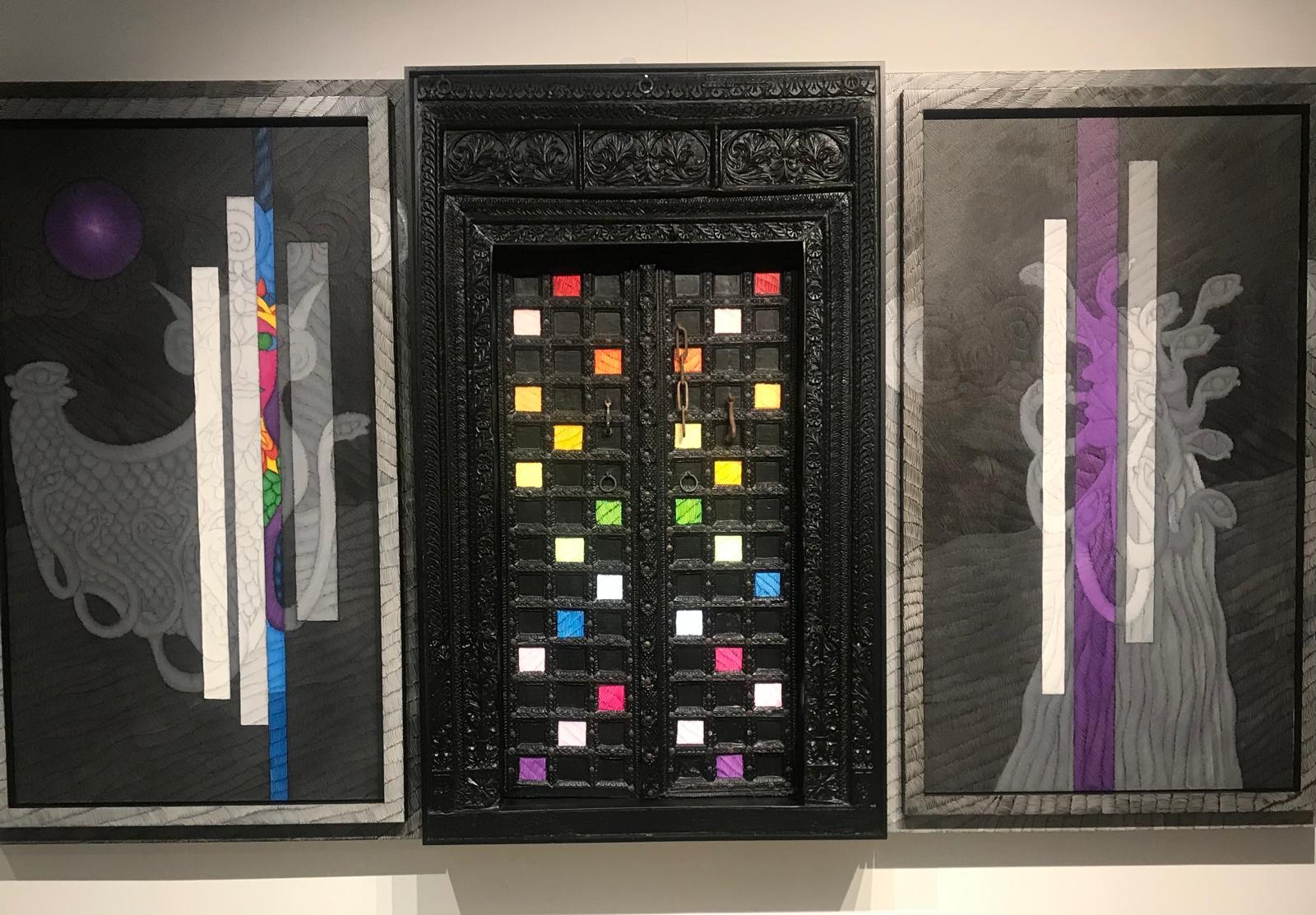
Healers of Both Shores, Mixed Media (2024) 220x480x30
Ahmet Güneştekin seems to have crafted a narrative where tragedy and healing are intertwined by combining these two characters. Indeed, while Medusa's curse and Şahmeran's healing seem to represent two sides of the transformation, both characters share a reality of victimization and death. This transformation is also a resistance and rebirth that women bring about through their own free will. Death itself is perceived as a painful event in most cultures. However, what emerges in both narratives is a murder that is covered up along with betrayal and presented as if it were commonplace. Şahmeran's body is dismembered and presented to the powerful (male) sultan. The fact that the one who kills her is also a wise and healing person is a great paradox. Yet, Şahmeran makes a choice before dying, selecting the person who would benefit from her wisdom; in other words, she resists until the very end. Şahmeran is a wise and benevolent being. As a woman, she governs her subjects with peace and goodness. Both characters are connected to the power of nature, carrying the mystical and terrifying stories attributed to women throughout history. Medusa is depicted with her serpent hair, and Şahmeran with her serpent body. In mythology, the female body carries the tension between fertility and destructiveness, as well as reflecting the coexistence of life and death, pain and darkness. The transition from polytheistic to monotheistic religions, and the subsequent categorization of women as 'good women' and 'evil women' by men, along with the shaping of narratives and worship accordingly, created significant inequalities in gender roles. While the serpent symbolizes immortality and wisdom in many mythological narratives, in traditional discourse, women and serpents (Eve, Lilith) are considered seductive and dangerous.
Mythological imagery can appear as fragmented and reassembled stories across cultures. Medusa is a figure from Western mythology, while Şahmeran is from Eastern mythology. Especially in Anatolian lands, the intertwining of ancient Greek, Persian, and Mesopotamian myths presents a cultural richness, but it can also blur the differences specific to different societies. Reducing it to a single dimension diminishes its cultural depth and creates confusion in terms of meaning and symbolism. Shahmaran appears in Kurdish and Anatolian mythology as a symbol of wisdom and justice; she is not just merely a healer. Medusa, on the other hand, is neither wise nor healing; she is the one who turns people to stone with her cursed gaze. Medusa does not symbolize fertility or immortality; she is mortal. Bringing these two figures, each with their own distinct stories, together in the same narrative is problematic in itself. The rape of Medusa, the punishment of the victim rather than the perpetrator, and her subsequent murder by another man—this situation, justified by customs and traditions, is a product of the patriarchal mindset passed down for thousands of years and could only be presented as "healing."
In the West, Medusa has been reinterpreted by feminist thought as a symbol of rape culture and patriarchal violence. However, some prominent art practices in recent years tend to romanticize this political background by reducing Medusa to a metaphor of healing and individual transformation. Similarly, some approaches developed with the claim of cross-cultural universality also blur the historical and political specificities of mythologies, transforming them into easily consumable aesthetic images. This superficial circulation, legitimized through art, is not sufficiently questioned. The way women artists approach Medusa, however, reveals a completely different direction. Especially since the 1970s, Medusa has been transformed from a figure monstrified by male-dominated narratives into a symbol of repressed female subjectivity, resistance, and transformative power. While Judy Chicago's installation The Dinner Party, produced within the same historical context, doesn't directly address Medusa, it proposes a powerful feminist historiography that makes visible the exclusion of women from historical records. By symbolically bringing together women marginalized by history at the same table, the work repositions them from passive figures of the past to founding subjects of culture. The Dinner Party reveals that women are not merely objects of history, but agents who produce meaning and symbols. In this respect, the work finds common ground with the new meanings Medusa has acquired in feminist thought. Both aim to make visible the silences produced by the patriarchal representational regime, to bring women's experiences to the center of historical memory, and to transform the established symbolic order. Thus, although Chicago's work does not directly reinterpret Medusa, it can be considered one of the most effective interventions transforming the representational politics of feminist art.
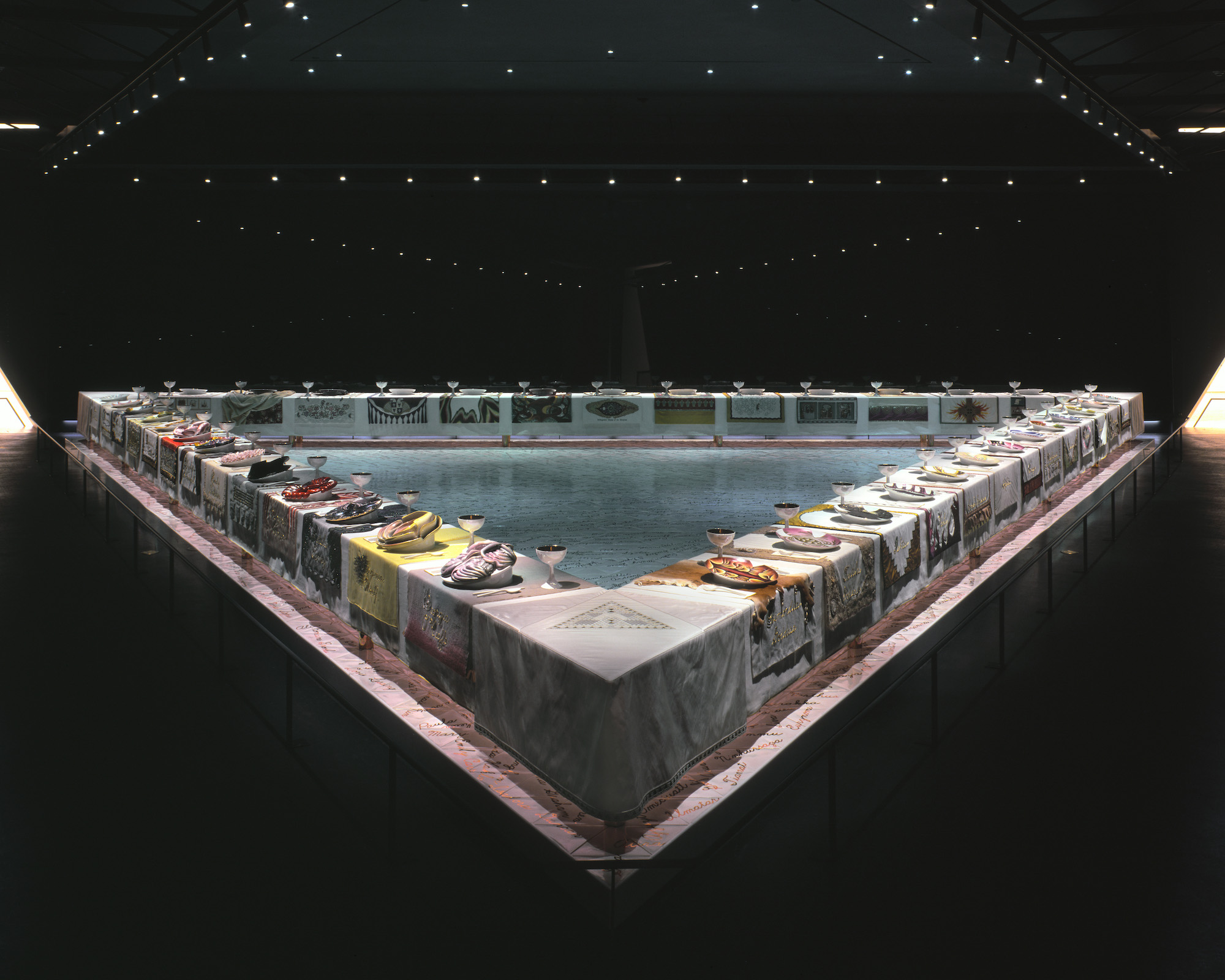
Judy Chicago, The Dinner Party (1974- 1979)
Judy Chicago's work, The Dinner Party, is not free from gender roles, just like Shahmaran and Medusa. On the contrary, this work cannot be evaluated in a purely apolitical way within art, just as Shahmaran and Medusa cannot be considered separately from this context. Romanticizing the tragedies of both figures means legitimizing the suffering and deaths that women face in real life. Art rejects an aesthetic understanding that reproduces the traditional narrative by subverting the marginalized identity. From a feminist art criticism perspective, it is necessary to examine how the work reinterprets mythological images, questions the representation of the female body, and explores power dynamics. In mythological narratives, Medusa is a figure "monstrous" due to male violence (Poseidon's rape and Athena's punishment); however, her victimization is often not expressed. Feminist art transforms her into a symbol that evolves from victimization to power. Luciano Garbati's Medusa sculpture depicts Medusa holding the severed head of the Greek hero Perseus, triumphantly swinging it around. With this interpretation, Medusa evolves from a monster created by male violence into a powerful woman who stands against that violence. She becomes a figure who holds her head high, not one who bows it. Her gaze no longer kills; it demands accountability. Garbati's interpretation transforms both the symbolic and political meaning of Medusa. As in Luciano Garbati's work, Medusa with the Head of Perseus (2008), the treatment of Shahmaran and Medusa as healer figures and the reduction of this aspect solely to the theme of healing is problematic when evaluated from a critical perspective that focuses on political consequences. Because associating both figures solely with healing risks obscuring the dimensions of victimization and violence in their mythological narratives.

Luciano Garbati, Medusa with the Head of Perseus (2008)
While Medusa is a victim punished after rape and whose body is transformed into a weapon, representing her as a healer means ignoring and aestheticizing her tragic resistance; this reveals another dimension of the marginalization women have experienced throughout history. The myth of Şahmeran being killed and her body then used for healing also signifies the devaluation of everything a woman possesses during her lifetime. Because when a man's life or the basic needs of society are at stake, the life of any living being considered "the other" loses its importance. This stems from the legitimization of the power, violence, and discourse of the patriarchal structure. The desire for power and authority sees itself as having the right to destroy everything in its path. Thus, these narratives carry a subtext that legitimizes the instrumentalization of the female body. Healing is only possible after death; There is a form of control over the dead body. As Mahsum Çiçek points out, “The Medusa myth is about how those in power transform the individual in a terrifying way. While the patriarchal aspect of power is often mentioned, its heteronormative aspect is frequently neglected.” To identify these characters with healing through art means to normalize the political and sexist domination created by mythological violence. This approach leads to women being ignored in art history, reduced to a spectacle, and their fates, which repeat in a vicious cycle, gaining legitimacy through art at the hands of men.
The Representation of the Female Body and the Nature-Woman Duality
The acceptance of the female body as "healing" within the nature-woman duality is a product of a perspective that has historically excluded women from the public sphere. Medusa's serpents and Shahmaran's half-serpent form establish a symbiotic bond between nature and woman. However, this bond transforms into an instrumentalization that confines women to their biological fate. While Medusa's gaze's power to turn to stone is actually a defense mechanism, the theme of 'healing' depoliticizes this power. The social conditions that changed with modernization have transformed the name and position of women in art thanks to their struggles. Although the concepts of "observer" and "observed" manifest themselves in daily life practices as well as in art history, women's objections to this situation are overcome through raising awareness and solidarity. Moreover, feminism and feminist artists have developed a strong objection to social memory and understanding precisely at this point. Feminists aim to find and make visible forgotten women and countless unrepresented artists; They also reinforce discussions about the female body through art. Art is one of the indispensable conditions for a woman's self-actualization. Because a woman's struggle to be herself involves the necessity of representing, recognizing, owning, and expressing her own body in original ways. Whether this is possible within a gendered understanding of power and society continues to be debated. However, as long as gender discrimination is not eliminated, the liberation and productivity of women will continue to deepen discussions about the artist's freedom and originality.
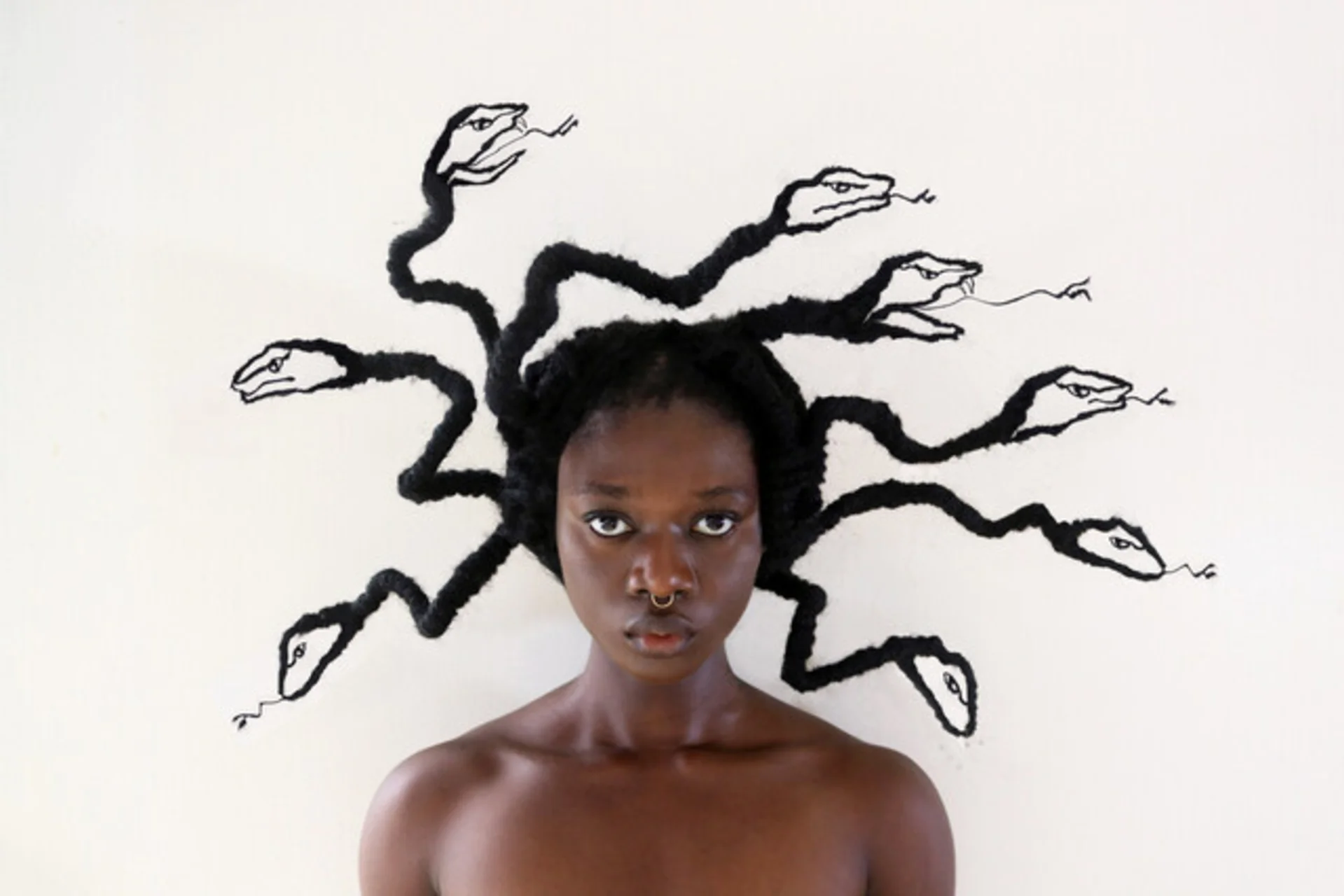
Laetitia Ky, Medusa's Gaze (2022) (Artsy, 2023)
Laetitia Ky is an artist and activist from Ivory Coast, the creator of the work The Gaze of Medusa (2022). Ky's work transforms her own body, drawing inspiration from the beauty of Africa exploited by white Western men and the hairstyles of African women in the pre-colonial era. By turning her hair into a means of expression, the artist challenges the patriarchal structure of the society in which she lives. The artist describes The Gaze of Medusa with these words: “It is a beautiful metaphor for how the world punishes the victims of rape rather than the rapists.” In the photograph, the artist's hair is transformed into serpents, transferring the Medusa figure onto her own body. There is no healing here; it is a statement made by the woman about her own body, transforming into a narrative that evolves from victimization to resistance.
Feminist Art and the Critique of Myths
Feminist artists have produced their art in opposition to cultural discourses that focus on the female body rather than on women themselves, rejecting the notions of maternal instinct, sentimentality, intuition, and standard ideal beauty that represent women. Standing in direct opposition to the male gaze that characterizes women as compassionate and helpless, feminist artists emphasize that women must now speak for themselves. Against the image of women defined by roles such as motherhood, muse, or seduction, in addition to being an object of spectacle in the eyes of men, feminists and feminist artists strive to break this masculine perspective. Reducing women to a healing discourse based on mythical narratives and confining them within social codes has no place in art history. The marketing of a masculine gaze under the guise of healing idealization in the name of art demonstrates not only a lack of knowledge but also inadequacy in artistic practices.
Liberating the representation of the female body from the cult of the mother goddess and focusing on a critique of the cultural codes created around the body is essential for a radical and revolutionary transformation in society. Criticisms of the inadequate and inaccurate representation of women in art institutions and museums have revealed the need for new readings and writings. While male artists, with the resources at their disposal, developed a style and advanced it through the female body, female artists, due to the conditions of the time, were unable to develop an identity and style; their efforts to exist in art history were also overshadowed. Feminist art history, in response to this situation, re-examines art history with a new perspective and new questions, expressing not the repetition of the past but the development of a stance by women against the existing system and the representation of men. The concept of representation is a term used in many fields such as political science, law, philosophy, and art in different meanings; it can be defined as taking the place of something, being a symbol, reflecting its distinctive feature, or a form of presentation. In other words, representation is a tool that can be internalized socially and culturally and become a part of the self. Therefore, representations are politically important; It also serves a powerful function in enabling those in power to protect their own spheres of influence. While the media represents women, it creates a space that restricts and codes them. Against this patriarchal structure, which places women within a mystical discourse that attempts to deny their presence in the public sphere, Mary Cassatt expressed her critique with her painting At the Opera (1878), created during her time.
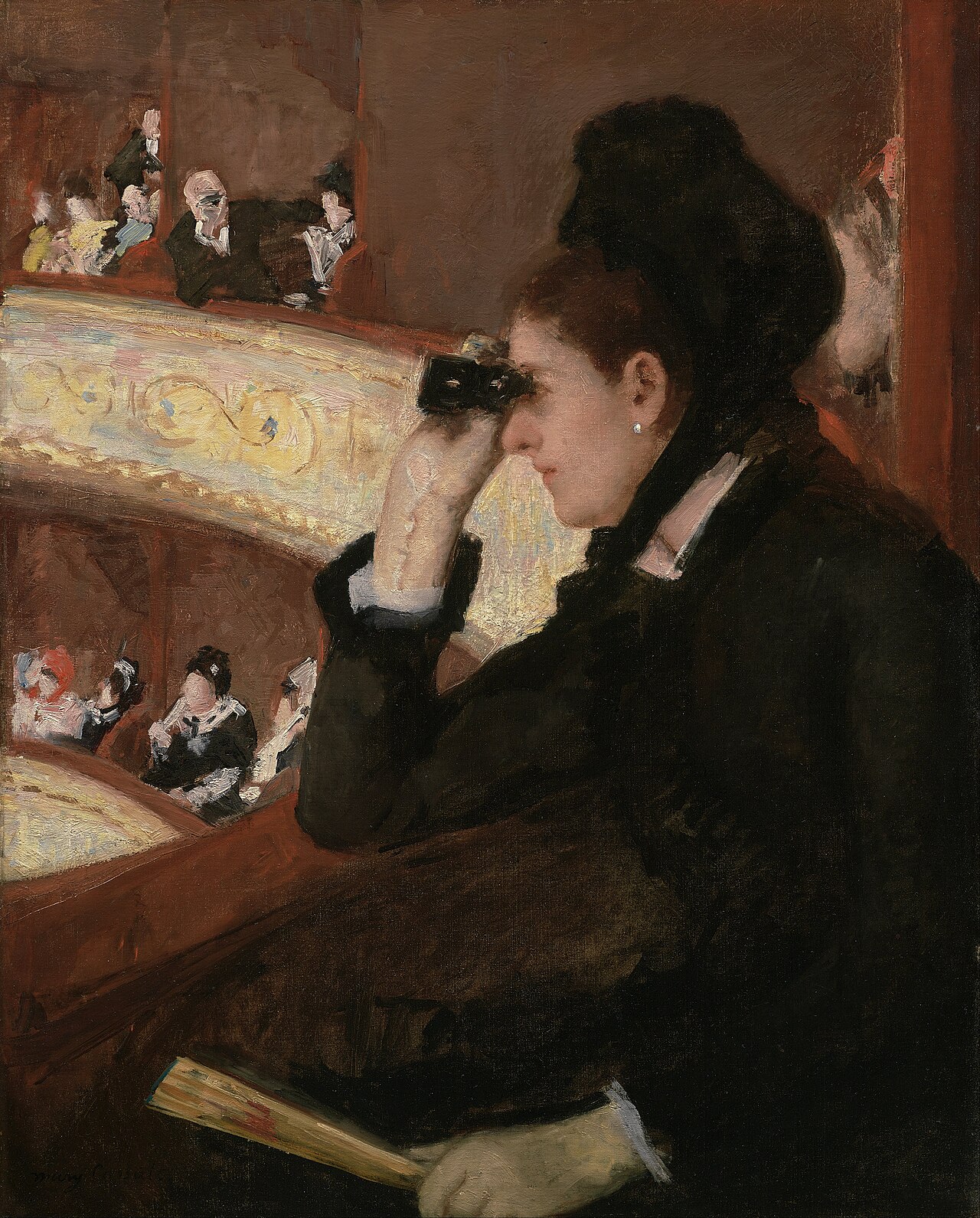 Mary Cassatt, In the Loge (1878)
In this painting, Cassatt depicts social gathering places -the box seat, where social life is most visible, in a unique way. The composition features a female figure observing and watching her surroundings almost like a spy. In the background, a man, looking through binoculars, watches her without hesitation, slightly leaning forward. The woman's attention being directed elsewhere further emphasizes the relationship between observer and observed. According to some interpretations, Cassatt's painting is a counterpoint to Degas's constantly observing frames; However, the woman's confident demeanor and her avoidance of direct eye contact with the viewer make this work unique. The fan she holds tightly in her hand is also far removed from the fragile and weak female typology. In her paintings depicting women's presence in public spaces, Cassatt emphasizes the discomfort created by gazes lingering on the female body. The inability of women to behave freely in social settings naturally confines them to the home, while the male gaze is depicted as a natural right, without the woman's consent. This situation demonstrates the legitimization of the male gaze within the social gender relations of the time. Cassatt's work offers a significant visual critique that questions the power of the gaze, thanks to the distance she places between the viewer and the female figure.
The primary condition for achieving gender equality in society is a fundamental social transformation. Without questioning and changing the privileged position held by men within the current system, it is extremely difficult for women to assert their own existence. Throughout history, under the dominance of men who controlled religious institutions and political power, women have been labeled as sinners, criminals, witches, and even considered beings whose very humanity was questioned. Women, arguing that they are equal before God, have struggled to prove their existence against men who debated whether women have souls or not, by stating the most fundamental truth: "Women are human beings."
A re-reading of mythological violence is necessary; the processes of violence and objectification to which Medusa and Shahmaran were subjected in patriarchal mythologies should be analyzed in light of feminist theory, and the limits and potentials of these figures' representations of healing should be questioned. Medusa's punishment after rape is evidence of the usurpation of her bodily autonomy by male gods and also demonstrates the historical continuity of honor killings in the present day. It is clear that femicides continue with similar references in both the East and the West. The killing of Shahmaran and the use of her body for healing should be criticized as a striking example of the instrumentalization of the female body and its ability to exist only under the dominion of men. The association of both figures with 'healing' means positioning women as natural healers and denying their existence in real life. Women represented through healing are part of a discourse that historically legitimizes their exclusion from the public sphere.
On the other hand, universalizing the theme of healing risks obscuring cultural specificities; for example, the emphasis on justice in the Kurdish myths surrounding Şahmeran would be relegated to the background in this context. Yet, the forms of struggle that Kurdish women have waged for many years are historically extremely important. Their active resistance involves an effort to exist through their language and uniqueness, rather than through healing practices. Just as it is important to transform Medusa from a passive victim into an active subject, it is equally essential to reinterpret Şahmeran with reference to the politics of the female body, transforming the myth into a tool against gender inequality. Although both characters are destroyed by male violence, they are reborn only through resistance. The stories of Medusa and Şahmeran -against bodily and symbolic violence- reveal, a historical reflection of the struggle against violence against women, the attempts to silence women, and the shedding of blood. Reading these figures not only as healers but also as symbols of resistance that question and critique power mechanisms will enrich feminist theory and practice. The task of artists and academics is to subvert patriarchal narratives by critically re-creating these myths, turning them inside out.
Translate: Ceyda Kiymir
Notes:
- Antmen, A. (2020). Art, gender, art history and feminist criticism (E. S. Antmen, Trans., 6th edition). Istanbul: İletişim Yayınları.
- Artsy. (2023). Laetitia Ky: Medusa’s Gaze. https://www.artsy.net/artwork/laetitia-ky-medusas-gaze Coşar, E. (2022).
- Ways the Theme of Women is Treated in Impressionism within the Works of Mary Cassatt, Berthe Morisot and Suzanne Valadon [Master's thesis, Kocaeli University].
- Çiçek, M. (2018, January 22). Freak reality. Birikim Magazine. Retrieved from https://birikimdergisi.com/guncel/8721/ucube-gerceklik Birikim Magazine
- Ekmek ve Gül. (2020). Sculpture of the day: Another depiction of Medusa. Retrieved from https://ekmekvegul.net/sectiklerimiz/gunun-heykeli-medusanin-bir-baska-tasviri
- Judy Chicago. (2025, September 25). The Dinner Party. Judy Chicago Art. Retrieved from https://judychicago.com/gallery/the-dinner-party/dp-artwork/
- Nochlin, L. (2020). Women, Art and Power (S. Evren, Trans.). Istanbul: Yapı Kredi Publications

info@firezz.com

Comments (0)