
Hito Steyerl’s video installation Mechanical Kurds explores the human labor that remains hidden behind the seemingly automated world of artificial intelligence and machine learning. The work, created in 2025, was commissioned by the New Museum in New York and Jeu de Paume in Paris. In 2026, it received its first presentation in Italy at MACRO in Rome, curated by Alice Labor, and in the same year was awarded the S+T+ARTS Prize Grand Prize – Artistic Exploration at Ars Electronica. At the center of the work, which combines a 13-minute single-channel HD video with spatial installation elements, are images from the Domiz refugee camp in Iraqi Kurdistan and the experiences of the Kurdish-Syrian refugees living there. According to Ars Electronica, Kurdish-Syrian refugees in the camp work as micro-workers through crowdsourcing platforms, analyzing, identifying, and classifying thousands of images. Jeu de Paume’s description of the work notes that this labor is connected to the marking of objects in digital images with colored “bounding boxes”, the framing devices used in object-recognition systems. Such micro-tasks constitute one part of the human labor required for training machine-learning systems, particularly computer vision technologies.
 Mechanical Kurds, 2025 Single-channel HD video installation (color, sound) Duration: 13 min
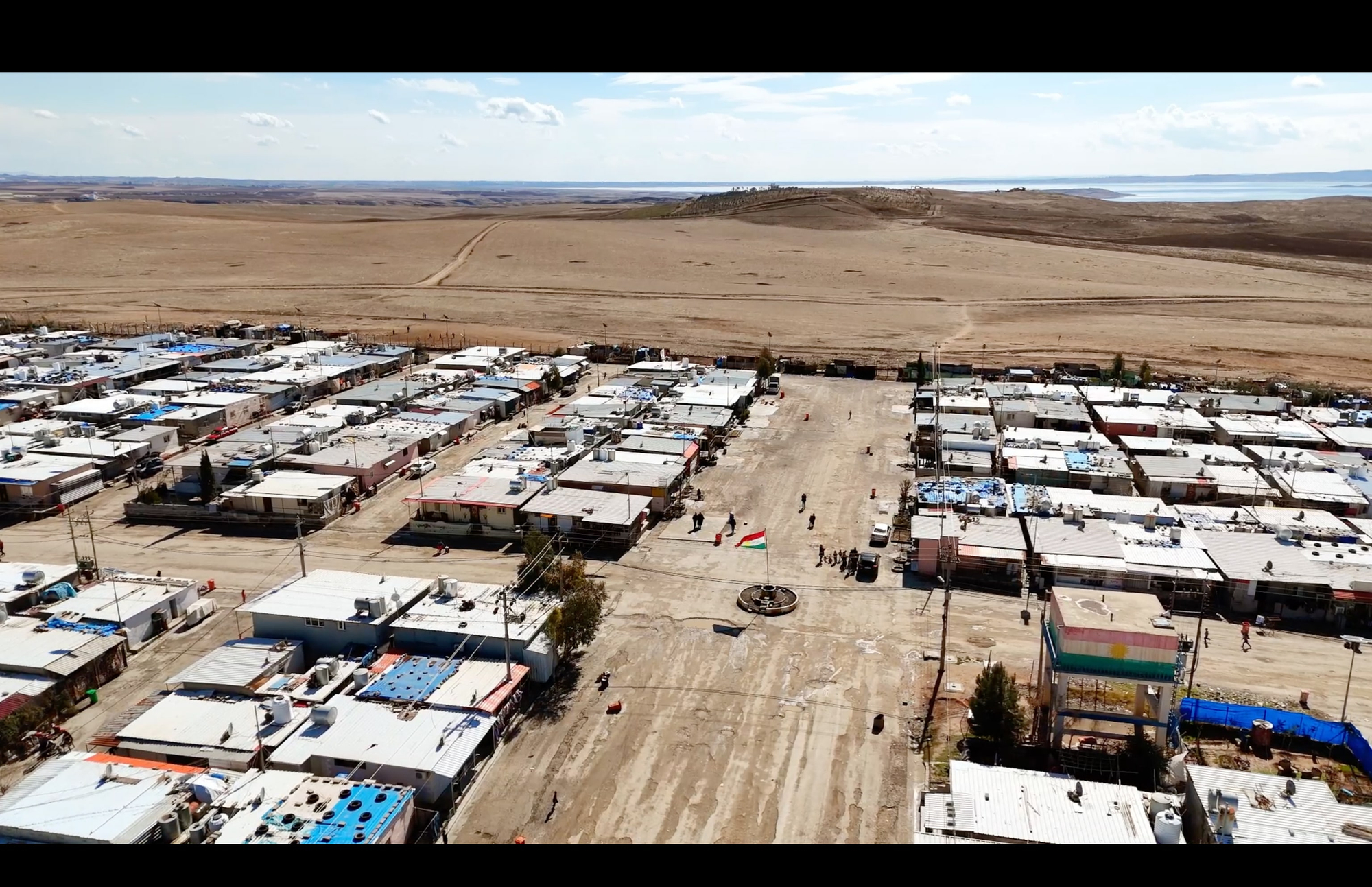
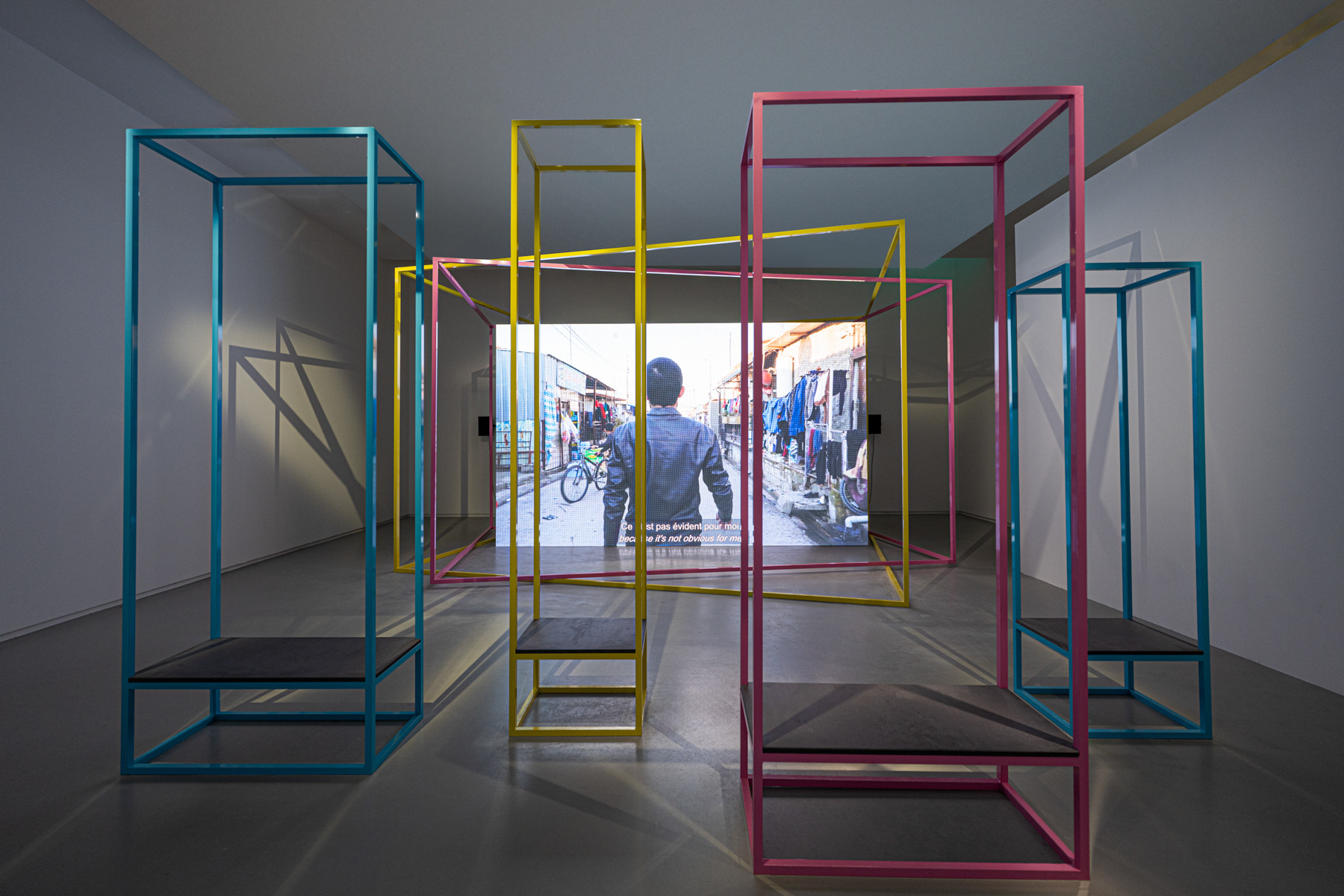
The title Mechanical Kurds does not limit this form of labor to contemporary AI technologies. The word “Mechanical” refers to a history that reaches back to the chess-playing automaton designed by Wolfgang von Kempelen in 1770, later known as the “Mechanical Turk.” Inside the device, which appeared to function like a machine, was in fact a hidden human chess player. This relationship resurfaced in a different form with Amazon’s Mechanical Turk platform, where small cognitive tasks that machines could not perform, or could not yet perform, were distributed to human workers. By replacing “Turk” with “Kurd” in the title, Steyerl connects this historical trajectory to the digital micro-labor performed by Kurdish refugees. The video does more than simply explain the images processed by micro-workers; it turns the camera directly toward the refugee camp itself. As the camp’s roads, structures, children, and various aspects of everyday life come into view, the bounding boxes used in computer vision systems are superimposed onto the footage. In this way, the bounding box shifts from a technical tool of classification into the visual language of the work itself. The refugee camp appears both as a lived space inhabited by people and as an image field in which machines can distinguish and categorize objects. Steyerl’s juxtaposition of documentary footage with images generated by artificial intelligence, together with the repetition of rectangular forms throughout the spatial arrangement of the installation, extends this logic of classification beyond the video itself.
As the visual flow of the video unfolds, images of the camp are placed alongside Alpine landscapes, a German city, and other environments. What is at stake here is not simply the camp’s “transformation” into another geography. By bringing different images together, the spatial and social relations embedded within each become visible. A city image consists of more than buildings and roads; it also contains ways of moving, dwelling, circulating, working, and living alongside others. The images of the camp reveal a different form of spatial organization. This juxtaposition suggests that images carry not only objects but also the relationships in which those objects are embedded. From the perspective of machine vision, objects can be separated and classified; from the perspective of lived experience, however, the same object can acquire different meanings within different relational contexts. A distance thus emerges between the classifiable fragments of an image and the life that unfolds within them. Here, it is important to maintain the distinction between the images on which the workers’ labor is performed and the images that Steyerl brings into the field of machine vision in the video. It is not possible to fully determine the geographical origin of the images labeled by the micro-workers. However, Ars Electronica’s statement indicates that this labor is related to the annotation of images associated with military purposes and to the preparation of image data required by computer vision systems used in autonomous vehicles and military drones. There is no suggestion that the workers are directly involved in developing drones or autonomous vehicles. By identifying and marking objects, people, and structures within images, they produce labeled datasets that can later be used in machine-learning systems. It is also noted that the workers do not know in which technological systems, or for what purposes, these images will ultimately be used.

Mechanical Kurds, 2025 Single-channel HD video installation (color, sound) Duration: 13 min
Consequently, the issue is not that Kurdish refugees are teaching “their own world” to an algorithm. The images before them cease to be a simple extension of their everyday lives and instead become part of a broader technological circulation whose ultimate purpose remains unknown to them. For this reason, the algorithm’s relation to the image cannot be placed on the same plane as the refugee’s relation to it. An algorithm has no lived world or historical experience; from its perspective, an image is a field of data to be processed and classified. The refugee, by contrast, has been displaced from a historical and social world and continues to live within a different visual, economic, and political order. One form of distance is technical and functional; the other is historical and geopolitical. As Mechanical Kurds brings these two different forms of distance into confrontation within the same image regime, it also invites viewers to reconsider the camp footage not merely as data, but within its own spatial and social relations. In this encounter, the image itself also passes through a labor process. Extracted from lived reality, it is broken down into objects and forms; these fragments are then transformed into classifiable units of data. The worker’s gaze, capacity for recognition, and decisions constitute the invisible labor behind this transformation. A machine does not see a “car,” a “person,” or a “building” in the way a human does; in order to recognize such categories, it depends on labeled datasets prepared through human labor. The micro-worker therefore does more than classify an image. They also contribute to shaping the conditions through which machine learning systems will come to process the world through specific distinctions and categories.

Mechanical Kurds, 2025 Single-channel HD video installation (color, sound) Duration: 13 min
Here, the very term “worker” becomes a problem. The micro-worker is a general labor category defined by the task performed. The task is completed, yet the singularity of the person who performs it often remains invisible. For the platform, what matters is not who classified the image but whether the classification task has been completed. The human being ceases to appear as a singular subject within their labor and becomes a functional component. For this reason, the reappearance of a worker’s name is not merely a biographical detail. A name points once again to the singularity that exists behind an abstract category of labor. Mechanical Kurds’ attempt to make human labor visible reaches another question at this point: when a person’s life, labor, and experience are placed at the center of an artwork, will that person be represented solely through general categories such as “Kurdish-Syrian refugee,” “micro-worker,” or “ghost worker,” or will they also be able to exist under their own name? In the official credits, the names Rebin Karim, M.H., and W.O. appear under the heading “With.” At the same time, the question of anonymity should not be overlooked. Steyerl notes that, for some participants in the project, anonymity was an important choice. Rather than treating the visibility of names as a self-evident ethical imperative, it may be more productive to ask how the work constructs the relationship between subjecthood and anonymity. Naming is not the only way to move a person beyond the category of “worker”; nevertheless, it remains a powerful means of signalling that an individual possesses a life and a singularity that exceed their labor. Following from this, the question posed by Mechanical Kurds is not only whose labor becomes visible. Whose name becomes visible, and whose capacity to see and distinguish becomes part of production? If a machine can process the world only because human labor has first broken the image into parts, identified objects, and classified them, then whose labor is involved in constructing the world that the machine sees? This question opens up the line that connects the technological history of the artwork to the history of labor: mechanization occurs not only when machines replace humans, but also when human activities are divided into components that machines can process.
The Mechanical: Externality, the Machine, and the Fragmentation of Labor
The word “mechanical” in Hito Steyerl’s Mechanical Kurds does not refer solely to contemporary artificial intelligence technologies or the operation of digital machines. The concept of the mechanical has a much longer philosophical and political history. Throughout this history, the mechanical has been understood in different ways: as a model for explaining the workings of nature, as the technical organization of the machine, and as the division of human labor into discrete operations. One of the questions connecting these different uses is the establishment of relations within an order determined from the outside rather than as an organic whole emerging from within. The mechanical, therefore, does not begin merely with the existence of the machine; it emerges when an activity is separated from its internal relations and subjected to an external determination. Hegel’s concept of mechanism provides an important starting point here. In Science of Logic, the mechanical relation is based on the fact that the elements brought together do not form an organic unity arising from within themselves. Hegel writes: “Mechanism, at least ordinary and unfree Mechanism, and also Chemism, must undoubtedly be regarded as an immanent principle, because the determining external factor itself is again only an object that is thus externally determined and indifferent to such determination; or, in Chemism, the other object is similarly a chemically determined object; in general, an essential moment of the totality always lies in something external.” (Hegel, 2014, p. 560). What is decisive here is the “external factor.” Parts may be connected and together produce a particular outcome; however, if the determination that holds them together does not arise from their own internal relations, that unity remains mechanical. For Hegel, mechanization is therefore concerned less with movement itself than with the way that movement is determined.

This distinction is important for Mechanical Kurds. In the work, the human capacity to see, distinguish, and classify is not eliminated; rather, it is divided into components and reorganized within an externally determined workflow. Looking at an image, recognizing an object within it, establishing its boundaries, and placing it into a category constitute a perceptual activity that is inseparable in everyday experience. Within a crowdsourcing system, however, this activity is divided into specific and measurable tasks: locating the object, drawing its boundaries, selecting its category, and confirming the operation. Mechanization thus appears not as the elimination of human capacities but as their reorganization within an externally determined process. The mechanical character of Mechanical Kurds begins precisely here: the human sees, yet the operations into which seeing will be divided, and the distinctions that will be transferred to the system, are determined in advance by a pre-existing order of production.
“Therefore, in the same proportion as labor loses its character of craft, this economic relation, the relation between capitalist and worker as the two poles of the production relation, increasingly acquires a purer and more complete form. As the specific skill of labor becomes increasingly abstract and indifferent, labor itself increasingly becomes purely abstract activity, purely mechanical activity, and therefore an activity indifferent to its particular form, a purely formal, or what amounts to the same thing, a purely material activity, an ‘activity in general’ for which it makes no difference what form it takes.” (Marx, 1979, p. 379). The transformation Marx highlights here is the progressive abstraction of the specific knowledge and skills embedded in a particular craft. As the “specific skill” of labor becomes increasingly abstract and indifferent, the way in which a particular worker performs a particular task becomes less decisive from the standpoint of production. Labor approaches an abstract form of activity that can be transferred across different production processes. Marx’s expressions “purely mechanical activity” and “activity in general” describe this process of abstraction. The specific movement performed by the worker becomes detached from both knowledge of the production process as a whole and from the particular character of the task itself, making it interchangeable with other operations, repeatable, and capable of being reorganized.
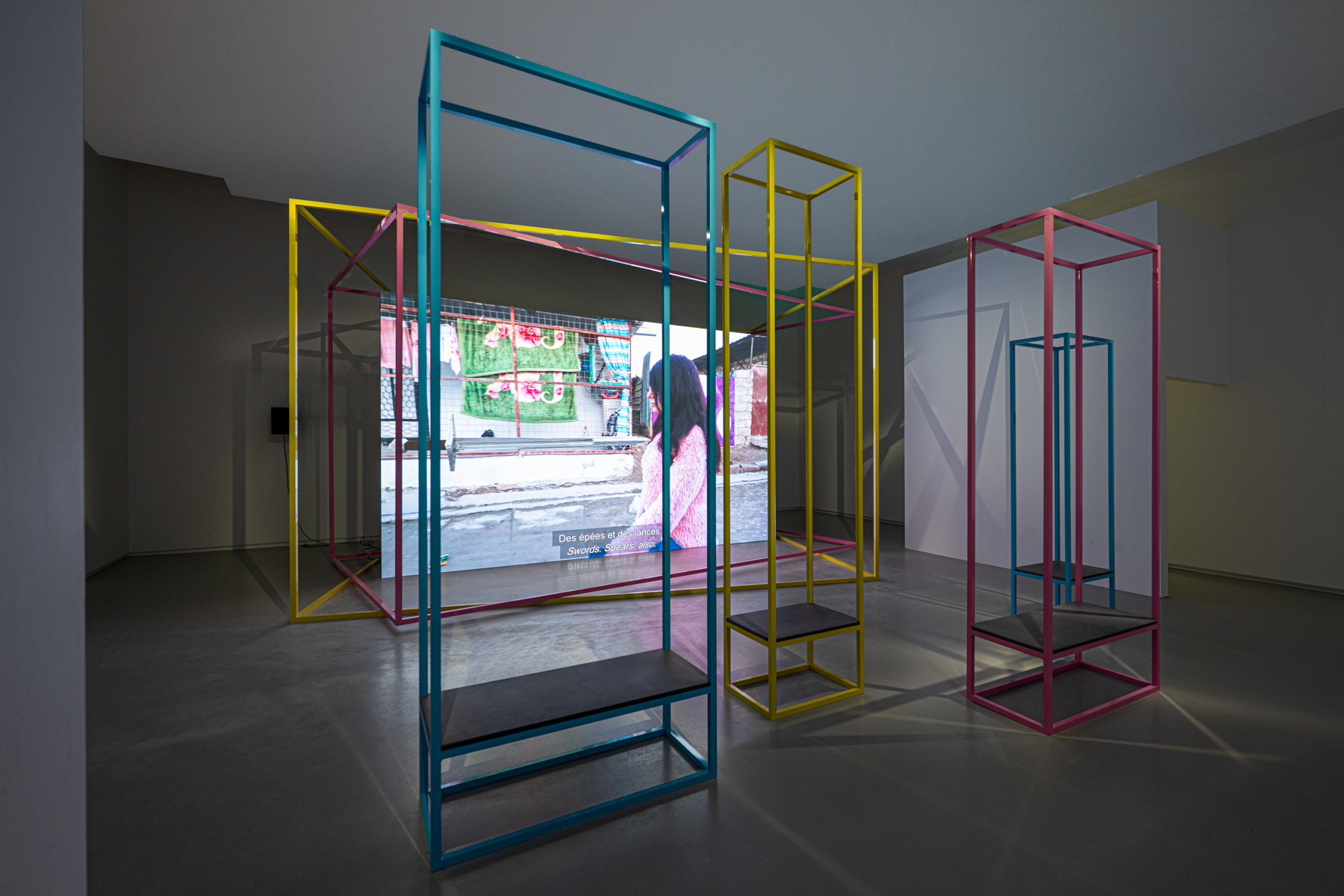
Mechanical Kurds, 2025 Single-channel HD video installation (color, sound) Duration: 13 min
At this point, it is no longer sufficient to think of the machine merely as a neutral tool used by human beings. Activities that have been fragmented and abstracted within the production process can be reorganized within a technical system; operations once embodied in the worker’s experience, skill, and bodily practice can be separated from the overall organization of production and become part of another capacity. As a result, the distance between the worker’s overall involvement in the production process and the individual operation they perform grows wider. Repeating a movement, assembling a component, or carrying out a particular control procedure becomes a task that can be defined independently of its meaning within production as a whole. The fundamental transformation here occurs before the machine replaces the human: it lies in the division of human labor into components that can be taken over and technically reorganized by the machine. For Hegel, the mechanical refers to the external determination of relations; for Marx, this determination becomes materialized through the abstraction of labor and the fragmentation of the production process. Mechanical Kurds, in turn, extends this historical trajectory from bodily movement to perceptual activity. In digital micro-labor, it is not only movement that is fragmented. Seeing, paying attention, distinguishing, drawing boundaries, classifying, and confirming also become separable units of labor. The abstract form of labor that Marx describes as an “activity in general” appears here as a perceptual activity. Recognizing a specific object, determining its boundaries within an image, or selecting a category is detached from the totality of a lived visual experience and transformed into a measurable micro-task. For this reason, mechanization in the contemporary technological world of Mechanical Kurds does not simply mean that humans perform a physical function in relation to machines. Human vision, attention, and powers of discrimination are also incorporated into the production process of machine learning. Marking an image as a “person,” “car,” “building,” or some other object is one of the conditions that enables machines to later process these distinctions as data. Humans do not merely provide data to machines; they contribute to the production of data that has been made usable through the distinctions by which machines will come to process the world. In this sense, machine learning is not simply the learning of the machine. It is also the transformation of specific forms of human labor into data that can be learned from, reused, and operationalized.
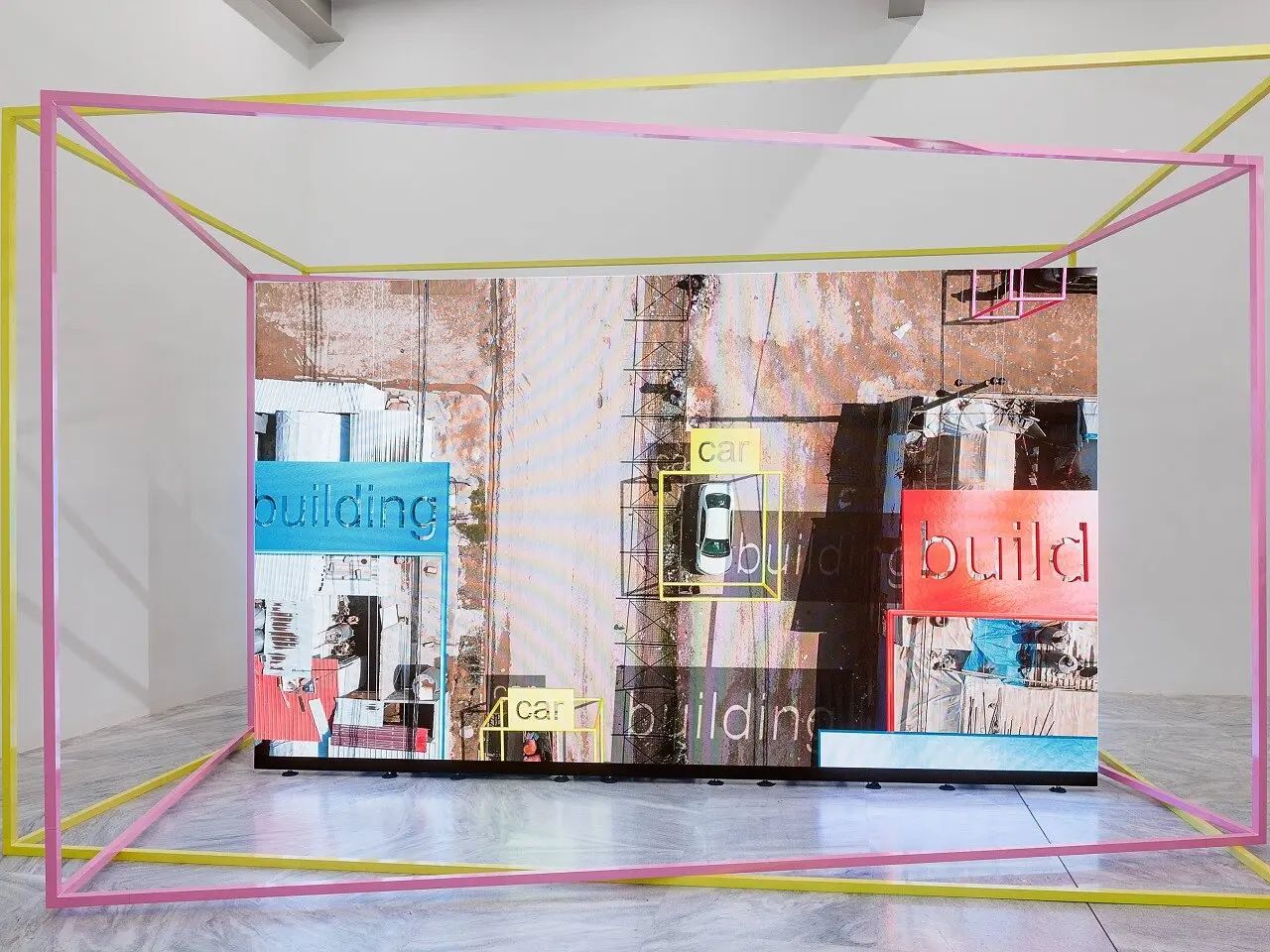
Mechanical Kurds, 2025 Single-channel HD video installation (color, sound) Duration: 13 min
Here, the meaning of mechanization expands once again. Seeing becomes a classifiable task; distinguishing becomes data production; and a singular decision becomes a piece of data that can later be used by another system. Human activity, separated from the holistic experience of the person performing it, becomes a productive input that can be deployed elsewhere within the system. Once a machine’s capacity for recognition emerges, the human labor that contributed to its formation can recede into the background. The distinctions made by the worker reappear as the machine’s capacity to recognize; human attention reappears as algorithmic processing; and singular decisions reappear as components of larger datasets. Mechanical Kurds makes this transformation visible not through a simple opposition between human and machine, but through the way particular elements of human activity are rendered reusable within a technical system.
At this point, however, the question is no longer simply how machines learn. If the machine can learn the world only through the fragmentation of human labor into discrete components, then who carries out this fragmentation? Whose capacities for seeing, paying attention, and distinguishing are transformed into machine knowledge? Who will devote their time to working, and who will have the time to think, govern, and produce knowledge? In this way, the question of digital micro-labor moves beyond the technical history of the mechanical and arrives at the problem of the political distribution of labor. Is the distribution of labor also a distribution of time, attention, and intelligence? By placing human labor at the infrastructural core of machine learning, Mechanical Kurds directs this question toward the ways labor is distributed and toward which forms of activity different people are able to access. At this point, Jacques Rancière’s critique, developed through an engagement with Plato, becomes decisive.
The Distribution of Labor, the Distribution of Intelligence
The history of mechanization has never been limited to the history of the development of tools and machines alone. It is also the history of determining which activities people will perform, who will work, and who will have time to think. The division of a task into separate parts is not simply a matter of organizing production technically; it also means placing people’s activities and time within a particular order. For this reason, the distinction between labor and thought points to a question broader than the organization of production itself: Who will work, who will think, who will speak, and who will have time for something beyond their assigned activity?
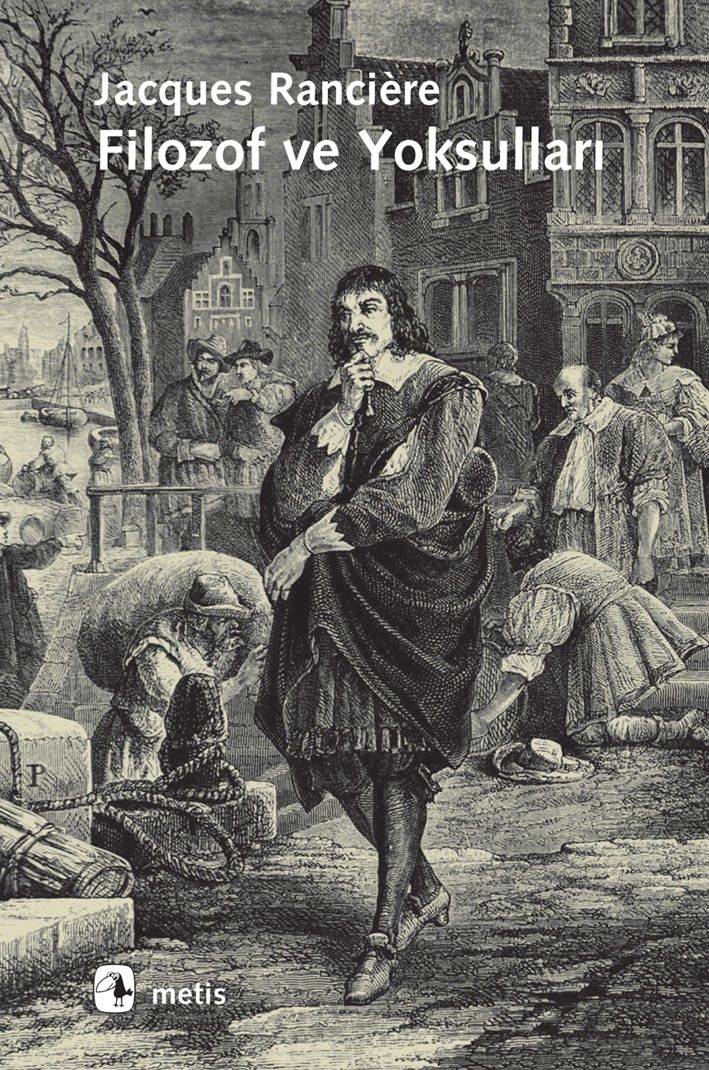
In The Philosopher and His Poor, Jacques Rancière returns to the philosophical history of this question. The issue he traces concerns how social tasks are distributed and how classifications regarding people’s natures, abilities, and social positions are transformed into a political order. Rancière recounts the origin of the division of labor in Plato’s Republic as follows: “In the beginning there were four. Or five. Approximately as many as the needs of the body. A farmer for food. A mason for shelter. A weaver for clothing. In addition, a shoemaker and another worker to provide the necessary materials. This is how Plato’s republic is proclaimed. No gods, no founding myth. Only individuals and the means of satisfying needs.” (Rancière, 2013, p. 21). Yet this initial division of labor quickly ceases to be merely an arrangement for meeting needs. The question of who performs which task comes to be considered alongside the question of what kind of nature each person possesses. The principle that everyone should do “their own work” is transformed into a social order in which different natures and abilities are distributed hierarchically. In Plato’s political order, producers, guardians, and rulers are separated from one another; the imagery of gold, silver, bronze, and iron presents this separation as though it were a natural difference. A social function thus ceases to be simply what a person does and becomes a determination of what that person is.
In Aristotle, as Rancière presents it, the distinction shifts toward the value assigned to tasks and activities: “A city is not merely a concentration of needs and a distribution of the means of production. From the very beginning, something else is required: justice, that is, the rule of the better over the less good. There are noble and less noble tasks, degrading and less degrading forms of work, and natures corresponding to them. One must distinguish.” (Rancière, 2013, p. 21). Here, “to distinguish” means more than differentiating existing occupations; it means establishing a social norm regarding which forms of work are noble and which are base, which activities are suited to ruling and which to being ruled. The distinction based on natures in Plato is thus complemented in Aristotle by a hierarchy concerning the value of tasks and activities. For Rancière, what matters is that these distinctions do not merely explain society; they also determine which activities and ways of life people are able to access. For this reason, Rancière’s question is not limited to the distribution of economic resources. Ways of life, activities, and time are also distributed. While some are presumed to have time for thinking, governing, and pursuing truth, others have their time assigned to labor. A person’s social position is therefore determined not only by what they do, but also by the time available to them for doing something else. In this respect, Plato’s classification according to different natures and Aristotle’s distinction between noble and less noble activities converge on the same political problem: within a social order, what people are able to devote their time to is determined no less than what they are able to do.
This distinction appears in a more concrete scene in Plato’s Meno. In order to demonstrate how geometric knowledge emerges, Socrates asks Meno to summon one of his attendants. Meno calls a slave. Socrates first asks whether he is Greek and whether he speaks Greek; Meno replies that he was “born in the house.” The person who enters the scene is therefore not given a name and is identified simply as Meno’s slave. Socrates then draws a square on the ground and asks the slave what the figure is. After establishing together that a square with sides measuring two feet has an area of four square feet, he asks how long the side of a square with twice that area would have to be. The slave initially assumes that the side must also be doubled. Socrates continues his questioning and has him calculate the area produced by this answer, leading the slave to realize that doubling the side produces not double but four times the area. The slave offers a second guess, which also proves incorrect, and eventually admits that he does not know. Socrates continues with further questions, and the slave ultimately arrives at the correct relationship, discovering that the diagonal produces a square with an area of eight square feet. At the end of the exchange, Socrates asks Meno whether the slave supplied the answers himself, and Meno agrees that the answers belonged to the slave.
In The Philosopher and His Poor, Rancière explains the significance of this scene as follows: “Meno’s slave, who by himself discovers the formula for doubling the square, thereby proves two things: that science is possible, but not just any science. To awaken this dormant knowledge requires the sting of aristocratic dialectical provocation, not the lessons of the democratic sophist Protagoras or the popular philosopher Antisthenes.” (Rancière, 2013, p. 58). For Rancière, the important point is not simply that the slave can solve a geometric problem. His answers demonstrate a capacity for thought and reasoning; yet that capacity is activated within the question-and-answer framework established by Socrates. Socrates draws the figure, determines the questions, and, after each answer, establishes the next stage of the inquiry. The slave provides the answers himself, but he does not determine either the formulation of the problem or the direction of the investigation. Two distinct conditions are therefore separated within the same scene: possessing the capacity to think and possessing the power to determine the problem on which that capacity will be exercised and the direction in which it will proceed. This is the distinction that gives Rancière’s reading its importance. Possessing the capacity to think is not the same as being able to use that capacity within an activity one has determined for oneself.
From here emerges a broader question concerning the relationship between knowledge and social freedom. The fact that a person possesses the capacity to think does not mean that they can use that capacity to determine the conditions of their own life. The slave in Meno can arrive at a geometric relation, answer questions, and demonstrate a capacity for reasoning; yet the scene does not alter his social position. While he appears as a thinking subject within the dialogue, on the social level he remains Meno’s slave. Moreover, he is never given a name; the term used to identify him refers to a relation of ownership belonging to someone else. Here, the distinction between the capacity to think and social status becomes clear. A person’s ability to think does not automatically determine which activities they are able to exercise authority over. This distinction becomes important once again in relation to Mechanical Kurds, although it would be misleading to equate the two situations. The refugees in the work possess the capacities to see, distinguish, compare, and decide. Yet the conditions under which these capacities are exercised are not the same as the degree of control they possess over other dimensions of their lives. A refugee camp cannot be understood as an autonomous social space in which people can shape every aspect of their lives according to their own will. Its administrative structure, dependence on external institutions, and the conditions governing mobility limit the possibilities available to those who live there. There is, therefore, a distinction between being able to make decisions about an image and being able to make decisions about the spatial and social conditions of one’s own life. A refugee may identify the relationships between roads, buildings, vehicles, and public spaces within an image, yet the social relations represented by that visual order may not be equally accessible within everyday life. In an image of a city, transportation, work, housing, circulation, and public encounters are organized within a particular continuity. Classifying an image does not mean inhabiting those relationships. In this way, Mechanical Kurds also reveals the distance between visual knowledge and the social relations upon which that knowledge depends.

Mechanical Kurds, 2025 Single-channel HD video installation (color, sound) Duration: 13 min
Therefore, without establishing a direct equivalence between Meno and Mechanical Kurds, one can identify a continuity of problematics between them. In Meno, the slave’s capacity to think and his social position appear side by side within the same scene. In Mechanical Kurds, the refugees’ perceptual capacities and the labor conditions under which those capacities are employed confront one another within the same system of production. In the former, the slave can solve a geometric problem but cannot determine his social position; in the latter, the refugee can read and classify images and contribute to the production of data for machine learning, yet this laboring capacity does not entail a comparable power to determine the conditions of his own life. What links the two cases is not the treatment of intelligence as an abstract faculty operating identically in everyone, but the question of the activities to which intelligence is attached within particular social arrangements. In the scene from Meno, this arrangement is structured by the philosopher’s questions; in digital micro-labor, it is structured by task definitions, platform interfaces, classification schemes, and data-production processes. Rancière’s question can therefore be reformulated here: before asking who can think, we must ask under what conditions, and for what purposes, whose thought becomes usable. Mechanical Kurds adds a spatial dimension to this question. While living in a place where they cannot fully determine the material conditions of their lives, refugees encounter the spatial orders of other worlds through the images they analyze as part of their labor. The city appears as a space in which the relations of social life, such as transportation, work, housing, and public encounter, are organized through a certain continuity. The camp, by contrast, is a living space that does not generate its own continuity entirely from within but remains dependent on external economic, political, and administrative structures. This distinction takes on another dimension when considered alongside the argument Rancière develops through Joseph Jacotot in The Ignorant Schoolmaster: Five Lessons in Intellectual Emancipation.
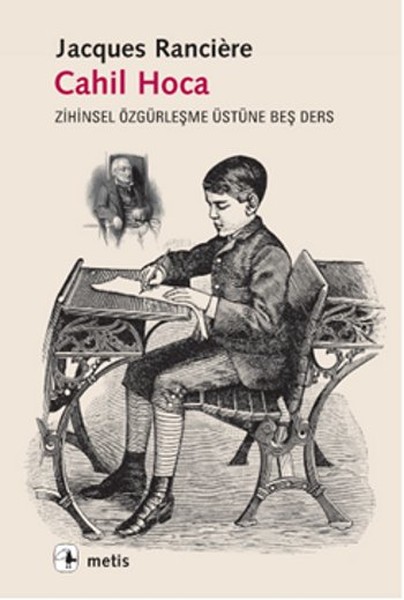
The starting point of Jacotot’s experiment is simple: the teacher and the students do not speak the same language. Nevertheless, the students begin to learn through a shared book. Reflecting on this experiment, Rancière writes: “The thing that human beings learn best, and that no master can teach them, is their mother tongue.” (Rancière, 2014, p. 13). Here, the teacher does not begin from the assumption that the student’s intelligence is inferior to his own. There is something held in common between teacher and student: the book. Faced with this common object, the student uses attention, compares, repeats, establishes relations, and forms connections between meanings. Learning thus emerges not as the transmission of knowledge from one intelligence to another, but as an intelligence directing itself toward the thing before it. What is decisive in Jacotot’s experiment is not the teacher’s ignorance, but the separation of the authority to teach from any superiority of knowledge. The teacher ceases to be the person who identifies what the student does not know and supplies the missing knowledge. The common object is not an instrument for closing a gap in knowledge between teacher and student, but an object toward which two intelligences direct themselves in different ways. For Jacotot, equality therefore does not mean that the student possesses the same knowledge as the teacher. It means that intelligences are not placed on two hierarchically distinct levels from the outset.
The difference between Meno and Jacotot becomes important at this point. In Meno, the slave’s capacity for thought is activated within the question-and-answer structure established by Socrates. In Jacotot’s pedagogy, by contrast, no pre-existing hierarchy of intelligence between teacher and student is assumed. In one case, the philosopher determines the direction of inquiry; in the other, learning takes place through the student’s use of their own attention and intelligence in relation to a common object. This distinction lies at the heart of Rancière’s idea of equality. Equality is not established through the transmission of knowledge from one intelligence to another; rather, it begins with the assumption that everyone is capable of investigating the same thing through the use of their own intelligence. Yet intellectual emancipation does not mean that social conditions disappear of their own accord. A distance remains between a person’s ability to use their own intelligence and their capacity to exercise power over the material and social conditions that shape their life. The question of digital labor in Mechanical Kurds shifts this distinction onto a different terrain. At first glance, the relationship between the micro-worker and the algorithm may appear pedagogical: the human classifies images, and the machine learns from those classifications. Yet the micro-worker is not a teacher transmitting knowledge to the algorithm, just as the algorithm is not a student attempting to understand the world before it. The relationship is organized within a platform, a set of predefined tasks, and a particular labor regime. The worker performs a specific task, and the result of that task is subsequently transformed into data that can be used in the learning process of a technical system. Here, Jacotot’s “common object” is effectively reversed. The common object shifts from the book to the image, yet the image is not a shared object of inquiry toward which two intelligences are equally directed. The human employs attention and powers of discernment; the distinctions they produce are transferred into the learning process of a technical system. Whereas the common object is the condition of learning in Jacotot, in Mechanical Kurds the image becomes an object of labor.
Mechanical Kurds, 2025 Single-channel HD video installation (color, sound) Duration: 13 min
This distinction becomes more concrete when considered in relation to the conditions of Domiz. Established in 2012 to accommodate refugees arriving from Syria and gradually becoming a more permanent settlement over time, Domiz nevertheless cannot sustain its continuity in the manner of a city. The camp’s services are organized through administrative and humanitarian structures, and the continuity of basic services remains dependent upon institutional frameworks. Education forms part of this arrangement as well. The Refugee Education Integration Policy implemented in the Kurdistan Region seeks to integrate refugee children into the public education system and to connect education with secondary schooling, vocational training, higher education, and livelihood opportunities. It is therefore not possible to establish an automatic relationship between education within the camp and emancipation. Education may provide access to broader social possibilities; however, the realization of those possibilities depends on access to documentation, transportation, economic resources, legal status, and institutions beyond the camp itself. UNHCR’s discussions of education policy likewise emphasize this institutional connection between education, recognized qualifications, vocational training, higher education, and livelihood opportunities.
It would also be inaccurate to describe the camp as a space entirely outside production or devoid of economic activity. Refugees may work, and economic activity can exist within the camp. The distinction must therefore be drawn elsewhere. Unlike a city, the camp is not an autonomous space that organizes relations of production, circulation, housing, and social reproduction within a relatively integrated social structure. Refugees in the Kurdistan Region of Iraq may access healthcare and education services and may find opportunities for work; at the same time, they can face various limitations regarding legal status and freedom of movement. For this reason, the camp’s dependence on external structures does not mean an absence of production. Rather, it means that the continuity of life is secured through economic, administrative, and political relations that extend beyond the camp itself.
In Mechanical Kurds, digital micro-labor intersects with this externally dependent structure on a different level. Images produced elsewhere in the world appear before camp residents. A city, a road, an automobile, or a building confronts them not as a direct part of their own lives, but as a visual object to be processed. They direct their attention toward the image, distinguish objects, and classify them; yet this process does not directly incorporate them into the social relations of the world represented in the image. They may identify a city, determine the boundaries of a building, or mark the location of a vehicle, but such operations do not grant access to that city’s relations of work, transportation, housing, or public life. A distance thus emerges between visual knowledge and the social relations upon which that knowledge rests. A relationship of estrangement can be identified here between the refugee and the algorithm, but it would be misleading to claim that these forms of estrangement are the same. For the algorithm, the image is a field of data to be processed and classified. A city, road, building, or person becomes a set of visual features that can be separated and organized under specific categories. For the refugee, by contrast, estrangement is historical and geopolitical: following displacement, the individual finds themself in another living environment while working on images produced beyond the horizon of their own experience. The algorithm’s estrangement cannot be understood as a lived history; the refugee’s estrangement is the result of a particular history of displacement and specific political conditions. Human and machine may stand before the same image, but they are not there for the same reason. The human converts a portion of their allotted work time into a micro-task; the machine incorporates the result of that labor into its own processing capacity. For this reason, Jacotot’s “common object” in Mechanical Kurds does not simply become an image; it becomes an image transformed into labor. The image ceases to be a common object investigated equally by two intelligences and becomes instead an object of labor through which human attention, powers of discernment, and decisions are rendered usable by a technical system. Here, Rancière’s question reappears: the issue is whose attention, time, and intelligence are made usable, and within what regime of production.
A new form of digital labor emerges precisely at this point: the human capacity for attention becomes work. Seeing, distinguishing, comparing, and confirming are divided into measurable micro-tasks. The perceptual relation through which people engage with the world is transformed into an activity with economic value. The camp’s externally dependent and uncertain temporality is thereby connected to another process of production. In a setting where access to stable employment is limited, the capacities to see and distinguish can become part of a global chain of data production. Rancière’s critique of the historical distribution of labor and thought takes on a contemporary form here. The worker’s capacity to see and pay attention is itself absorbed into work time. In Mechanical Kurds, the refugee worker’s perceptual labor is incorporated into the data-production process of machine learning. The camp’s externally dependent living conditions are linked, through digital platforms, to another process of production. While people live in circumstances where they exercise only limited control over the conditions of their own lives, their capacities to see and distinguish are transformed into inputs for a different production process. Rancière’s question can therefore be posed once again: Who thinks? Mechanical Kurds, however, adds another question: when the machine sees, whose gaze is actually at work?

Mechanical Kurds, 2025 Single-channel HD video installation (color, sound) Duration: 13 min
From Seeing to Classifying
This question brings us back to Steyerl’s images of the camp. In the video, two different modes of seeing confront one another: the images marked by bounding boxes and the camera directed toward the refugee camp. In some of the urban images enclosed by bounding boxes, a road, a car, a building, or a person appears first and foremost as an identifiable object. Rather than presenting the city as a whole, the image selects those elements that a machine can recognize. A road is marked as a road, a car as a car, a person as a person. In this way, a particular part of the image is separated from its surroundings and rendered classifiable. In Steyerl’s shots of the camp, however, the same visual elements appear within a broader network of spatial relations. A tent is a space of shelter; a road is a route along which everyday movements take place. Tents, structures, vehicles, open spaces, and people together form the image of a lived environment. The bounding box produces an object’s recognizability for the machine by separating it from its surroundings. The camera, by contrast, allows the relations between objects to remain visible. In one case, the image is divided into classifiable fragments; in the other, those fragments remain embedded within a spatial and social context. This does not mean that the city images are merely technical while the camp images are merely relational. Rather, Steyerl’s juxtaposition of different images reveals the difference between an image’s technical processability and the social relations carried by a space. Visual features can be transferred from one image to another, yet the relations a space establishes with shelter, movement, work, and everyday life cannot be reduced to geometric features alone. The fact that one image can be technically matched with another does not mean that the social relations contained within it are transferred in the same way.
Mechanical Kurds, 2025 Single-channel HD video installation (color, sound) Duration: 13 min
The meaning of the bounding box also expands at this point. As a frame drawn around an object, it is an operation that determines the scale at which an image will be read. When it separates a tent, a road, or a person from its surroundings, the relations within which those elements exist recede into the background, while the characteristics recognizable to the machine move to the foreground. Steyerl’s camera, meanwhile, reveals the field in which these separated objects become related once again. The video thus juxtaposes the logic of machine vision, which isolates objects from their surroundings, with the qualities of lived space, in which objects remain connected through relations. The refugee camp therefore emerges as a concrete site where data production takes place and where the same image can pass through different modes of seeing and processing. On the one hand, tents, roads, people, and structures form the material environment of everyday life; on the other, the image transforms those same elements into inputs for data production by separating them into classifiable objects. Human beings live within the camp; the machine attempts to recognize the objects within the image. These two operations, meeting on the same visual plane, demonstrate that an image can be constituted in different ways. The concern of Mechanical Kurds is therefore to show which qualities become foregrounded and which recede when a lived environment is transformed into an object of technical classification. The difference between the object enclosed by the bounding box and the living environment shown by Steyerl’s camera becomes clear here: one divides the image into processable parts; the other allows the relations established among those parts to remain visible. The separation required for machine learning is carried out through human labor.
Within Steyerl’s broader thinking on the image, a connection can also be drawn between In Defense of the Poor Image and Mechanical Kurds. Poor Image foregrounded the circulation of images: images that are copied, compressed, re-uploaded, and moved across networks. Mechanical Kurds, by contrast, makes visible the conditions under which images are processed. The image is read, separated into components, divided into objects and categories, labeled, and reorganized within a data system. In this way, the image ceases to be merely a circulating object and becomes an input in another process of production. The shift here is from the movement of the image to the rendering of the image usable. For this reason, the juxtaposition of urban and camp imagery in the video should not be understood merely as a comparison between two different spaces. The city appears as a complex structure in which production, circulation, work, housing, and social relations are interconnected through forms of continuity. People do not encounter roads, buildings, or vehicles solely as visual features; they experience them through specific forms of use and social relations. Yet those relations themselves are not directly transferred into the technical classification of the image. The fact that a road can be labeled as a “road” within an image does not mean that its uses within the city, its history, or the social relations that unfold upon it are carried into the data label itself.
A similar distinction applies to the camp. A refugee camp such as Domiz does not possess the kind of continuity characteristic of an autonomous city whose reproduction is sustained entirely through its own relations of production. The continuation of life depends on structures beyond the camp in terms of education, healthcare, administration, economic opportunities, and a range of institutional relations. This does not mean that the camp is devoid of production or economic activity; rather, the question concerns the institutional and economic relations through which the continuity of life is maintained. Accordingly, the fact that the camp imagery in the video conveys a degree of indeterminacy and dependence on external structures does not mean that all of its spatial relations are temporary or unstable. More precisely, what confront each other are different forms of organization: the image of the camp and the image organized by the machine through fixed categories. In this encounter, the categorical certainty of the bounding box becomes especially significant. The tent, the road, the person, or the vehicle each become separately identifiable within the image. Yet these categories do not fully account for the relations those objects establish with one another. It is here that the distinction between technical classification and lived space emerges: the same visual element can be both an object of data production and part of a particular living environment. Mechanical Kurds does not present these two levels separately; it overlays them within the same image. Viewed from this perspective, the word “mechanical” in Mechanical Kurds acquires a renewed meaning. The mechanical refers to the rendering of an image into something that can be divided into discrete parts, identified, and processed again. The incorporation of human labor into this operation of separation is not external to the mechanical process. Human vision divides the image into categories; the technical system learns through those categories. The relationship between human labor and the machine therefore emerges through the incorporation of seeing itself into the process of production.
For this reason, Steyerl’s question is directed less toward how “intelligent” artificial intelligence may be than toward the material and social processes through which the machine’s capacity to see is produced. What exists within the image is not merely a represented world. The modes of production, spatial arrangements, migration trajectories, labor relations, and technical infrastructures that constitute that world also participate in the making of the image itself. Mechanical Kurds places these layers into relation on a single visual plane: built urban environments alongside the lived spaces of the camp, human vision alongside machine classification, and lived space alongside the technically processable image. By the end of the video, a question emerges that goes beyond asking, “Through whose labor does the machine learn?” When a world is divided into objects recognizable to a machine, how do that world’s relations, ambiguities, and unrealized possibilities find expression within the image? Mechanical Kurds does not provide a closed answer to this question. Within the image, there is also the world that makes seeing possible.

Hito Steyerl is a filmmaker and writer based in Berlin. Her work addresses media, technology, and the global circulation of images through video installations, digital environments, and writing. She is Professor for Emergent Digital Media at Munich Art Academy. Her research platform at AdbK Munich, run with Francis Hunger, is at www.carrier-bag.net. She is represented by Esther Schipper(Berlin) and Andrew Kreps Gallery (New York).
References
Hegel, G.W.F. (2014). Mantık Bilimi (Trans. A. Yardımlı). İdea Yayınları.
Marx, K. (1979). Grundrisse (Trans. S. Nişanyan). Birikim Yayınları.
Rancière, J. (2013). Filozof ve Yoksulları (Trans. A. U. Kılıç). Metis Yayınları.
Rancière, J. (2014). Cahil Hoca: Zihinsel Özgürleşme Üstüne Beş Ders (Trans. S. Kılıç). Metis Yayınları.


Comments (1)
Thanks for the piece. Docufiction might be a good entrance to mechanical kurds. And the possibility of "the documented" to have the means of production of its "autobiofiction".