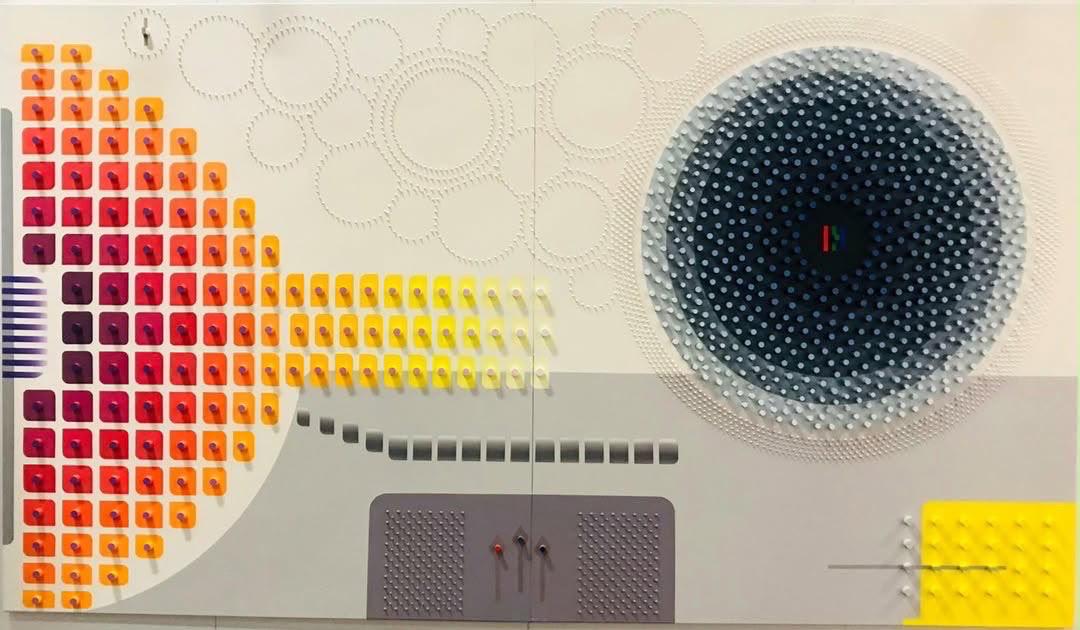
Discussions on contemporary Kurdish art have long been shaped primarily around questions of identity, memory, and historical experience. Although this approach has generated a substantial body of theoretical work, analyses focusing on the aesthetic concerns of modern and contemporary painting itself, such as surface, materiality, composition, and modes of pictorial construction, have remained comparatively limited. Ömer Mirdemir’s solo exhibition, Points of Authority, opened in Mardin, makes an important contribution to this underexplored field of discussion. In his work, Mirdemir treats the surface as a dynamic structure through which relationships, connections, and modes of organization are generated, bringing the modernist question of the surface into dialogue with the systemic logic of contemporary technical culture. In doing so, the exhibition opens a distinctive field of inquiry that foregrounds not what painting represents, but how it is constructed.
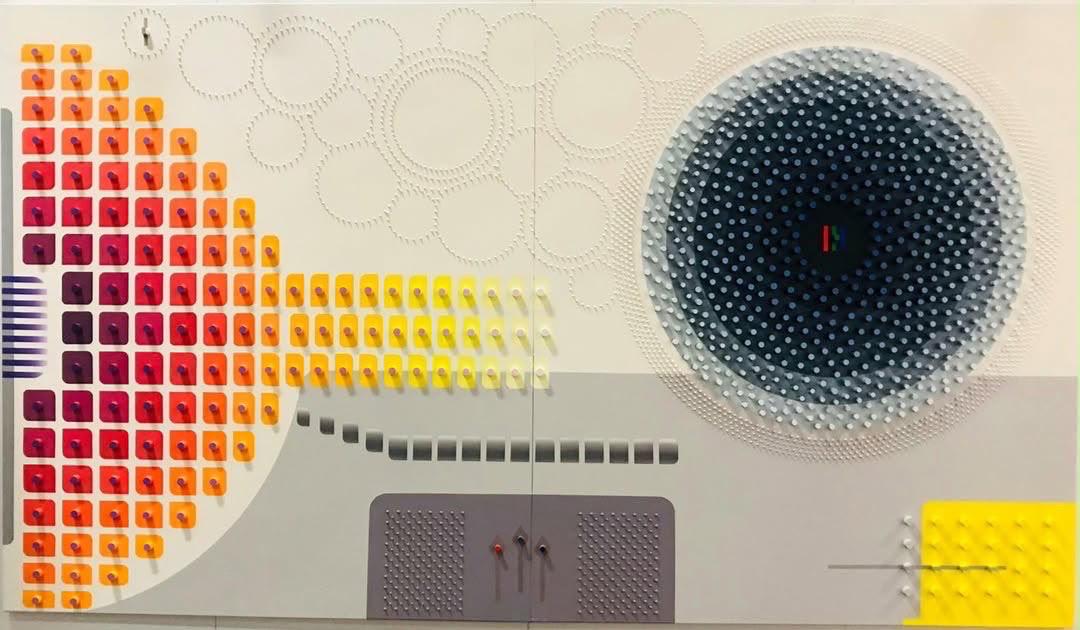 High Half, 200 × 350 cm, Mixed Media, 2021
Modern painting gradually turned away from the representational system that had defined Western art since the Renaissance and toward an investigation of its own conditions of possibility. By questioning the absoluteness of perspective and the fixed appearance of objects, Impressionism grounded visual experience in momentary perception. In Post-Impressionism and Expressionism, color and form became increasingly autonomous from the objects they represented, while Cubism fractured the unity of perspective through multiple viewpoints. Suprematism, Constructivism, and abstract painting further displaced the figure's referential relation to the external world from its position as the constitutive principle of painting. As a result, painting was transformed into an autonomous aesthetic object concerned with its own surface, color, space, and material structure rather than with the renewed depiction of the visible world.
Clement Greenberg theorized this transformation through the autonomy of painting and the flatness of the picture plane, establishing it as one of the central principles of modernist aesthetics. In The Aesthetic Regime of Art, Jacques Rancière situates Greenberg’s essay “Avant-Garde and Kitsch” within a broader historical framework. Developing his analysis through the relationship between capitalism and culture, Rancière summarizes Greenberg’s understanding of modernism as follows: “Capitalism, the author explains, having begun to destroy the forms of religious, cultural, and stylistic tradition that linked artists to the masses, art, compelled to fold back upon itself, could find no other means of continuing its development than to turn its attention away from the content of shared experience and toward the means of its own practice, making those very means the subject matter of art or literature itself.” Within this framework, modern painting emerged as an anti-representational formation that investigates its own surface, materiality, and conditions of production, parting ways with figure, perspective, depiction, and the illusion of reality.
From the 1960s onward, this debate entered a new phase. By slashing the canvas and transforming the surface into a physical event, Lucio Fontana prompted a reconsideration of the picture plane as a structural system capable of intervening in the surface and generating its own material relations. In The Story of Modern Art, Norbert Lynton writes: “While these paintings by Fontana can, on the one hand, be regarded as explicit attacks on painting as an artistic practice, on the other hand, they may also be seen as attempts to create an impression of depth within a two-dimensional medium. Fontana’s own interpretation focuses on this ‘spazialismo’” (Lynton, 2024, p. 262). The central question of the debate was now how the surface is constructed, how it functions, and through what kinds of relations it produces its own material reality.
However, by the late 1960s, discussions of the surface began to take a different direction under new historical conditions. As cybernetic theory, information technologies, computerization, and systems thinking increasingly reshaped everyday life, the world came to be understood through networks, data flows, operational processes, and organizational models. Art did not remain outside this transformation. Consequently, the surface was no longer understood solely in terms of its material properties; it became a site for rethinking how relations are established, how information circulates, and how forces are distributed. KP Brehmer’s works, developed through statistics, economic indicators, maps, and graphic systems, constitute one of the most compelling examples of this historical shift within the field of painting. The retrospective The Big Picture, curated by Selen Ansen and presented at Arter between 10 September 2020 and 21 March 2021, likewise proposed reading Brehmer’s practice through precisely this lens. Bringing together more than two hundred artworks and archival materials, the exhibition approached statistics, graphs, and maps as aesthetic apparatuses that construct the regime of visibility through which economic processes, social relations, and mechanisms of power become perceptible. Mirdemir’s surface pursues a different question within a similar historical horizon. Its focus turns toward the relational matrices that make data possible, the distributions of force that generate the graph, and the structural logic through which systems are constituted. The surface unfolds as an aesthetic topography in which the operational logic of contemporary life acquires a material form. In this sense, Ömer Mirdemir’s paintings can be situated within this historical trajectory. Through materials added to the surface, the artist’s practice investigates how connectivity, intensities, rhythms, and fields of force emerge. Composition develops not as a static arrangement of juxtaposed elements but as a dynamic process of morphogenesis* in which relations are continuously produced and reproduced.
 High Half, Mixed Media, 2021, Detail
This theoretical framework situates Mirdemir’s practice within a shared intellectual trajectory alongside aesthetic inquiries into information, data, and visual systems in contemporary art. This same trajectory also intersects with the modes of visual thinking developed in contemporary Kurdish art over the last three decades. Artistic practices shaped by political history, migration, memory, and identity have not only rendered the experience of fragmented geographies visible, but have also transformed the tensions between instability and continuity, dispersion and rearticulation, into a field of aesthetic investigation. Mirdemir’s paintings advance a distinct line of inquiry that brings this historical accumulation into dialogue with the structural construction of the surface and the relational logic of contemporary technical culture.
Ömer Mirdemir’s practice emerges precisely at this threshold. His work High Half can be read as a key work that crystallizes his investigation of the surface. Here, the material added to the surface ceases to function as a merely plastic supplement and becomes intrinsic to the relational logic of the composition itself. Alongside his training in painting, the artist’s background in physics and his knowledge of electronic systems invite a reading of the work through the traces of a particular mode of thinking. Foundational concepts of physical science, such as field, force, relation, and system, find their plastic equivalents in the contacts, orientations, tensions, and encounters established among forms on the surface. In electronic circuits and microprocessors, each component acquires meaning through the network of connections in which it operates. Similarly, Mirdemir’s volumetric additions appear as relational nodes that shape the rhythm, intensities, and orientations of the composition. The modular protrusions multiplying across the surface, the circular concentrations emerging at specific points, and the organic extensions not yet anchored to a stable form constitute the principal plastic components of this relational configuration. This plastic structure becomes a material topology open to encounters between forces, shifting flows, and continuously rearticulated networks of relations. In this sense, the surface emerges as a conceptual space in which different modes of organization are tested and brought into contact with one another.
Painting thus becomes an inquiry that brings together, within a single surface, the technical modes of organization characteristic of the contemporary world and the plural field of thought opened up by fragmented historical experiences. With its proliferating volumetric protrusions, modular additions, and increasingly concentrated circular focal point, High Half stands as one of the clearest examples of this investigation. The composition develops through the tension established between the horizontally expanding color fields on the left and the increasingly condensed circular center on the right. While the warm hues extending from red to yellow generate an energetic circulation across the surface, the transitions opening toward blue introduce a secondary rhythm that counterbalances this movement. Color becomes a constitutive element regulating the orientation, intensity, and circulation of the volumetric modules across the surface. Rather than repeating an identical form, each module proposes a new variation shaped through subtle deviations. The composition therefore resists closure into a fixed order and instead invites interpretation as a relational matrix that continuously reproduces its own tensions, intensities, and encounters.
At this point, the white, thorn-like formations that emerge in the upper section of the composition introduce a new conceptual layer. Branching outward, changing direction, and remaining unattached to any stable center, these forms are not secondary elements completing the rhythm of the modular surface; rather, they bear the traces of a different mode of becoming. Instead of concentrating toward a single center, these proliferating and shifting flows evoke a topology in formation rather than the idea of a completed order. The composition therefore exceeds the limits of a single organizational model, becoming a plural space in which different regimes of force encounter one another on the same surface. While the circular centers evoke centralized forms of organization in which force is concentrated within a single focal point, the horizontally expanding modular arrangements make visible systematic and plural forms of connectivity. The white formations in the upper section, by contrast, open up the possibility of nomadic flows that have not yet been integrated into an established order and derive their direction from movement itself. The painting thus brings into confrontation three distinct spatial regimes within the same surface: centralized forms of power, networked forms of organization, and nomadic modes of becoming.
 High Half, Miksed Media, 2021 Detail
This tripartite structure acquires a clearer theoretical grounding when considered alongside the distinction between the “state apparatus” and the “nomadic war machine” developed by Gilles Deleuze and Félix Guattari in A Thousand Plateaus. For Deleuze and Guattari, however, these two modes of formation are not opposing poles separated by fixed boundaries; rather, they constitute force fields that continuously come into contact with one another, transform one another, and are reconfigured across different planes. As they write in A Thousand Plateaus: “This opposition, or rather this tension at the limit between these two sciences, between State science and the nomadic science of the war machine, is found at different moments and on different levels” (Deleuze & Guattari, 1990, p. 49). This tension becomes visible on Mirdemir’s surface through the relationship between centralized order and formations in motion. For Deleuze and Guattari, the state apparatus functions as a mechanism of capture that binds space to a measurable, hierarchical, and centralized order, whereas the nomadic war machine generates movement not from a predetermined center but from the immanent dynamics of flow itself. Mirdemir’s composition does not merely represent these two poles; it also renders visible the transitions, tensions, and intermediate forms that emerge between them. The surface therefore appears less as a representation of a stable order than as a dynamic field of forces in which different regimes of organization encounter and transform one another. The viewer’s gaze likewise does not settle on individual forms; instead, by tracing how these forces are distributed across the surface, how they intensify, and how they give rise to new formations, it participates in the conceptual topography of the composition.
This structural logic bears a strong affinity with the modes of thought characteristic of contemporary technical culture. Today, as information circulates through networks, datasets, algorithms, and visualization techniques, social reality itself is increasingly read through statistics, graphs, network maps, and data visualizations. These visual models do more than organize quantitative information; by making intensities, distributions, centers, and connections visible, they establish the distinctive visual regime of contemporary life. Mirdemir’s surface likewise acquires meaning within the aesthetic horizon of this regime. The modular arrangements proliferating horizontally and the circular focal points concentrated at specific locations establish an unexpected proximity to the distributive logic of contemporary data culture. At the same time, the white, thorn-like formations that emerge across the surface reveal a mode of becoming that has not yet been fully subordinated to a specific organizational principle, deriving its direction instead from its own internal movement. These forms may be understood as an open field of potential that carries the initial movements of organization still in the process of formation, standing in contrast to the classificatory and regulatory logic of data systems. Here, the diagram becomes an immanent principle governing the rhythm, orientation, and distribution of forces within the composition. The viewer’s gaze, rather than focusing on individual forms, participates in the work’s process of becoming by following the tensions, concentrations, and deviations that move across the surface. In this sense, the painting does not reproduce the images of technical culture; it reconstructs its mode of thought through the material organization of the surface. Such a reading places Mirdemir within a shared intellectual terrain with contemporary artistic practices that take information, data, and visual systems as objects of aesthetic inquiry.

From the Exhibition Space
For this reason, Mirdemir’s paintings do not simply extend the trajectory opened by modernist abstraction; they rethink it within a contemporary problematic. As Norbert Lynton notes, “None of the pioneers of abstract painting, such as Malevich, Mondrian, Kandinsky, or Delaunay, regarded abstract form as entirely separate from an existing object. They sought to generalize and deepen their visual impressions in order to endow them with enduring and universal qualities beyond individuality” (Lynton, 2024, p. 265). Abstract painting sought to move beyond the visible world in pursuit of a universal language of form. Mirdemir’s inquiry, however, focuses less on form itself than on the ways relations between forms operate. The modules proliferating across the surface transform the composition as a whole with each new articulation, generating new intensities, new orientations, and new connections. The surface therefore ceases to function as a completed composition and instead becomes a dynamic structure that continuously differentiates and reorganizes itself according to its own internal logic.
The originality of Mirdemir’s practice lies in its reconfiguration of the surface as an aesthetic problem. The idea of autonomy that modernism introduced into painting is transformed in his work into the material organization of relations. The surface operates as a dynamic field in which forms affect, direct, and transform one another. For a long time, theoretical frameworks concerning contemporary Kurdish art were shaped around the aesthetic and political questions made visible through identity, memory, and historical experience. Mirdemir’s proposal shifts this discussion onto a different plane. His surfaces function as material structures through which the relational logic of contemporary technical culture is reproduced. In this respect, his practice brings the modernist debate on the surface into dialogue with contemporary modes of organization, proposing a new conceptual axis for contemporary Kurdish art.


Yorumlar (0)