Opened on October 18 at subSPACE, operating under the umbrella of avesta | CULTURE in Diyarbakır’s Sur district, Ya duyemîn / İkincisi / The second one probes a familiar assumption in contemporary art. What happens to an artwork after it is first shown? Curated by Gül Hür and Şener Özmen, the exhibition will be on view until February 28, 2027. Works produced at different times by Fikret Atay, Mahmut Celayir, Murat Gök, Sidar Alışık, Şener Özmen, and Zeynep Uruç come together again in the same space.
 Exhibition Poster
The exhibition appears to take its name from the fact that it is subSPACE’s second exhibition. Yet the “second” here carries far more than a simple number in an institution’s calendar. Against the art world’s longstanding and almost absolute reverence for the “first,” the exhibition makes a case for the second, for that which is shown again and looked at anew. It does not proclaim this as a thesis, but puts it into practice as a working method. It brings together works from different times and makes the difference that opens up between them the very thing on display.
The exhibition takes as its starting point a sentence from Hiner Saleem’s novel Ez û Ez (Jiyana min a piştî mirinê): “Min hertim wisa bawer dikir ku du jiyanên min hene. Wexta min fam kir ku yek tenê ye, Ya duyemîn dest pê kir.” In English: “I always thought I had two lives. When I learned that I had only one, the second one began.” In the novel, the narrator asks that, after his death, his ashes be taken back to his homeland, to his mother’s grave. But borders, bureaucracy, and foreignness deny passage even to ashes. The fact that the book was written in French and later translated into Kurdish is also significant. The sentence that gives the exhibition its title had already passed from one language into another before even setting out on its journey. This detail encapsulates the logic of the exhibition. The second life does not replace the first; it means that the first continues in another language, in another place.
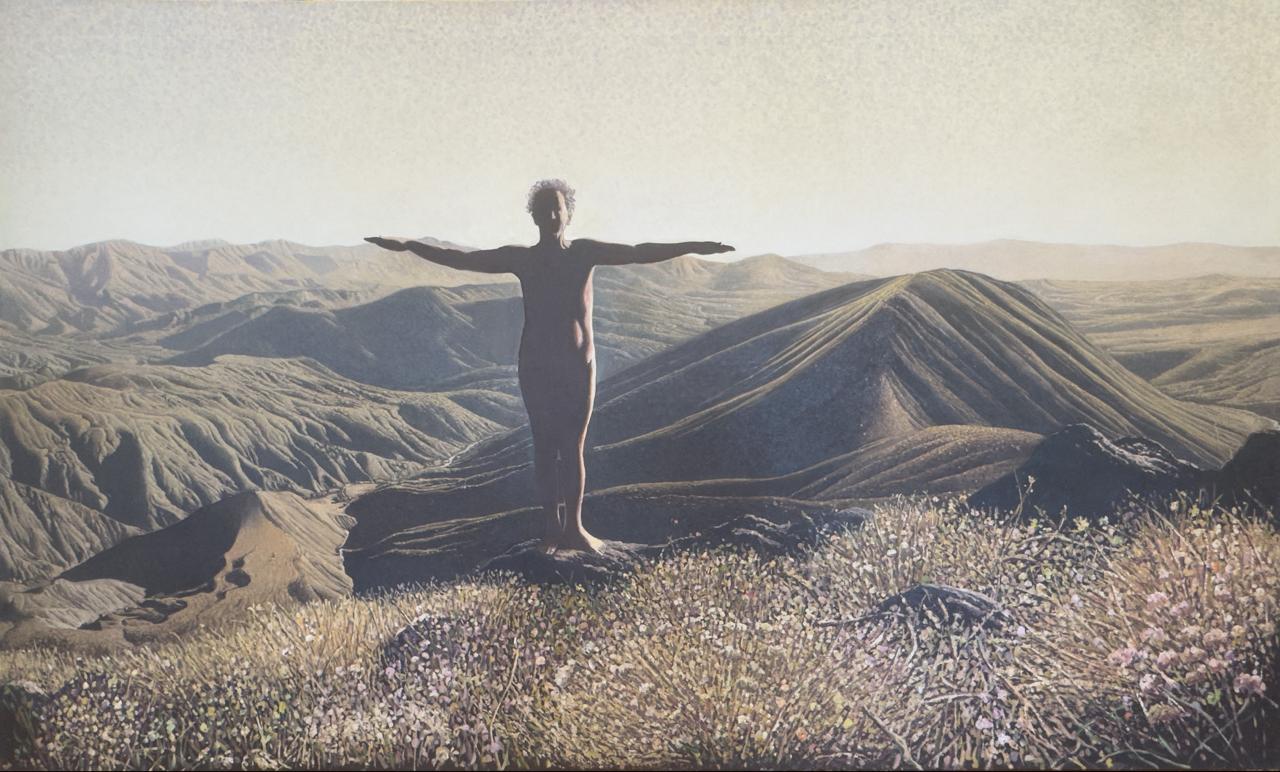
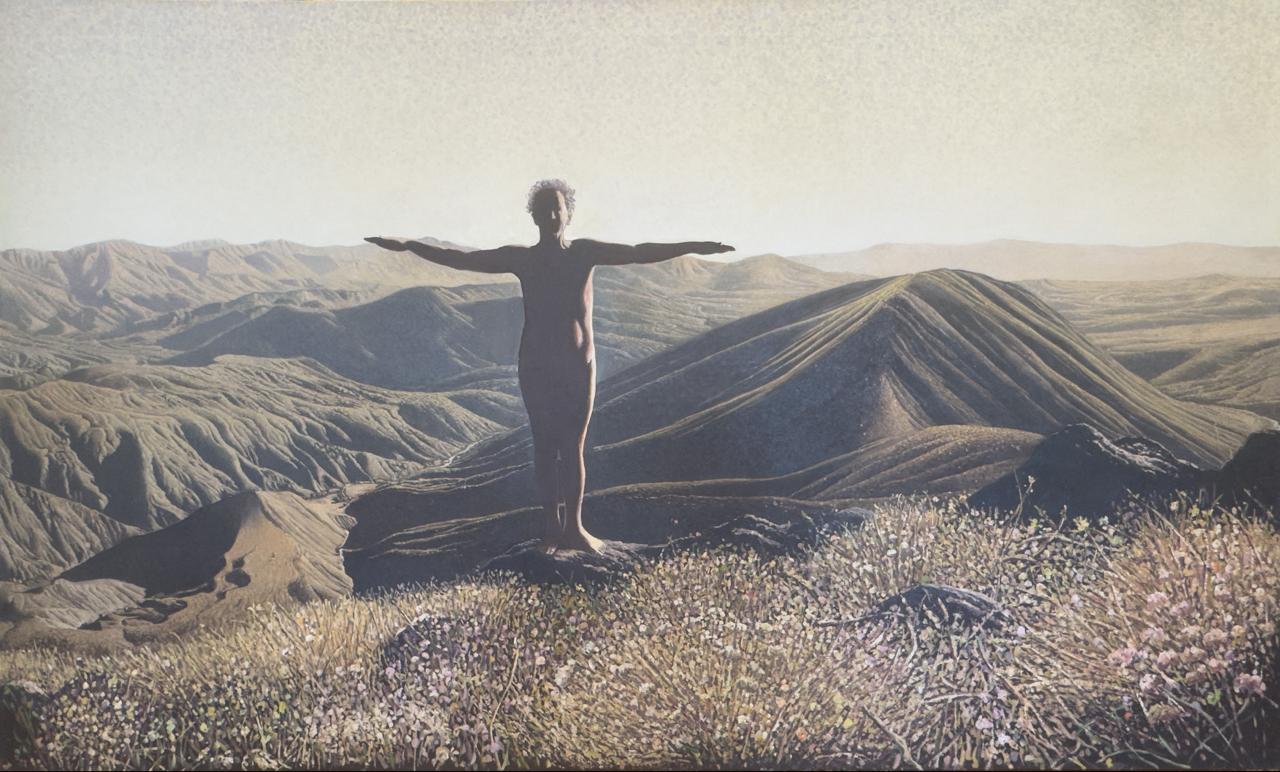 Mahmut Celayir, Self-Portrait, 2015, Oil on canvas · 150 × 250 cm
Each of the works in the exhibition comes from a different time. They were produced under different conditions, encountered different audiences, and were read in relation to different works in different exhibitions. Now, they are all under the same roof in Sur. Rather than erasing the histories of the works, this juxtaposition lays bare the temporal distance between them. Mahmut Celayir’s Otoportre (Self-Portrait, 2015, oil on canvas) and Otoportre (Self-Portrait, 2020, five-minute video) give tangible form to this distance through observations the artist made in the Kurdish countryside at different times. The changing human body against the continuity of the rural landscape reveals the temporal dimension of the artist’s relationship with his surroundings. The contrast between the relatively unchanged presence of the landscape and the transformation of the body also invites us to reconsider our relationship with the geography we inhabit.
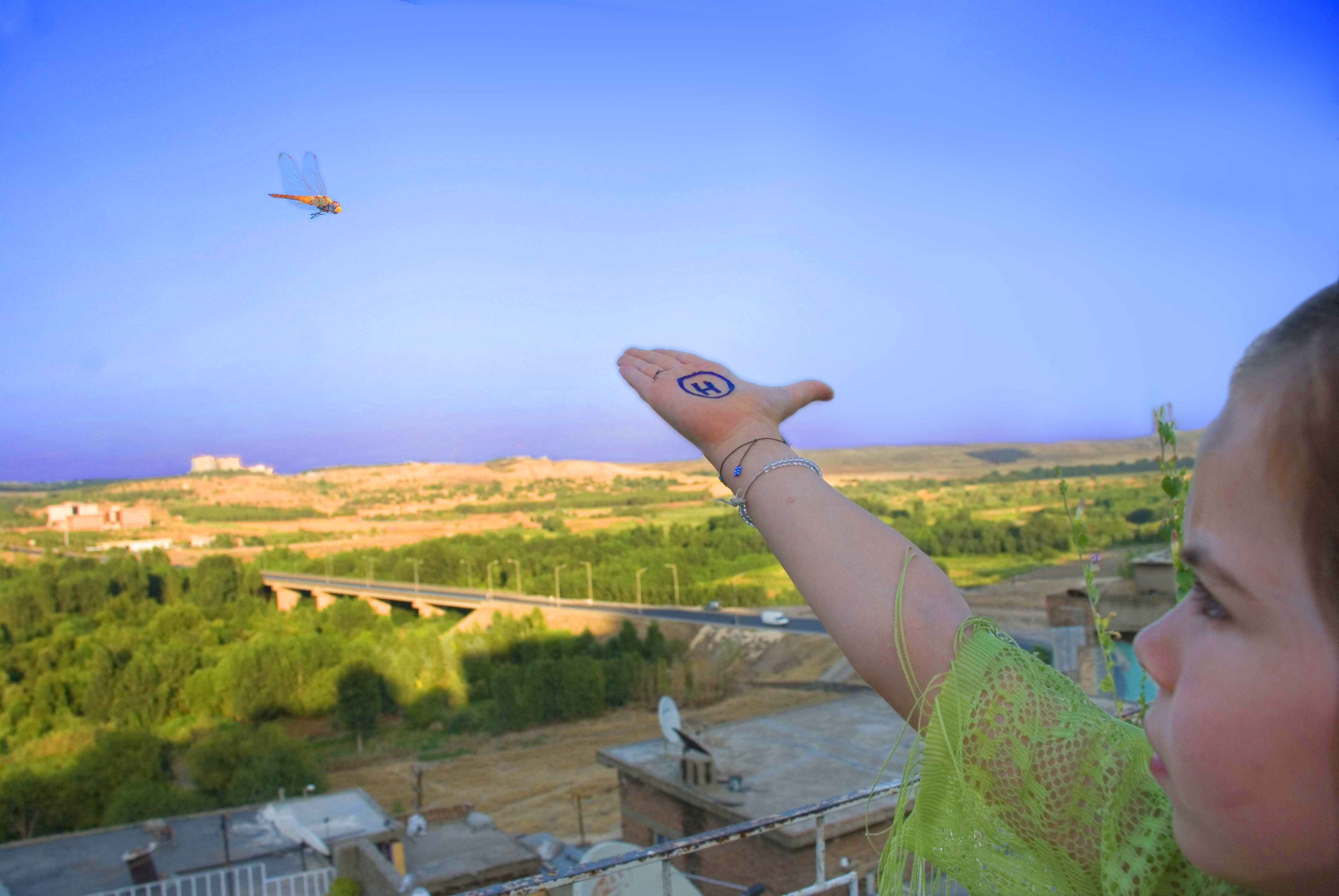 Berfîn, 2010, Photograph, 30 × 45 cm
Murat Gök’s video Low Approach (Alçak Uçuş, 2009) and his photographic work Berfîn (2010), meanwhile, bring together different forms that everyday life takes in the same geography in the face of military intervention and the fragile balance of nature. In Low Approach, a military jet intervenes in the flow of everyday life through its sound, disrupting civilian life and making the bodily and sensory impact of the military presence in the sky palpable. In Berfîn, a dragonfly, also known in Kurdish as the “helicopter insect,” appears in the same photograph as a child’s drawing of a helicopter and a view of the Hevsel Gardens. On one side is a small creature belonging to nature and carrying its own equilibrium; on the other, an aircraft that has become a symbol of military power. Between these two images, Gök establishes a tension between destructiveness and innocence, intervention and natural existence. This contrast can be read as an oxymoron that reveals the distance between the insect, as part of nature, and the military technology that looms over civilian life. While Celayir’s works foreground the relationship between the rural landscape and the human body as it unfolds over time, Gök’s works reveal everyday life in the same geography through different forms of military intervention and different relationships with nature. The works are thus not presented simply as pieces produced at different points in time, but as encounters that reveal how our relationship with the geography we inhabit acquires meaning at different moments. Rather than eliminating this temporal distance, Ya duyemîn turns it into a relationship of display in which the works open one another up to renewed readings.
Situating this approach within the contemporary art system helps bring the exhibition more clearly into focus. Biennials, art fairs, and gallery programs are largely built around a culture of the “premiere.” Works that are newly produced, shown for the first time, and have not yet entered circulation are considered more valuable. Press texts use the phrase “for the first time” as a marker of value, while institutions measure their programs against the pace of novelty. Once an artwork has been shown, however, it often becomes an inventory item, a line on a CV, or an entry in a collection file. Second, third, and fourth presentations are generally recorded in the system’s memory as “repetitions,” and within this logic, repetition is regarded merely as a record of circulation. Yet when a work is shown again years later, in another city and alongside other works, it often says more than it did in its first presentation. Ya duyemîn questions precisely this way of recording a work’s life. It argues that repetition can in fact become a second act of production, and that every new presentation adds another history to the work. This is why placing the Kurdish word “duyemîn” at the forefront is more than a detail. Here, being second ceases to occupy a subordinate position and instead becomes the point of departure.
The exhibition resonates with a longstanding tradition in aesthetic theory. Hans-Georg Gadamer does not approach the artwork as an object; drawing on Kant and Schiller, he understands it in terms of play. The work does not exist as something complete in itself; rather, it is realized anew each time it is presented. For Gadamer, presentation is not something applied to the work from outside; it is an event that belongs to the work’s own mode of being. The work comes into being only in being presented, in encountering a viewer. Each new presentation of the same work is a realization of its own being, and none is merely a diminished repetition of another (Gadamer, 2008, pp. 142–154). Gadamer’s notion of contemporaneity, which he takes from Kierkegaard, is also relevant here. The work becomes contemporaneous with the person viewing it at the moment of encounter, and historical distance does not disappear; instead, it becomes a condition of meaning (Gadamer, 2008, p. 178). Within this framework, what Ya duyemîn proposes can be read as follows: a work’s second presentation is not the shadow of its first; it is another moment in which the work is realized. The word “second,” then, does not simply indicate a sequence, but suggests that nothing that comes after the first can remain the same. When an artwork is shown for the second time, it may stand before us as the same work, but the eyes looking at it, the space in which it appears, and the works beside it have changed. The encounter itself becomes a new layer of aesthetic experience added to the history of the work. The work reconstructs the present, just as the present-day viewer reconstructs the past.
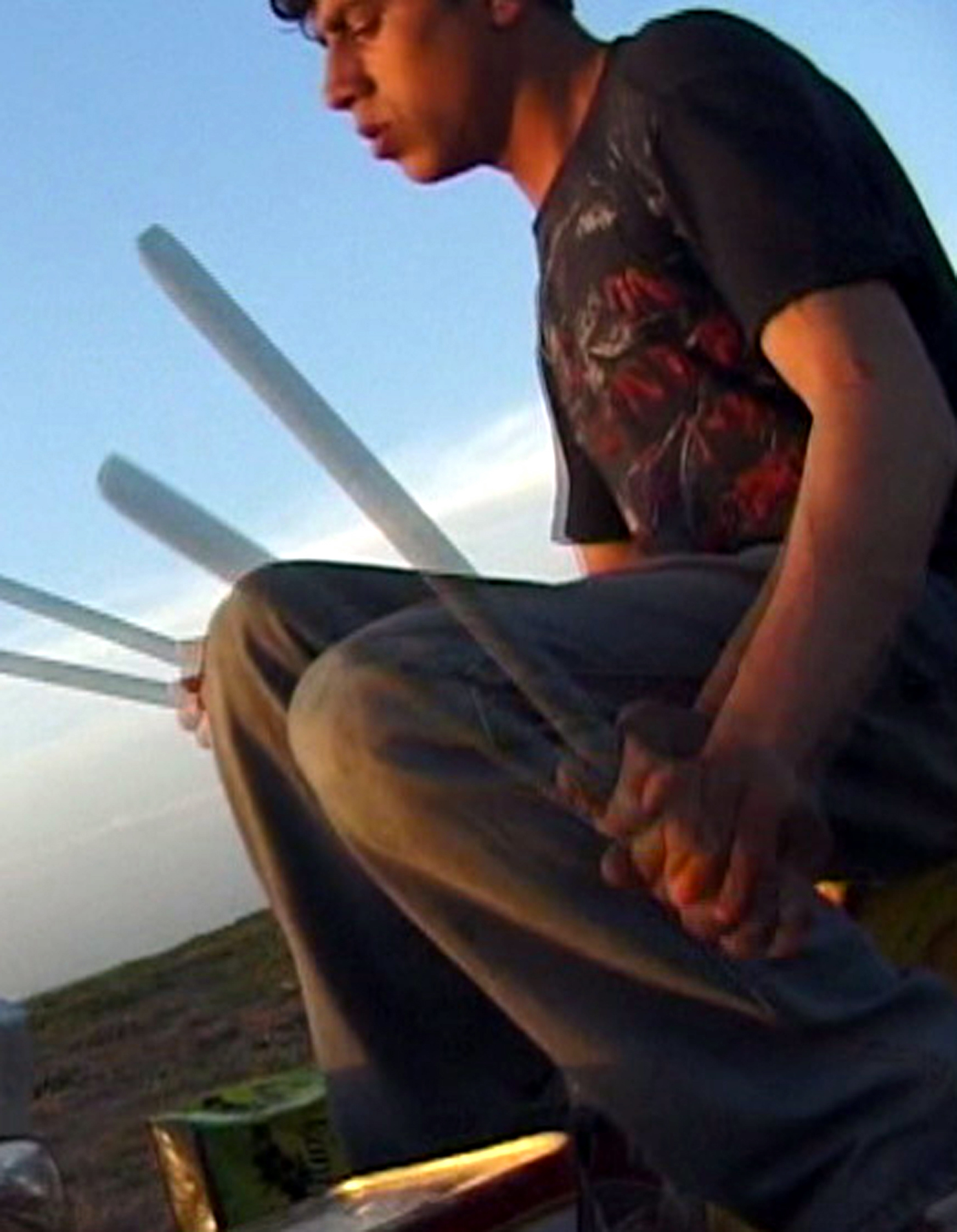 Tinica, 2004, Single-channel video · 7 min. 59 sec.
This perspective also changes the way we think about what it means to make an exhibition. Ya duyemîn does not follow the logic of a retrospective; rather than arranging the artists’ works along a chronological line, it brings together works produced at different times alongside works from the same period. In Fikret Atay’s single-channel video Tinica (2004), a young man creates a rhythm on a hill overlooking the city by striking plastic containers and tin cans with sticks. The sounds, initially raw and irregular, develop into an increasingly forceful percussion as the strikes intensify. As the rhythm grows more violent, the musical structure itself moves toward an act of destruction; in the end, the young man kicks the containers and cans, scattering them. The production of sound and the destruction of the objects merge into a single act.
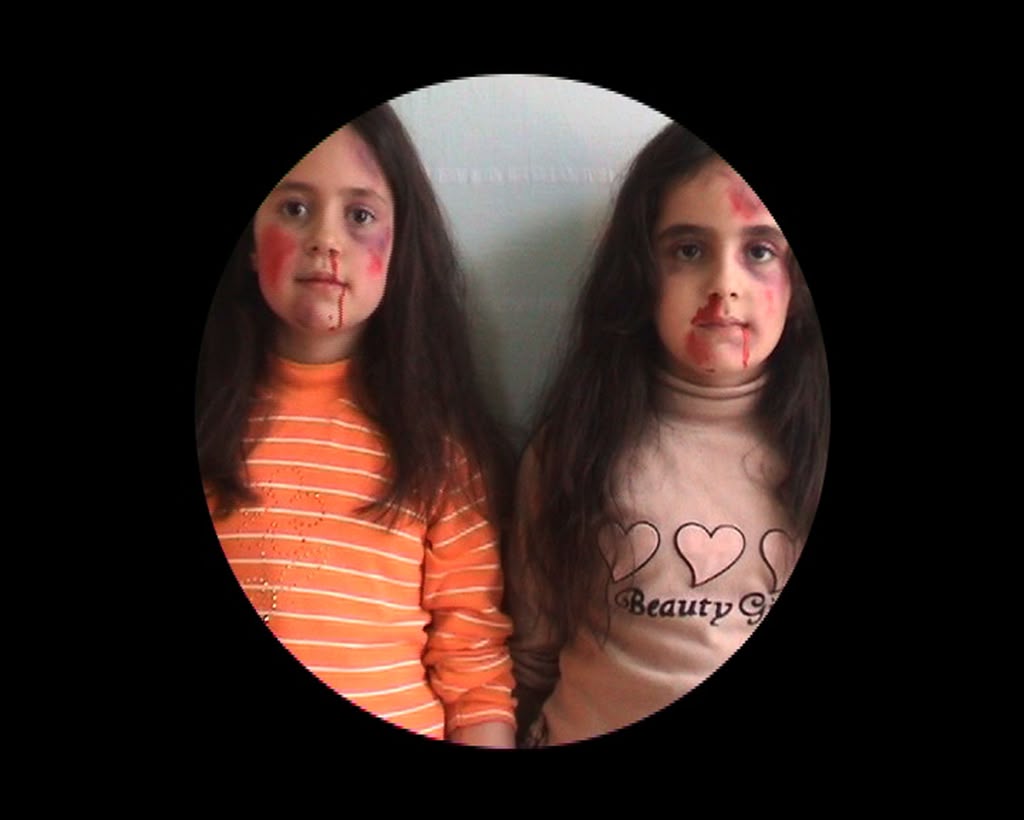 Our Village, 2004, Single-channel video, PAL DV · 7 min. 09 sec.
In Şener Özmen’s single-channel video Our Village (2004), the faces of two children singing in Kurdish appear increasingly bruised as the song is repeatedly interrupted. These interruptions in the flow of the song transform musical expression into an experience of oppression and torture. While the increasingly intense rhythm of sound in Atay’s video culminates in the destruction of objects, the interruption of the Kurdish song in Özmen’s video makes the traces of violence on the children’s bodies increasingly visible. Both works date from 2004, yet they establish the relationship between sound, body, and violence in different ways. Considered side by side in the exhibition, these two works from the same historical moment reveal sound as both a form of expression and production and a space into which oppression can intervene.
Presenting works from different times alongside works produced during the same period reactivates the past within the present. Chronology ceases here to function as the sole organizing principle; different dates, as well as different artistic relationships formed within the same historical moment, create a space of simultaneous encounter. As the works placed side by side reveal the distance between them, that very distance also changes the ways in which they are read. Jacques Rancière’s concept of the “distribution of the sensible” is illuminating here. Art and politics operate within a distribution that determines what can be seen, said, and done, while the politics of art emerges in the possibility of rearranging that distribution. In deciding within which juxtapositions and temporal relationships works are to be shown, an exhibition reconfigures this regime of visibility. By bringing together works from different periods as well as works produced in the same year, Ya duyemîn establishes relationships that extend beyond chronological order. To show a work again is to rearrange the conditions under which it can be seen. In this sense, curatorial practice is not limited to presenting the work or placing it within a predetermined narrative; by enabling it to encounter other works, it adds a new chapter to the work’s public existence.
To detach the exhibition from its local context, however, would result in an incomplete reading. Located in Sur, subSPACE creates a space for contemporary art within avesta | CULTURE. The same building houses a bookstore, the Celadet Alî Bedirxan Library, and arts and culture programs. In its own words, subSPACE looks at artistic production “from one step below,” and when considered together with the library in the building’s basement, it also provides the setting for an exhibition that unfolds among accumulated layers. This structure calls to mind Gaston Bachelard’s conception of the house in The Poetics of Space as a vertical being extending from attic to cellar, and his reading of this verticality through C. G. Jung’s double image. For Bachelard, the cellar is the dark being of the house and is associated with subterranean forces; when we dream of the cellar, we come to terms with the irrationality of the depths (Bachelard, 1996, pp. 51–53). The presence of books, language, and the archive on the lower levels of a building also lends depth to the works exhibited above. Here, artworks encounter one another again within a structure in which books, language, memory, and cultural production are intertwined. This interweaving means that the works do not stand within the silent neutrality of a white cube, but alongside things that are read, translated, archived, and spoken. The visibility of Kurdish on the wall of an art institution, alongside books and the library, is also particularly significant. In this geography, language is both a carrier of memory and a witness to an interrupted continuity. Within such an interrupted continuity, the phrase “second life” ceases to be an abstract metaphor and acquires historical weight.
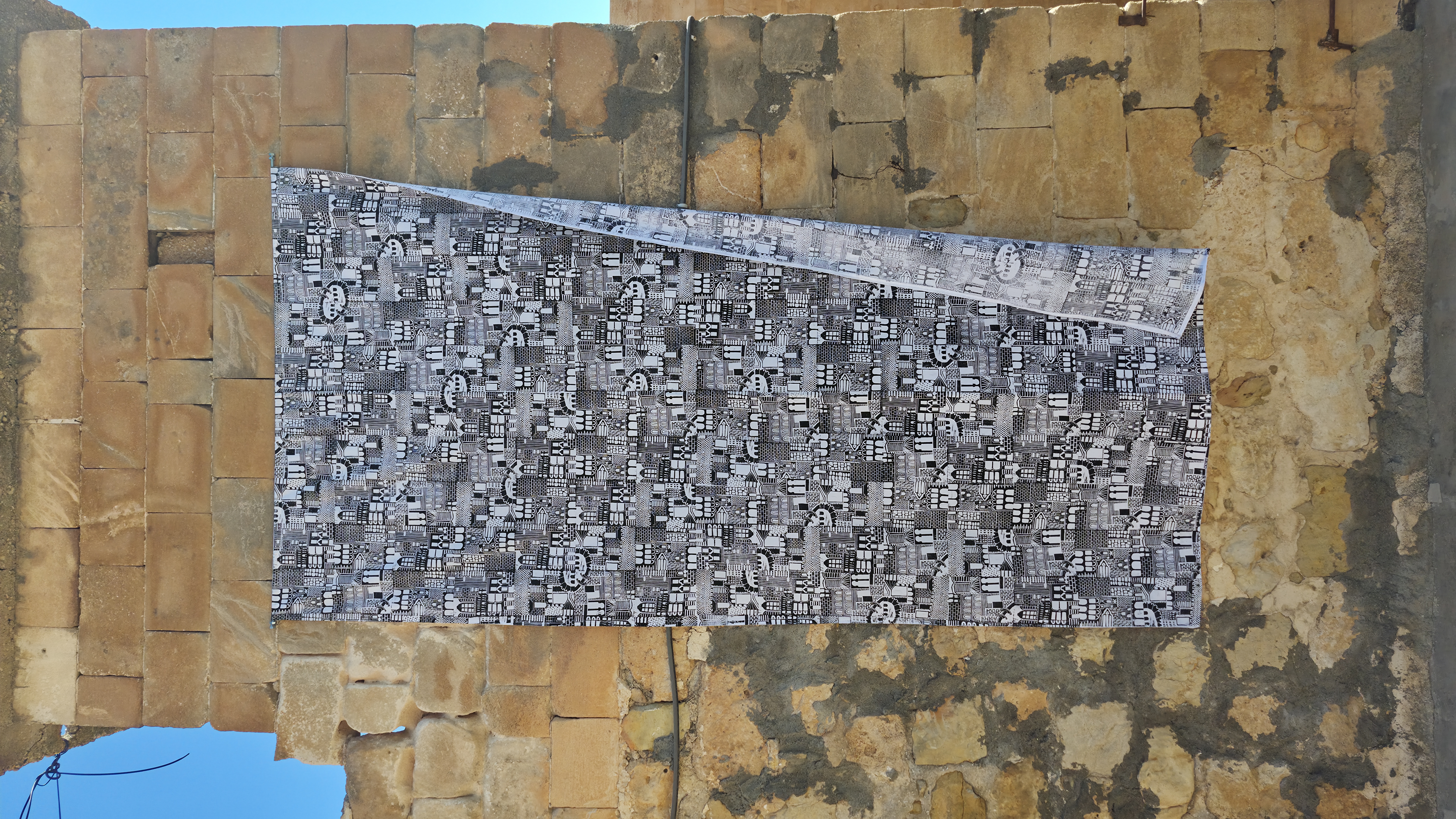 Urbs, 2026, Linocut on fabric · 150 × 300 cm
The exhibition’s relationship with geography takes different forms in the works of Sidar Alışık and Zeynep Uruç. Sidar Alışık’s Urbs(2026), a linocut on fabric, constructs an image of the city by transforming architectural elements such as thresholds, roofs, doors, walls, windows, and courtyards into symbolic forms. Evoking Diyarbakır’s historical architecture, these elements, stripped of their structural functions and brought together, emerge as signs that constitute the city’s visual memory. Here, the city appears not merely as a physical settlement, but as a visual whole constructed through the selection, transformation, and rearrangement of architectural forms.
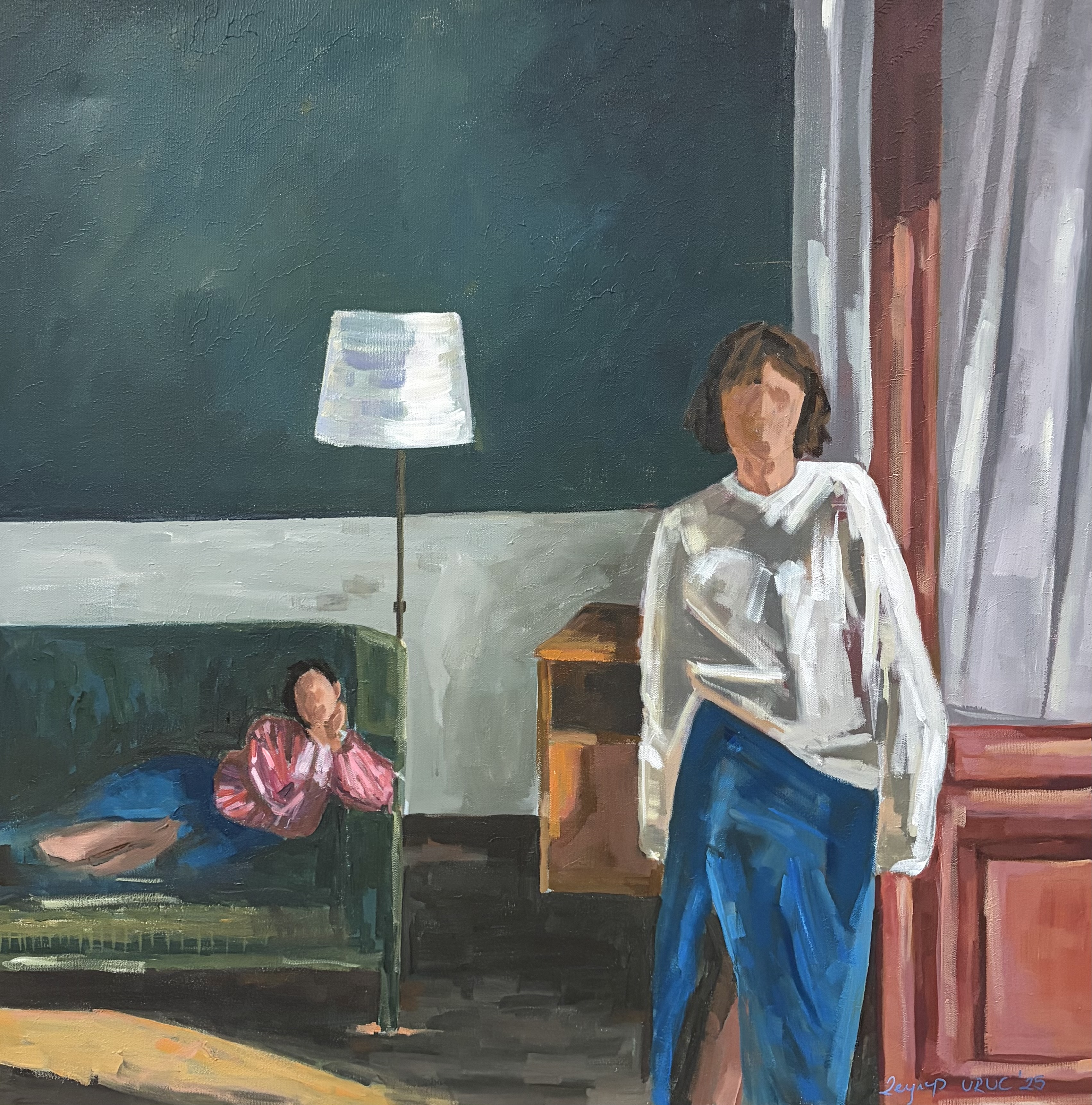
Between Darkness and Doorway, 2025, Acrylic on canvas · 76 × 76 cm
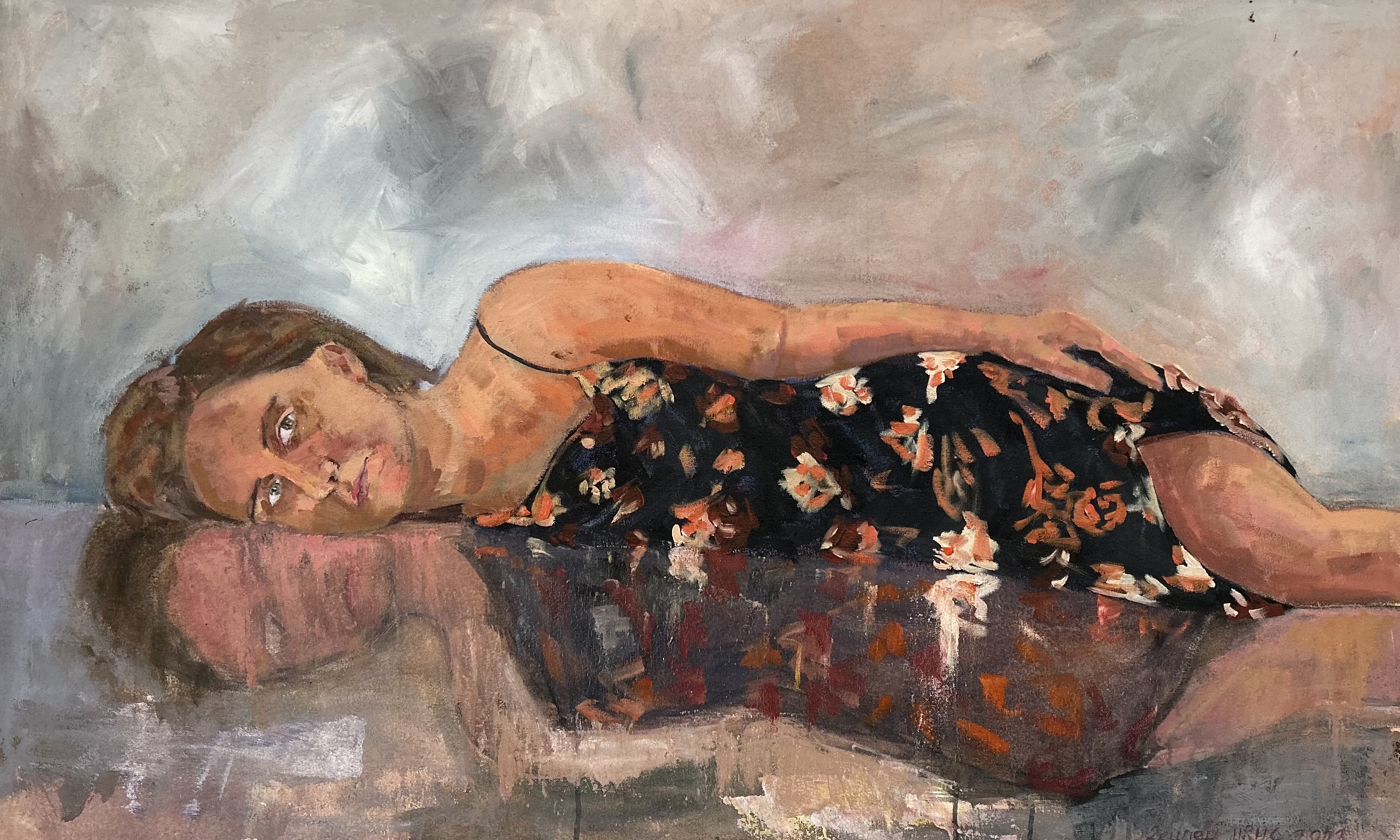 Reflection in Stillness, 2024, Acrylic on canvas · 75 × 122 cm
Zeynep Uruç’s acrylic paintings on canvas, Between Darkness and Doorway (Karanlık ile Eşik Arasında, 2025), Reflection in Stillness(Dinginlikte Yansıma, 2024), Reflection VII (Yansıma VII, 2025), and Reflection VI (Yansıma VI, 2025), shift the gaze from the city to the interior of the home and to the individual’s everyday experience. In these paintings, female figures are shown reclining on a sofa or on the floor, looking into a mirror, or bringing their faces directly into the image through a selfie. Everyday life in these scenes is not organized around an explicit conflict or dramatic event. The figures’ postures, faces, and presence within the domestic space foreground the individual’s relationship with their own world. To read Uruç’s paintings solely as representations of a social condition risks overlooking the specificity of this personal and everyday experience. While the architectural elements in Alışık’s work construct the visual language of a city, the figures in Uruç’s domestic interiors reveal different states of individual experience. The exhibition thus brings together two visual worlds operating at different scales: the city and the home, the symbols of a shared space and the individual’s everyday existence.
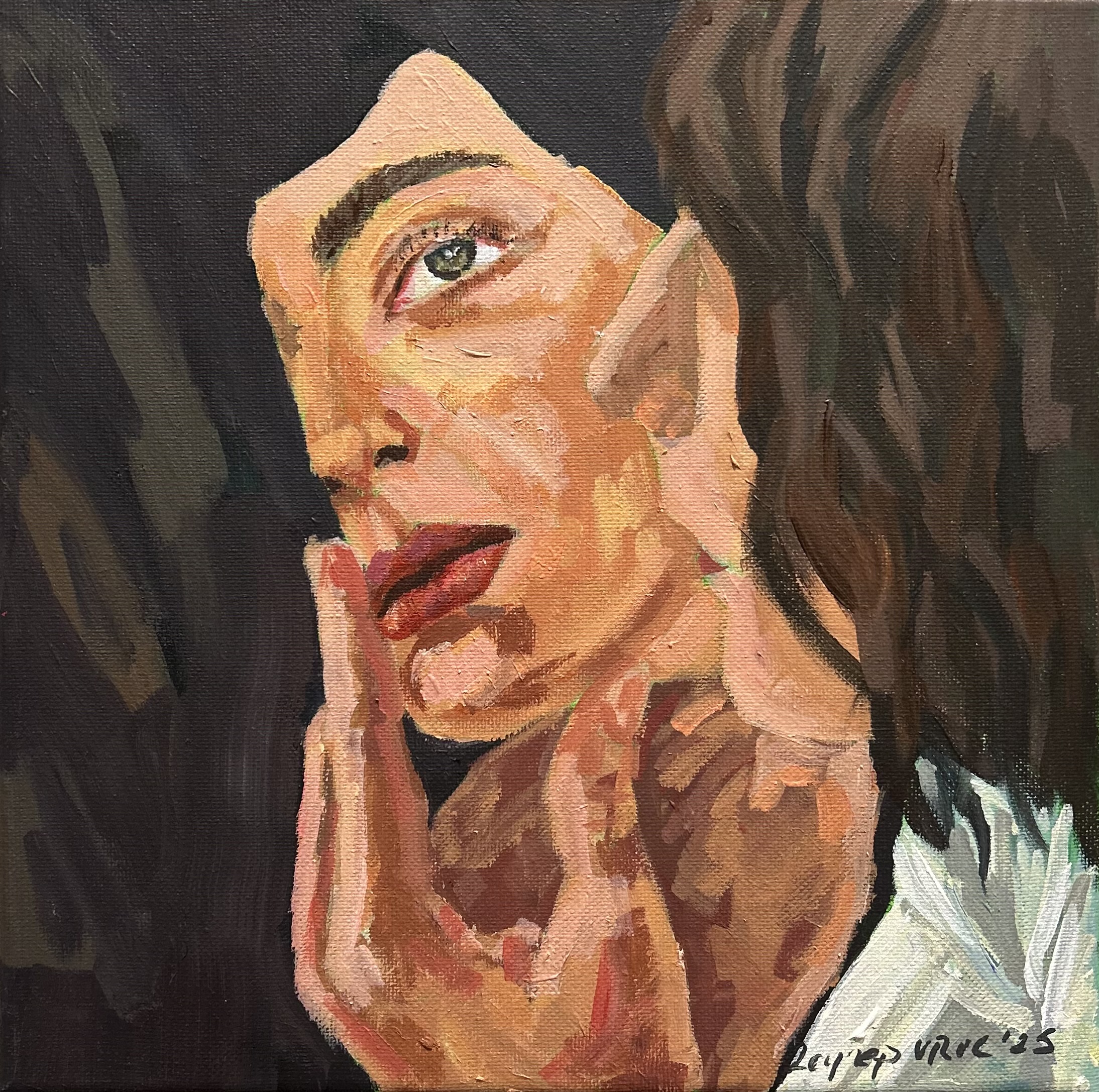 Reflection VI, 2025, Acrylic on canvas · 25 × 25 cm
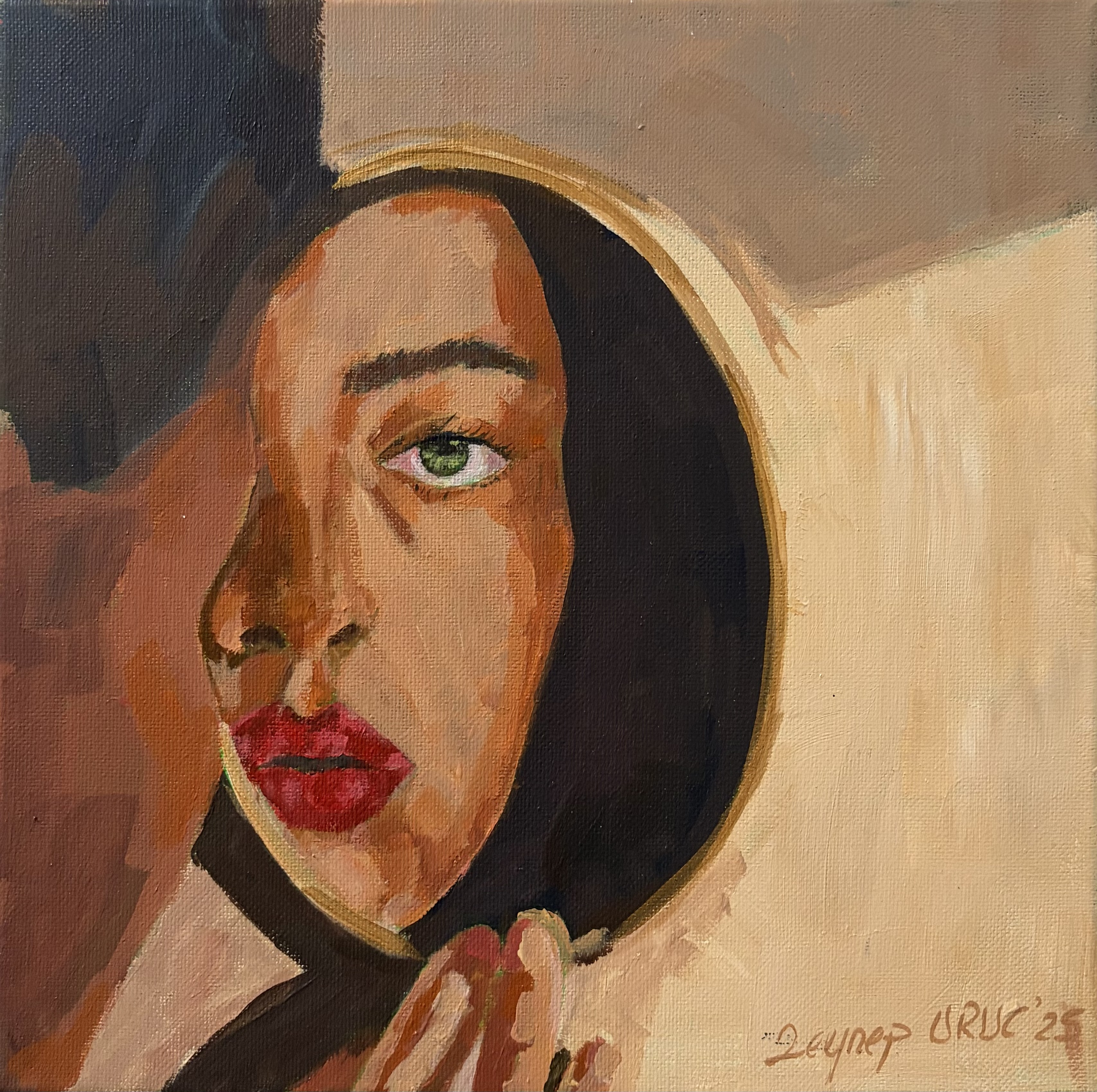 Reflection VII, 2025, Acrylic on canvas · 25 × 25 cm
This encounter makes it possible to consider the question of geography in the exhibition without reducing it to a single narrative of identity, belonging, or memory. Works produced at different times encounter new audiences and enter into new relationships in present-day Diyarbakır. The distance between the conditions in which a work was produced and those in which it is exhibited today can change the way the work is read. The difference between Sidar Alışık’s construction of a city image through architectural symbols and Zeynep Uruç’s focus on individual experiences within the home shows how the exhibition places different visual approaches side by side without binding them to a single narrative. Considering these works alongside Mahmut Celayir and Murat Gök’s visual approaches to the rural landscape, the human body, and everyday life further expands the ways in which the exhibition relates to space. What matters here is not that all the works address the same issue, but that the different experiences each creates through its own visual language and conditions of production encounter one another within the same exhibition space. What changes when one work is placed alongside another? What questions does an image from the past encounter today? Ya duyemîn opens up these questions, as well as the relationships between the works, within the field of visibility without dissolving them into a common narrative.
The art of a region is often read through the label of the “local” or “regional,” as material used to illustrate frameworks established at the center. Ya duyemîn reverses this habit. It does not introduce the question of an artwork’s second life as a theory imported from elsewhere; it poses the question under a Kurdish title, in Diyarbakır, within a building that houses books and a library. Here, concepts such as translation, repetition, and exile do not appear as borrowed terms taken from books, but intersect with the everyday reality of the space and its language.
The question addressed by the exhibition lies at the heart of its curatorial framework: Does the life of an artwork end at the moment the artist completes it? Or does every new presentation, every new viewer, and every new space add another time to the work? The exhibition offers no definitive answer. Instead, it searches for an answer by bringing the works together again and working with the distance between them. Works from different periods enter a shared time in Diyarbakır. The distance that opens up between the initial moment of production and the work’s presentation today becomes the exhibition’s central story. The story of an artwork does not end when it leaves the artist’s hands. Ya duyemîn does not merely say this; it also attempts to show it.
Notes:
Gadamer, Hans-Georg, Hakikat ve Yöntem I [Truth and Method I], trans. Hüsamettin Arslan and İsmail Yavuzcan, Istanbul: Paradigma Yayıncılık, 2008.
Bachelard, Gaston, Mekânın Poetikası [The Poetics of Space], trans. Aykut Derman, Istanbul: Kesit Yayıncılık, 1996.


Comments
00