Capitain Petzel Gallery in Berlin is hosting Kurdish artist Leyla Yenirce’s second solo exhibition, titled Core, from October 30 to December 19, 2026. Bringing together the artist’s large-scale paintings, new works, and a sound installation, the exhibition focuses on the relationship between the formation of the individual voice and collective expression. In her interdisciplinary practice spanning painting, video, sound, installation, and performance, Yenirce creates diverse spaces of narrative and encounter by reworking visual and auditory materials drawn from histories of women’s resistance, political violence, popular culture, and personal memory. In her previous works, the artist transformed archival images, found photographs, and media recordings through sampling, layering, and collage; in Core, she continues this investigation through painting and sound. The phonetic resemblance between the English word Core, meaning essence or nucleus, and the German word Chor, meaning choir, forms the conceptual starting point of the exhibition. While bringing women’s individual stories together within a shared sonic space, Yenirce also places the tradition of gold passed down through generations in Kurdish culture at the center of her paintings. Information regarding the exhibition’s curator is not provided in the gallery’s press release.
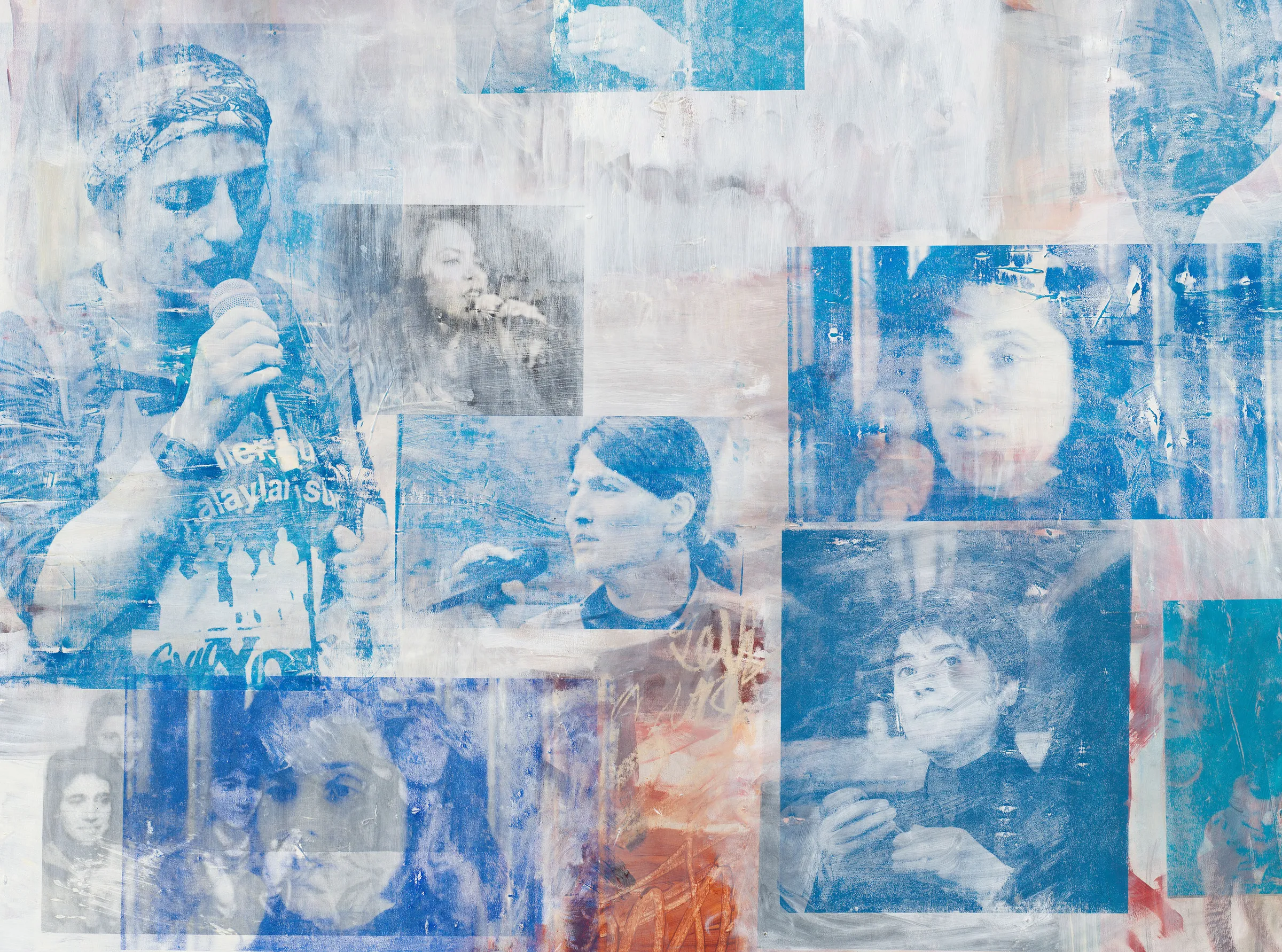
Blau, 2025, Oil and silkscreen ink on canvas, 200 x 235 cm, 78.7 x 92.5 inches
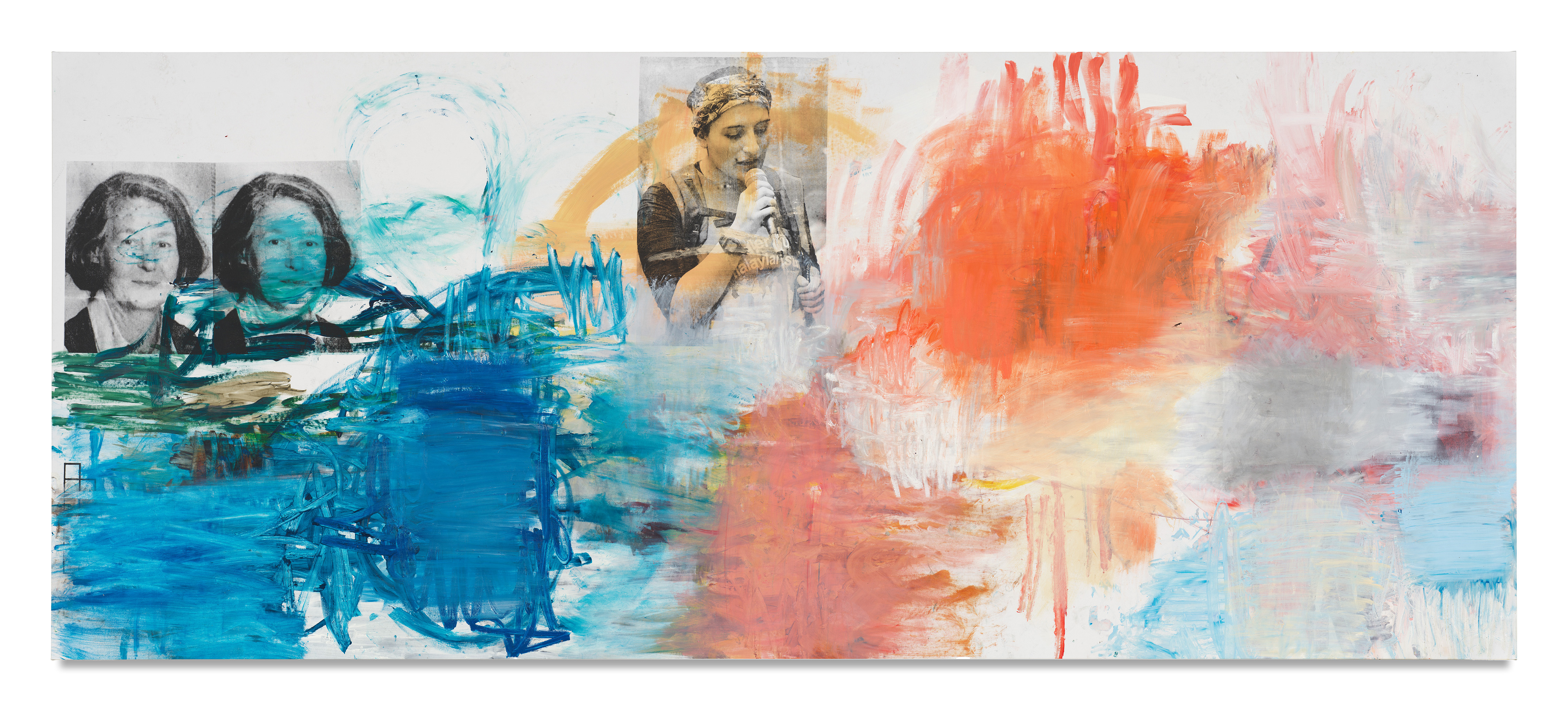
At the center of Yenirce’s paintings featured in the exhibition is the body of work titled Chor der Frauen (Women’s Choir), first shown in the Werdegang exhibition at the Landesmuseum Oldenburg in 2026. This body of work brings together different generations of Kurdish women who, over the past few decades, have struggled to assert their presence and their right to speak in the streets, in political struggle, in cultural production, and in everyday life. The feudal and patriarchal relations that have shaped women’s lives in Kurdish society have undergone significant transformation through the influence of revolutionary ideas, women’s organized struggles, their songs, and their interventions in social life. Moving beyond the social roles assigned to them, women began to participate in public life with their own names, voices, and decisions; through struggles extending from political organizing to art, from music to literature, and from education to various spheres of everyday life, they constructed their own subjectivities. Drawing on the phrase “Gold in the throat – the expression of the soul” from painter Charlotte Salomon’s Leben? oder Theater? (Life? or Theater?), Yenirce brings together portraits of women, transferred using the silkscreen technique, across large-scale canvases. Members of this fictional choir include the artist’s German teacher Christiane Haselier, who holds an important place in her life; Kurdish musician Helîn Bölek, who died during a hunger strike she began after being banned from performing; and Leyla Zana, who was imprisoned for ten years because of her political struggle for Kurdish rights. The portraits of these women, who come from different generations and experiences of struggle, are repeated and multiplied across the canvas. The gestural marks of oil paint sometimes obscure the silkscreened faces and at other times interrupt their visibility. In this way, the portraits bring individual life stories together within a shared visual field while also making women’s determination to claim a place in history through their own names, voices, and struggles the subject of the painting itself.
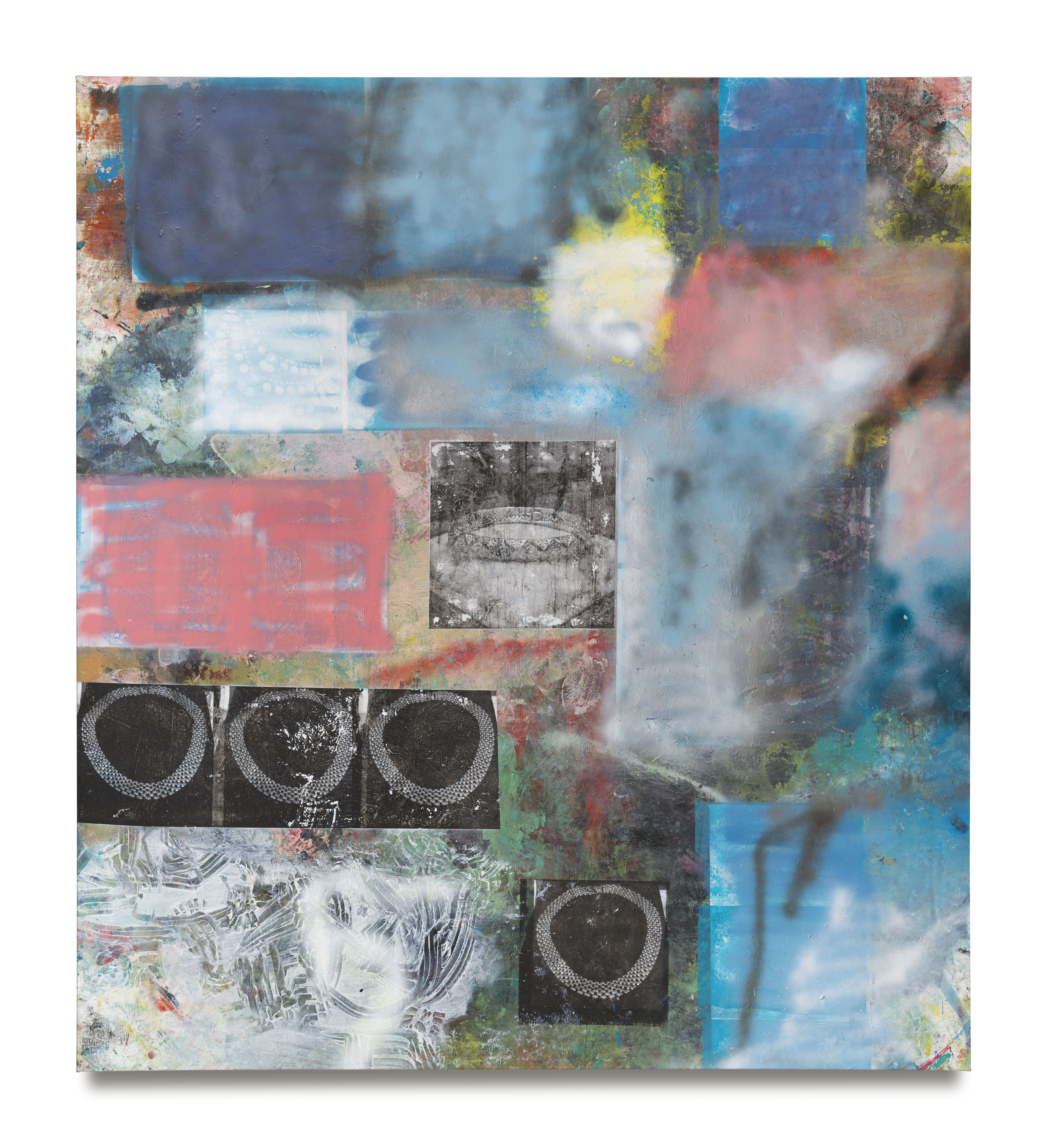
Tumult, 2026, Oil, acrylic spray and silkscreen ink on canvas, 200 x 180 cm, 78.7 x 70.9 inches
The visual repertoire of the streets in Kurdish cities has undergone a significant transformation alongside shifts in the political climate. For many years, walls, posters, and unauthorized prints bore the traces of political repression, banned demonstrations, and forms of struggle in public space; with the peace process, however, they gradually became sites for the circulation of different kinds of imagery. Images that made political demands, resistance, and collective struggle visible began to give way to gold jewelry advertisements covering the façades of stores and shops, window displays, and imagery associated with consumer culture. This shift was also reflected in the representation of women in public space: the female figure, once visible as a subject of political struggle, increasingly became situated within a different visual framework shaped by images of jewelry, beauty, and consumption. The large necklaces, bracelets, gold coins, and chains that Yenirce places at the center of her painting Tumult draw on the visual repertoire of this transformation as it extends into everyday life. From weddings and family gatherings to dowries and gift-giving practices among women, these images also carry the social circulation and cultural meanings of gold. Yet the artist’s interest is not limited to their bright and flawless appearance. The fading colors, cracked surfaces, and worn prints of jewelry advertisements exposed to sun, rain, and dust over time create a striking contrast with the material permanence of the gold they represent. By transferring these images gathered from the street onto the painted surface, Yenirce also brings the city’s changing visual memory into the work; gold jewelry imagery thus becomes both a marker of an aesthetic of consumption and visual material bearing traces of the social and political transformations experienced by Kurdish cities.
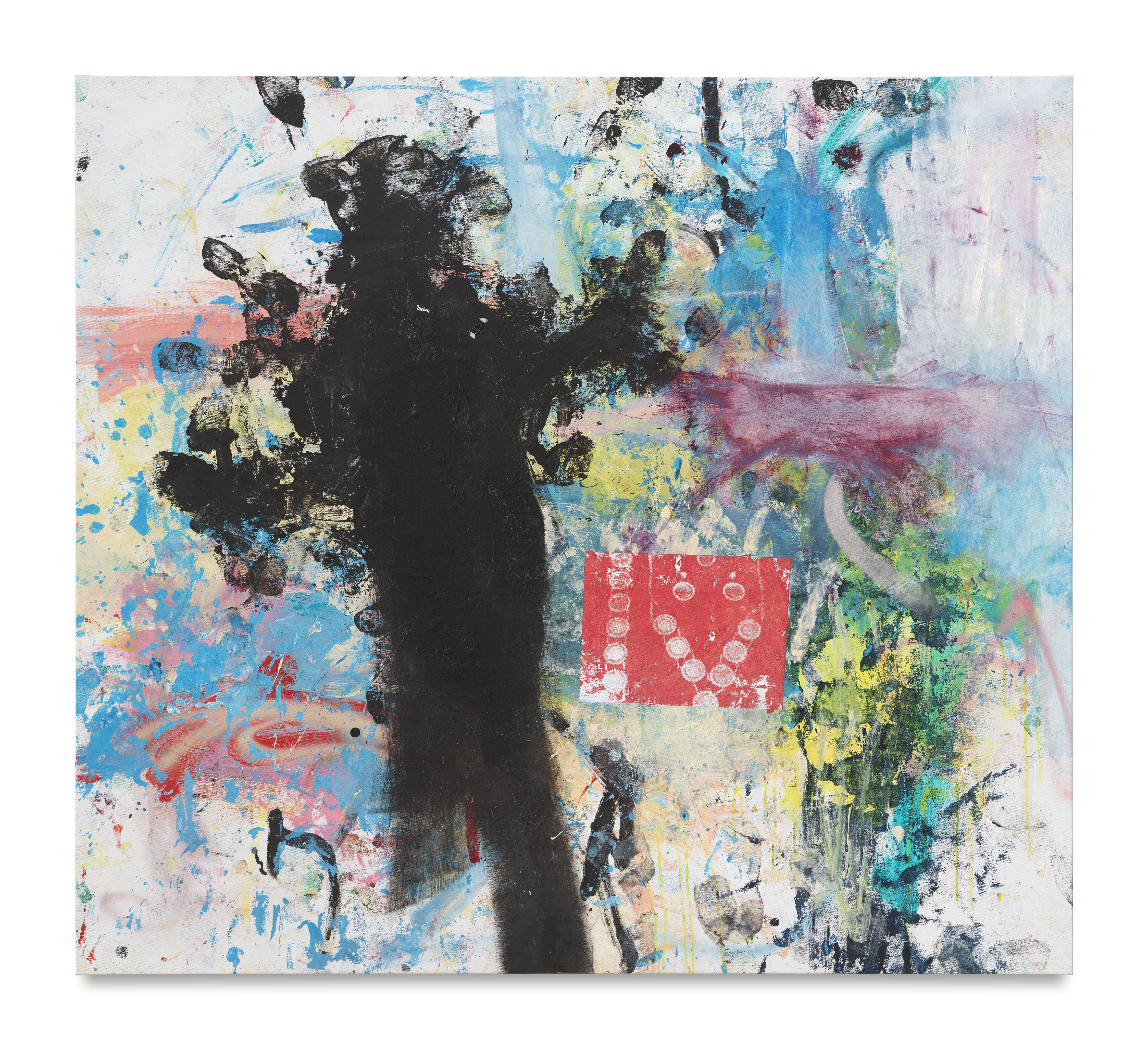
Rausch, 2026, Oil, acrylic spray and silkscreen ink on canvas, 180 x 200 cm, 70.9 x 78.7 inches
The point at which this visual world intersects with the artist’s personal history concerns the social and cultural role of gold in Kurdish culture. An important part of wedding and dowry traditions, gold is an inheritance passed down among women and across generations, acquiring both economic and symbolic value within family relationships. The fact that this transmission did not take place in the same way in Yenirce’s own life adds another dimension to the artist’s relationship with images of gold. Encountering, in the streets, in advertisements, and in everyday life, images of a tradition she did not directly experience within her own family history makes visible the distance between personal history and cultural environment. For this reason, Tumult does not approach gold merely as an ornament, a form of wealth, or an object of consumption. It brings together on the same painted surface multiple layers extending from the changing street culture of Kurdish cities and the social representation of women to intergenerational transmission and the artist’s own biography. The tumult and disorder suggested by the title emerge through the nature of these encounters. Advertising images circulating in the streets, the tradition of gold embedded in cultural memory, and the artist’s personal experience come together within the painting, each carrying its own distinct historical and social context.
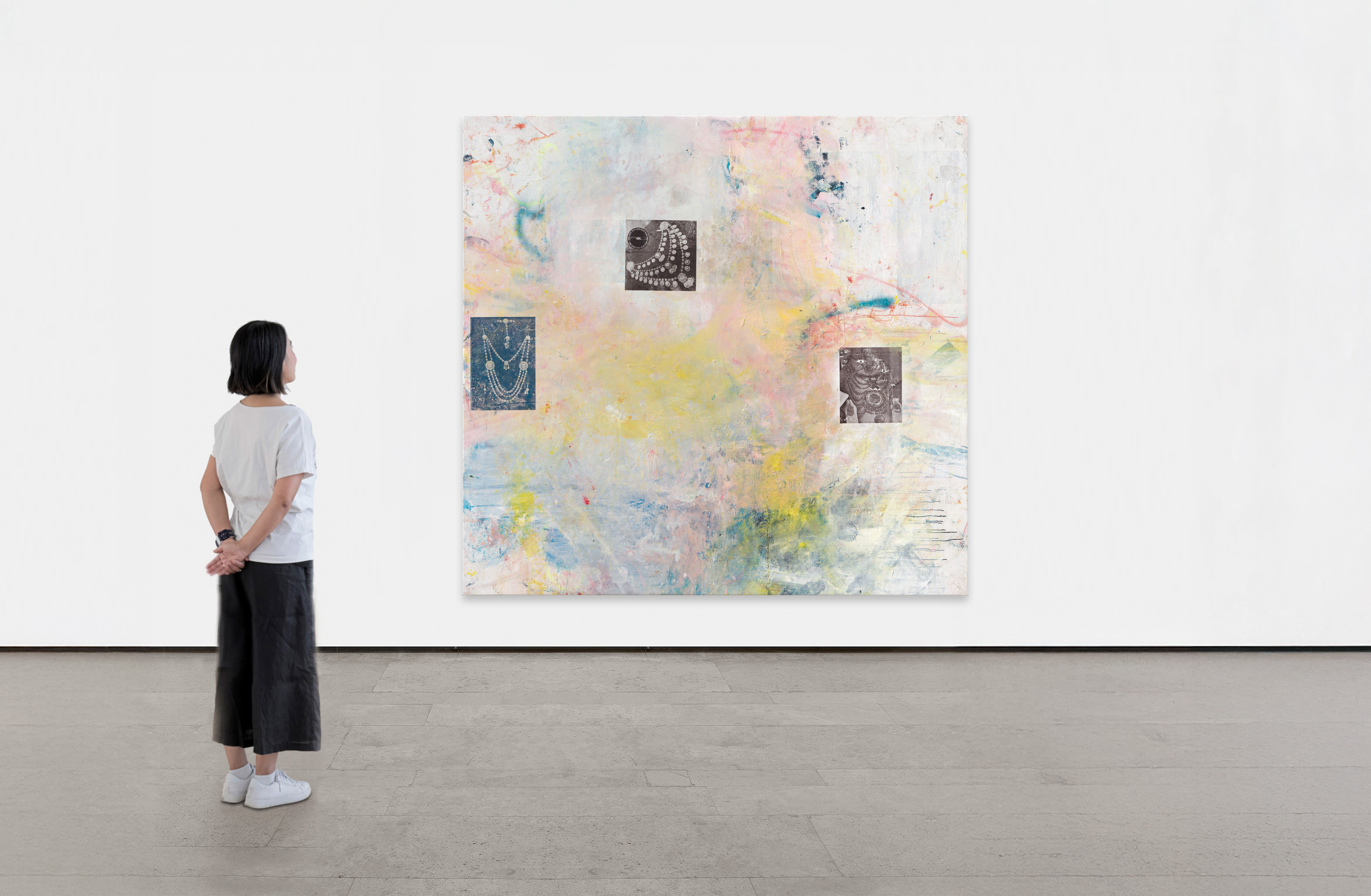
Schwefel, 2026, Oil, acrylic spray and silkscreen ink on canvas, 190 x 200 cm, 74.8 x 78.7 inches
In Tumult, executed on canvas in oil paint, acrylic spray, and silkscreen ink, images derived from photographs of jewelry through silkscreen printing become pictorial counterparts to this visual environment. While the reproductive nature of the printing technique evokes the logic of mass production associated with billboards and street posters, Yenirce’s interventions with paint and color continually disrupt this order. The images can no longer be read with the clarity and directness demanded by advertising. Some pieces of jewelry are buried beneath layers of paint, while others retain their contours and hold their place on the surface; colors blend into one another, and as some areas are obscured, other images re-emerge. Rather than simply layering one image over another, this pictorial construction brings together on the same surface visual traces encountered at different moments in time. The distinct textures of silkscreen, spray paint, and oil paint further accentuate this encounter. The bright, flat, and persuasive surface of advertising gives way in the painting to a fragmented, layered, and continually shifting visual field. Rather than reproducing the images she encounters on the street as they are, Yenirce thus reconstructs their circulation, deterioration, and transformation through the language of painting itself.
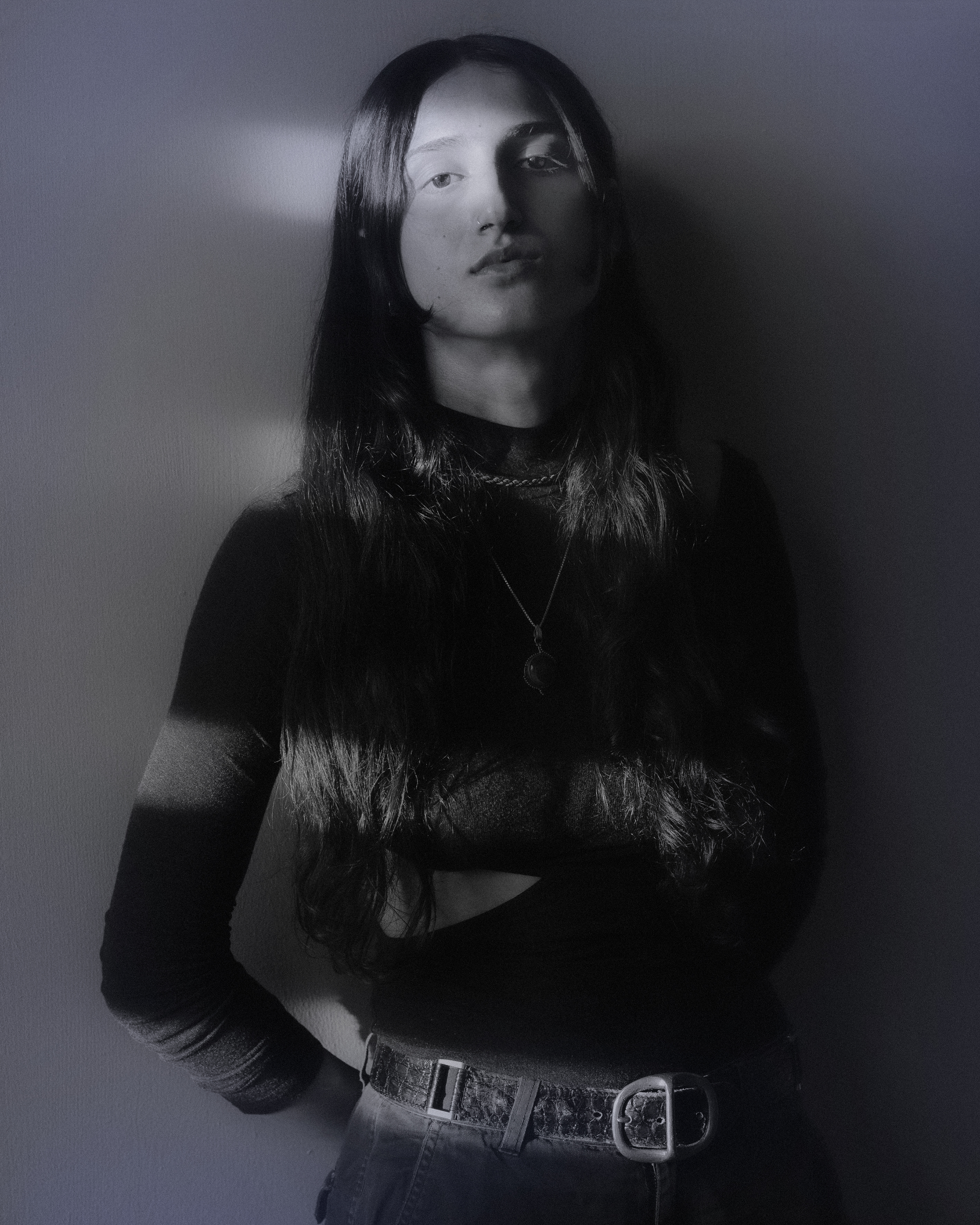
Leyla Yenirce
The relationship between sound and image that runs through Yenirce’s broader practice also finds expression in the dense and dynamic surface of Tumult. In an interview with Louise Benson, the artist says that she paints in silence because her paintings are already quite loud and colorful. This statement is significant for understanding the visual intensity Yenirce creates through color, print, gesture, and layers. In her practice, which moves between music and the visual arts, sound also carries over into the rhythm, repetitions, and movement across the painted surface. Tumult stands out as a work in which this multilayered approach to artistic production intersects with cultural heritage and personal memory. The installation of the same name, which constitutes the sonic dimension of the Core exhibition, is presented on the gallery’s lower floor. Yenirce uses two analog Korg synthesizers to create the five-minute composition. The sound she produces through a distortion pedal connected to the synthesizer becomes a means of expression through which the artist finds her own voice. The composition unfolds through moments of silence interspersed between dense and abrasive passages of sound. Yenirce describes the moment when she first created sound by connecting a distortion pedal to a synthesizer as the experience of having found a means through which she could express herself. This approach establishes a direct relationship between sound production and the act of painting: the movement of the brush across the canvas and the sound produced through the synthesizer keyboard emerge as two distinct forms of artistic self-expression.


Comments
00