Opening its doors on June 21, Manifesta 16 Ruhr, one of Europe’s leading nomadic contemporary art biennials, will remain open to visitors until October 4, 2026. The artistic framework of Manifesta 16 Ruhr was developed by an international curatorial team of eight members from diverse disciplinary backgrounds. Comprising Polish art historian and curator Anda Rottenberg, Polish curator Krzysztof Kościuczuk, Barcelona-based architect and urban planner Josep Bohigas, German curator and gallerist René Block, British art critic and curator Henry Meyric Hughes, independent art historian and curator Gürsoy Doğtaş, German architect and researcher Leonie Herweg, and German independent curator Michael Kurtz, the team shaped both the conceptual direction and artistic programme of Manifesta 16 Ruhr. Bringing together 106 participants across four German cities, this edition of Manifesta is hosted in 12 churches whose functions have significantly diminished as a result of industrialisation and post-war social transformations. By reimagining these sites as spaces for art, the biennial creates a shared platform for reflecting on the future of these churches, whose architectural, cultural, and historical significance remains considerable.
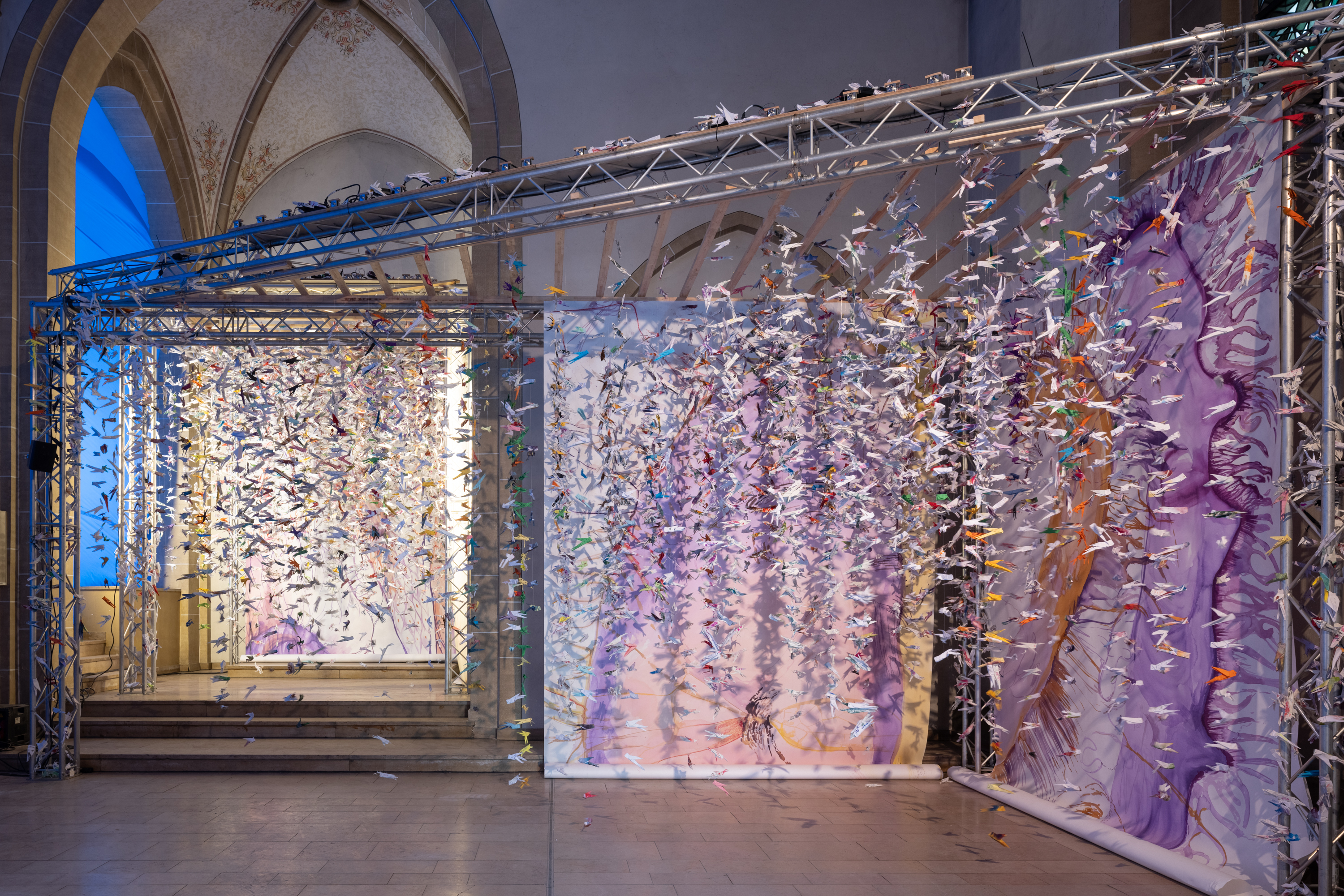
Contemporary Kurdish artist Havîn Al-Sindy is among the participants of this year’s Manifesta 16 Ruhr. Presenting her work How to carry a locust, Al-Sindy stands out as one of the biennial’s notable artists through her multidisciplinary and participating practice. Her works are exhibited at Saint Josef Church in Gelsenkirchen. In addition, together with Constructlab, Miedya Mahmod, and Julia Nitschke, Al-Sindy takes part in the educational programme Schule, Nachbarschaft und Wir (School, Neighborhood and Us), presented within this section of Manifesta. Through this programme, Al-Sindy and the participating artists view schools as expanded communities capable of becoming shared living spaces through meaningful connections with their surrounding neighbourhoods. Bringing together four artists and artistic collectives, the programme investigates how schools reflect and shape social cohesion, while emphasising diversity as a force that strengthens communal bonds through the site-specific collaborations each artist develops with a school.
How to carry a locust, 2026 © Havîn Al-Sîndy. Photo © Manifesta 16 Ruhr / Ivan Erofeev
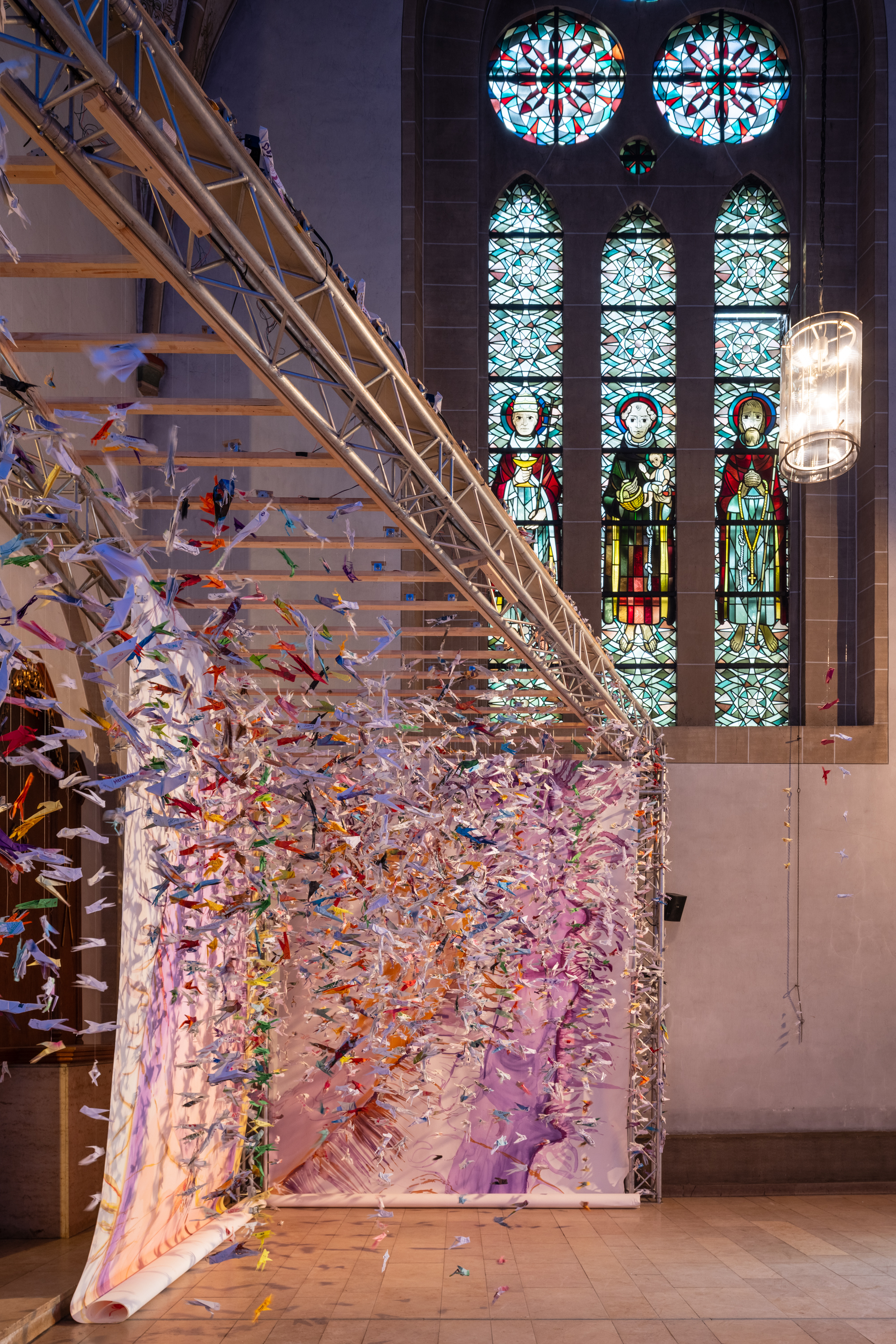
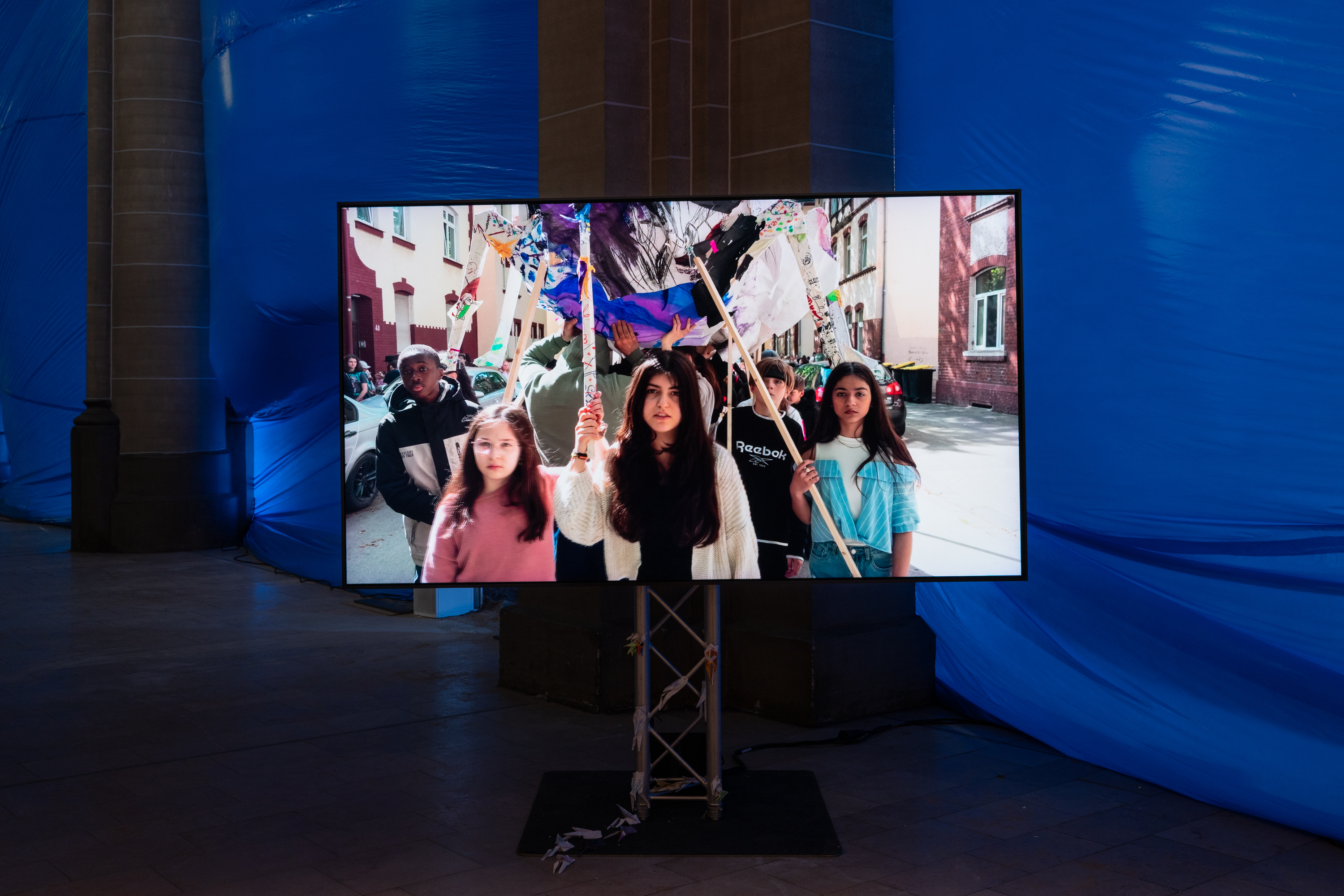
As part of the Schule, Nachbarschaft und Wir programme, Havîn Al-Sindy complemented the video and installation components of How to carry a locust with a large-scale participatory performance. Bringing together papers of varying colours and textures, the artist created an installation in which students collectively produced hundreds of life-sized locust forms, suspended from the ceiling of the space with strings. She also constructed a monumental locust sculpture using wire, fabric, and thread in a mixed-media technique, transforming the work into a collective performance through a ceremonial procession reminiscent of a shamanic ritual. Furthermore, Al-Sindy collaborated with Berlin-based fashion designer Ferhat Kartal, whose practice draws on Kurdish visual imagery, to present the multidisciplinary performance Kras û Fistan (Shirt and Dress) as part of the programme. Overall, Al-Sindy’s practice develops a multilayered artistic language that transcends any single mode of expression, bringing together image, space, and the body within a cohesive narrative framework.
Havîn Al-Sîndy's How to carry a locust installation, a work of many generationally-spanning hands, speaks out of Kurdish history — a history of being watched, of forced displacement, and of the struggle for self-determination. At the same time, it opens itself to present-day experiences in which war, dispossession, and survival are inscribed. Grasshoppers do not appear out of nowhere. They are nodal points: of different narratives, of crises, and of displaced responsibilities. What is called a plague is a relieving lie — for behind the swarm stand wars, climate change, the exploitation of land, and the struggle against oppression. Swarms and texts shaped by children inscribe themselves into the exhibition space, shift it, and expose its symbolic order. In this way the work emerges from organically grown collaborative processes. A portable grasshopper, moved by children, deliberately shifts questions, responsibilities, and observations.
How to carry a locust, 2026 © Havîn Al-Sîndy. Photo © Manifesta 16 Ruhr / Ivan Erofeev
Locust is a powerful image that the artist approaches as a metaphor. Rather than treating this metaphorical figure simply as an insect belonging to the natural world, Al-Sindy also frees it from a representational framework tied solely to ecological crisis. Locust emerges as both the political resonance of a collective memory and the symbolic vehicle of collective movement. By transforming a creature of nature within the imaginative realm of the mind, the image becomes embodied through the traces left by historical experience and shared lives in memory.
Locust serves as a symbolic counterpart to the relationship between past and present, as well as to the continuity that extends from individual memory to collective memory. It is both a harbinger of moments of crisis and a sign of new beginnings.
The sudden appearance of locust in swarms reveals the fragile fault lines of the social order. At the same time, it recalls the possibility of establishing a terrain of resistance from which a new order may emerge. While its movement may appear as a form of uncontrolled proliferation, it embodies the collective force generated through acting together. In other words, its chaotic emergence as a swarm transcends individual existence and becomes a manifestation of shared experience and collective responsibility. The swarm contains a potential far greater than the sum of its individual members, evolving into an expression of common purpose and collective action. To think through locust is therefore to move beyond narratives of migration and displacement and to engage with it as an image of solidarity, collective agency, and resistance. In this sense, it opens a space for imagining the reassembly of a fragmented social memory and the possibility of a shared future. The work strips locust of its conventional associations with infestation, plague, and crisis—phenomena commonly witnessed in the ordinary flow of life—and transforms it into a nodal point where diverse political and ontological narratives intersect. From this perspective, Locust cannot be understood merely as a representational image; rather, it extends toward a symbolic ground in which different historical experiences converge. For the artist, this is precisely why Locust functions as a dual symbol.
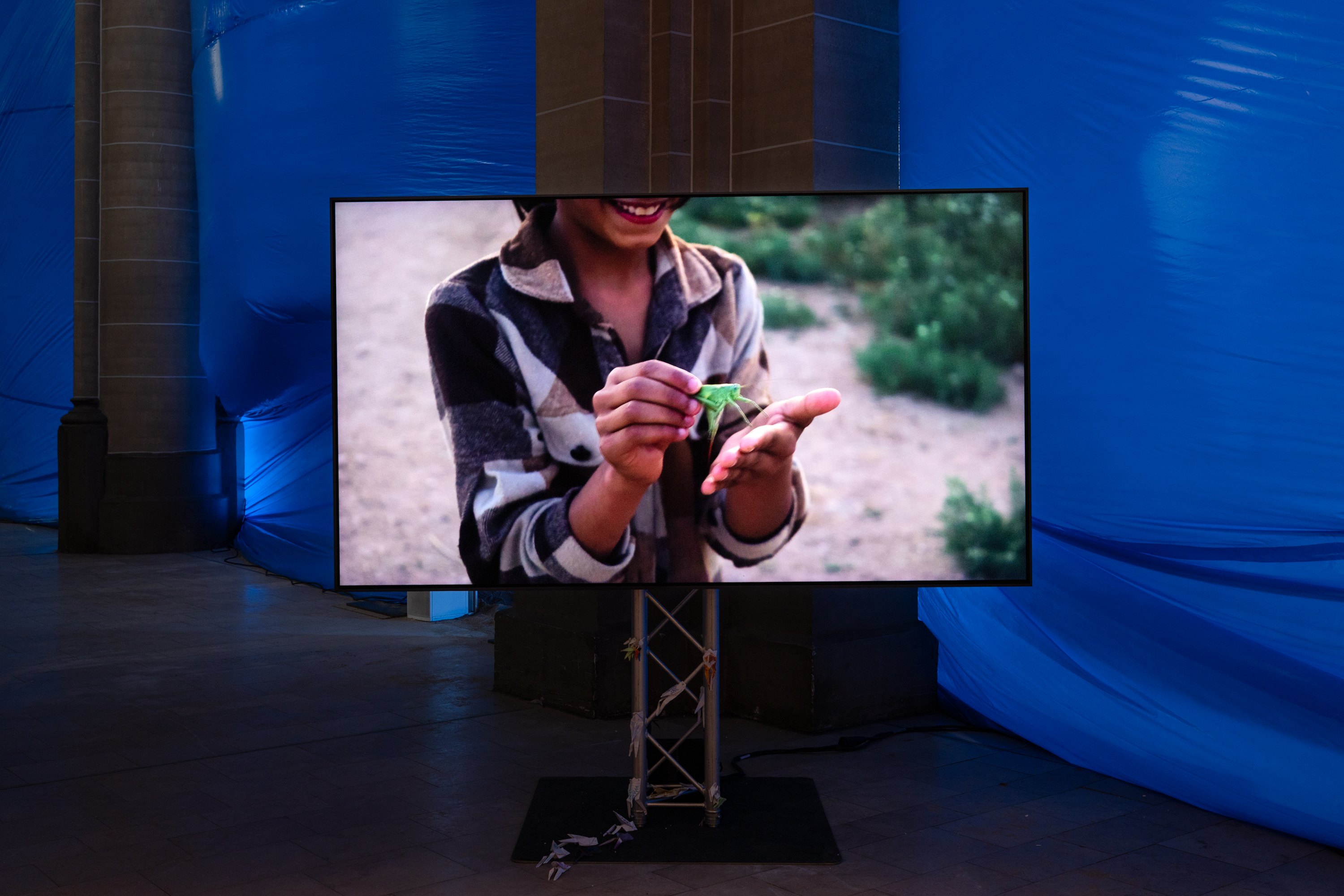
How to carry a locust, 2026 © Havîn Al-Sîndy. Photo © Manifesta 16 Ruhr / Ivan Erofeev
In many respects, Havîn Al-Sindy identifies this image with her own community. Historically subjected to war, violence, forced migration, and displacement, Kurdish society has endured repeated invasions, dispossession, and a historically fragmented existence. Locust thus becomes a symbolic embodiment of this historical experience and collective memory. Yet the artist does not construct this image solely through the lens of victimhood. Locust also signifies freedom, perseverance, and courage. The movement of the swarm points not merely to dispersal but to reunion; not only to destruction but to the possibility of rebuilding. In this sense, rupture becomes a necessity—a condition of existence capable of enduring despite countless obstacles while continuing to carry within itself the consciousness and embodiment of a shared world. Locust therefore emerges as the symbolic expression of a relationship that moves between victimhood and resistance, loss and hope, fragmentation and renewal. The powerful ontological and conceptual axis underpinning the work is also informed by the historical context of the Kobanî and Şengal resistances that followed the outbreak of the Syrian civil war. Beyond the realities of invasion and destruction, the work evokes the accumulation of sensibilities unwilling to accept the anachronistic violence unfolding along Turkey’s border with Syria. It recalls the movement of crowds accelerating as they descend rugged terrain and refusing to slow as they run uphill toward border fences. This evocation also resonates with moments of uprising and collective defiance that have emerged at borderlands elsewhere in the world.
In conclusion, the image of locust as conceived by Havîn Al-Sindy is deeply intertwined with the historical traumas of Kurdish society, transforming into both a repository of collective memory and a symbolic vehicle of collective resistance. Yet this memory does not remain confined to the past. On the contrary, it signifies the continuity of a collective mode of existence that actively shapes the present while projecting itself into the future.
In this respect, locust functions as a powerful political image in which migration, displacement, solidarity, and resistance converge within the same symbolic framework. Through this image, the artist transforms historical experience into an aesthetic narrative while foregrounding the political agency of collective memory and the enduring will to exist together.
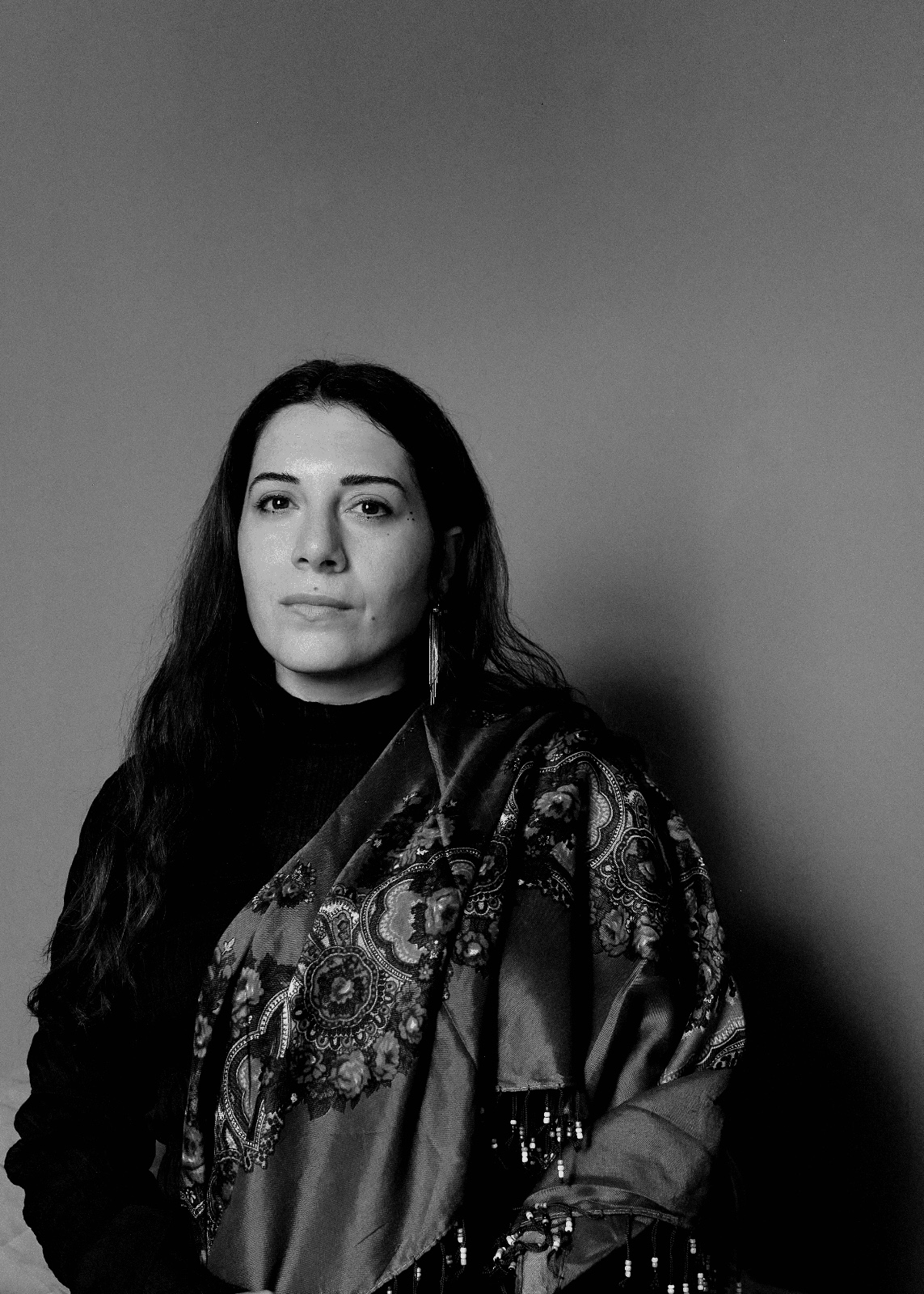
© Rebecca Racine Ramershoven
Havîn Al-Sindy is a contemporary artist whose practice is based between Germany and Kurdistan. Following her studies in biology and chemistry, Al-Sindy shifted her focus to artistic practice, bringing methods of scientific observation into her interdisciplinary works that encompass drawing, video, performance, installation, and sculpture. Her practice examines the constantly evolving relationships between the body, memory, language, and ecology, while exploring themes of belonging, migration, borders, intergenerational memory, and the invisible processes of nature.
Through methods such as burying paper in the earth, constructing collective spaces with clay, tracing the movements of plants and root systems, and developing multilingual narratives, the artist investigates the reciprocal relationship between humans and nature. Approaching natural processes not simply as subject matter but as active components of her artistic process, Al-Sindy’s work brings together biological transformation, ecological cycles, and collective memory within a shared narrative framework.
Working across multiple media, Al-Sindy’s practice spans drawing, video, performance, virtual reality, installation, and sculpture. Works such as Persona, Traces, Mapping Movements, Testimony of Boundaries, Nanê Rêk, Kras û Fistan, and How to carry a locust explore language, identity, collective memory, women’s experiences, and Kurdish cultural heritage through ecological and political perspectives. Today, the artist continues her practice between Germany and Kurdistan, developing education- and research-based projects with school students in North Rhine-Westphalia, artists at the Braunschweig University of Art, and artistic communities in Berlin and Erbil.
info@firezz.com


Comments
00