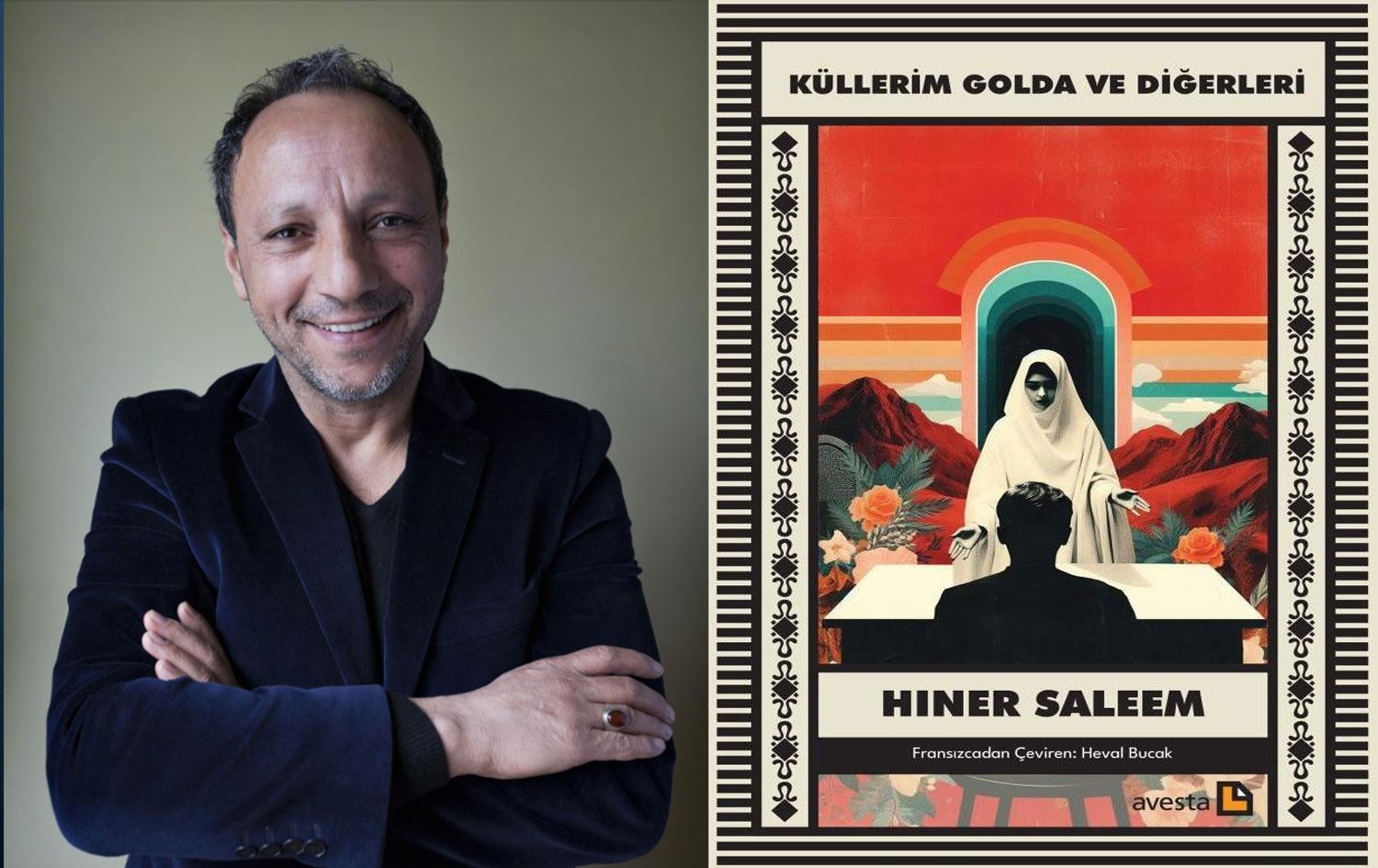

I always thought I had two lives. The second begins when I realize I have only one.
I counted my final minutes while listening to my breath: everything was fine. There was no sign of regret, sorrow, or despair on my face. I found it thrilling that a person holds their destiny in their own hands, that if they no longer wish to live, they can choose not to. Come on, my friend, today is your day. End it here. Did I ever have suicidal desires? Never, until that final moment. Fortunately.
The only person I thought about was my mother. I am glad she is dead; not because she died, but because she went before me. Had I gone first, she would have spent the rest of her life dying of grief.” (Saleem, 2024, p. 7)
Hiner Saleem’s autobiographical novel My Ashes, Golda and Others draws the reader into a deeply unsettling scene from its very first pages. In the passages above, Dilman reflects that he “always had two lives,” only becoming aware of one through the disappearance of the other. The force of the narrative emerges from the disturbing calmness of its language at the moment of death. As the protagonist approaches a death he has consciously chosen, he neither panics nor seeks reconciliation, nor does he experience a dramatic emotional climax. As suggested by the line, “I counted my final minutes while listening to my breath: everything was fine,” his attention remains fixed on breathing, and death appears almost as the continuation of a bodily rhythm. Breath becomes a measure that renders visible not only life itself but also its finitude. As the sense of continuity gives way to an awareness of limitation, life begins to be counted in minutes and measurable breaths. The narrator’s mind continues to weigh, calculate, and reason until the very end, and suicide takes shape less as an impulsive act than as a state reached through thought itself. “Life is beautiful. Before death, during death, and after death” (p. 8). Death unfolds in close proximity to ordinary existence, in the immediacy of the present tense, and remains part of the world even after it has occurred. For this reason, death and the everyday are inseparable; even the most devastating experiences are conveyed through a language that is restrained, lucid, and stripped of excess. Past, present, and future become simultaneously visible. Chronological time dissolves at the moment of dying, while scenes connect to one another through associations rather than linear progression. Saleem’s cinematic sensibility is particularly evident here. The narrative relies less on continuity than on interruption, less on sequence than on montage. Each scene establishes its own rhythm and frame; the intensity of a close-up is immediately dispersed by a cut or carried into another moment altogether. Time does not advance in a straight line. Leaps, flashbacks, and abrupt transitions mimic the workings of memory itself. This compositional logic not only links scenes together but also transforms them into semi-autonomous narrative units. Each fragment belongs to the whole while retaining its own density and emotional charge. In this way, the narrative exceeds the limits of a singular event. Death is not experienced as a definitive ending that occurs once and for all; rather, it becomes an experience continually reconstructed and relived. The narrative does not lead the subject toward closure. Instead, it suspends him within a state of disappearance that remains perpetually deferred and incomplete. The subject becomes a consciousness observing its own vanishing from without. Yet this consciousness never truly turns outward; it folds back upon itself, sustaining its existence through an unaddressed monologue. Death becomes an interior possibility, articulated through a quiet and unwavering awareness. The voice turns toward the past, reviving characters and experiences, yet it never receives an answer. That absence of response constitutes the most intense form of exile.
The novel revolves around a slip of paper containing instructions for the life Dilman imagines after his own death. In this note, he requests that his body be cremated and that, once it has returned to its “original state of dust,” the ashes be scattered over his mother's grave. “My seventy kilos, my sixty years, and my world full of dreams turned into a handful of dust” (p. 29). The elements that once sustained life have now lost their identity, reduced to an anonymous remnant, to ashes. “The man at the crematorium places me in an empty pickle jar: I didn’t bring an urn with me. The €3,200 paid in advance only covered the cremation of a lonely soul” (p. 19). Anonymous ashes stored in an empty pickle jar represent precisely what Saleem’s people, the Kurds, find most foreign. His people may not always care for the living, but they always care for their dead. “It is the spirit of solidarity born of a collective sense of threat. One Kurd may eat the flesh of another Kurd, but he will always bury his bones with dignity.” Yet Dilman Saleem no longer possesses even a body or bones for his people to claim. There remains, however, one problem to solve: he must find someone who will take care of him after his death. The first candidate is his friend Lezgin, who speaks beside the “little pickle jar” during the funeral ceremony held at the Kurdish Institute of Paris: “Dear friends, as you know, Kurds never die of natural causes... They die from chemical weapons or under torture. Dilman was a patriot, always optimistic, a leftist... We can say he died from all of these” (p. 24). Through this speech, Lezgin turns him into an idealized figure and promises to find someone who will “take his ashes back and scatter them over his mother’s grave.” The novel’s protagonist, however, explains his decision to take his own life in different terms: “What use is a life without a land to hold onto and a soul to belong to?” (p. 13). He then names Lloyd George, Woodrow Wilson, and Georges Clemenceau as those responsible. “They are the ones who pushed me into this impasse.” By partitioning Kurdish geography into four parts, these figures delivered the region to Arab, Turkish, and Iranian rule. As a result, the Kurdish people were cast into the uncertain prospect of unity, while the possibility of determining their own future was endlessly deferred. The desire for individual death is thus situated within a broader historical and political trajectory. Exiled into uncertainty, Dilman Saleem becomes severed from the land of his birth. The past recedes beyond reach, while the future remains an unrealizable possibility. To these uncertainties is added another: whether his ashes will ever return to their homeland. Lezgin, generous in making promises, responds very differently when contacted by phone two days after the funeral—while Saleem’s deceased self continues to linger within the physical world of the narrative. This time, his reply comes in the form of crude humor: “The reason I haven’t taken care of you since the memorial speech is my ass. — What about my ashes? — Your ashes? They can wait on my ass”(p. 40). This abrupt shift in tone reveals the fragility of the language of reverence established after death. The collective meaning produced at the funeral quickly dissolves, leaving behind a form of disconnection that not even death can stabilize. The ashes are no longer a sacred relic nor a memory worthy of preservation. They lose their value within everyday speech and become objects of ridicule. Under such conditions, no stable ground remains for the narrator to hold onto in the external world. What persists instead is the internal fracture between the Soul and the Ashes themselves.
At this point, the novel brings two distinct modes of being into confrontation. On one side stands the Soul, shaped through memory, roots, and identity associated with the East; on the other are the Ashes, the material residue of an individual life and of fragmented experience in Europe. These two modes continue to confront one another after death as though they were separate individuals. Throughout the book, the word Ashes is consistently capitalized and personified, whereas soul remains uncapitalized, left within the realm of the generic rather than the singular. Saleem illustrates this divide with striking clarity: “The Ashes and I do not share the same memory of events. I am irritable; the Ashes are relaxed. I am rigid; the Ashes are accommodating. I take everything seriously; the Ashes relativize everything” (p. 151). This opposition gradually develops into the coexistence of two beings: both witness the cremation, both speak on the telephone, and both participate in the declaration of death. The Soul wanders through the streets of Paris carrying the Ashes “on its back” and remains, even after death, in search of a woman. What emerges here is the construction of the Soul and the Ashes as two distinct regimes of experience. The text never reconciles them. The distance between the two is carefully maintained. In this sense, the Ashes appear as a singular companion who compensates for the subject’s physical and emotional absences while never fully agreeing with or merging into him. The East–West dialectic is enacted through the distance separating the subject’s immaterial continuity from its material remainder. This division also manifests itself on the level of aesthetic experience. The music listened to, the films watched, the books read, and the paintings encountered all produce these two trajectories in different ways. In its simplest form, the distinction can be traced through the contrast between Tahsin Taha* and Johnny Hallyday**, both of whom appear in Saleem’s narrative. The difference concerns not only form but also the very construction of experience. For Tahsin Taha—whom Saleem describes as the Kurdish equivalent of Leonard Cohen—music establishes a collective structure of feeling. The voice carries a people’s memory, mourning, and continuity; recurring motifs move beyond individual experience to create a shared field of ethical imagery. The subject becomes the bearer of a continuity greater than itself, while music functions as a form of belonging. With Johnny Hallyday, by contrast, music draws its energy from chance encounters, detours, and unforeseen events experienced by someone travelling with little more than a guitar and a suitcase, boarding whichever train happens to arrive. Life is not shaped by a predetermined route but by unexpected connections forged along the way. In this respect, Hallyday’s figure resonates with the logic that Louis Althusser develops in The Underground Current of the Materialism of the Encounter. For Althusser, there is no original point of departure, nor has there ever been one; thought “jumps onto a moving train and continues by the strength of its own momentum”(Althusser, p. 276). The subject therefore emerges not as the bearer of a pre-existing social continuity but as the product of contingent encounters. Rock aesthetics offer an experience capable of displacement, repetition, and reinvention, detached from any fixed context. Hallyday thus comes to signify a mode of existence that belongs nowhere in particular and yet can be recreated wherever it finds itself.

Saleem articulates the East–West divide through a concrete comparison grounded in social life. Speaking of the place where he was born, he writes: “Back home, you are always surrounded by people. No money? Your family helps you. Being threatened? They are there to defend you.” By contrast, Paris operates according to a different logic: “Here, the state has taken the place of society. Are you broke? The state helps you. Is someone threatening you? Neither you nor your tribe will catch them—the law will. There is no law over there, or only the law of the strongest.” (p. 71) This comparison reveals two distinct modes of social organization. In one, relations of proximity, kinship, and mutual obligation are decisive; in the other, the determining force is the abstract order of the state and the law. This distinction becomes especially visible in the following declaration: “I, the undersigned, Dilman Saleem, born in Akre on 9 March 1964, an Iraqi refugee—this is a word that makes me uneasy every time I see it—undertake, in accordance with Article 2 of the Geneva Convention relating to the Status of Refugees of 28 July 1951, to comply with the laws and regulations and with the measures taken to preserve public order; not to support the use of violence in the political sphere, either in word or deed; and, more generally, not to harm public order or the security of the state.” (p. 138) This statement, which may be read as the first genuine pact he enters into with a state, gives concrete form to the ethical orientation of his life. By accepting the obligations of the Geneva Convention, he explicitly renounces support for violence in both speech and action. The declaration functions not only as a legal commitment but also as the articulation of an ethical and aesthetic position. The divide between East and West is reproduced not only in the external world but within the subject himself. It is precisely here that the narrator’s internal fragmentation becomes visible: “I have become like time. I no longer know which clock to trust. My body has found refuge in the twilight of Paris. My soul inhabits a country of exile, melancholy, heartbreaking memories of separation, nostalgia, false identities, and false birth dates. Anxiety has become my mother tongue, and my head has become my homeland.” (p. 91) This inner division cannot be reduced to a simple feeling of longing. The narrator’s experience exceeds conventional nostalgia and approaches what might be called nostomania. It is something fundamentally different from ordinary homesickness. What persists is not merely a desire for the past but the continuation of an orientation even when both the “body” and the “place” to which one might return have disappeared. Nostos—the desire to return home—has lost its object, yet it has not lost its direction. Body and homeland dissolve on the same plane and are replaced by a mental construct. In this sense, the phrase “my head has become my homeland” signals a displacement of orientation rather than the recovery of belonging. Yet this displacement offers no resolution. On the contrary, it is repeatedly disrupted by political and historical designations: “The moment someone says Iraq, I want to climb out of the urn and leave. Ever since Iraq was invented in Paris by the French and the British, the word has produced a cacophony inside my head. It tortures me. A shrill noise echoes in my ears, like a runaway train crushing every Kurd in its path.” (p. 28) The train invoked here is neither the Althusserian figure of movement nor Hallyday’s image of escape. It is the sonic form of an unstoppable historical violence. Reverberating within the subject’s consciousness, this sound fractures orientation itself. As a result, even the mentally constructed homeland cannot become a stable refuge. Nostomania neither returns the subject to the past nor allows him to settle in the present; instead, it keeps him suspended within a movement of return that is endlessly deferred. This tension becomes even more acute in the narrator’s own words: “I am doing everything I can to ensure that the Ashes reach the homeland as soon as possible. Then I will finally be rid of them. The Ashes, meanwhile, are doing everything they can to prevent that from happening. I am divided between France, which I love yet where I feel like an exile, and Kurdistan, my so-called homeland where I feel like a stranger: during the day I hate it, but at night I cry for it.” (p. 91) What emerges is a form of attachment that has lost its tangible object while retaining its direction. The subject does not move back and forth between two opposing poles. Rather, he remains bound to both simultaneously and, for that very reason, cannot fully inhabit either one. The result is a state of simultaneous attachment in which experience takes the form of an existential, ethical, and political impasse.

The ethical dimension of this fragmented identity is concentrated in the figure of the mother. The line, “The only person I thought of was my mother. I am glad she is dead; not because she died, but because she went before me” (p. 7), makes the ethical orientation of the text immediately visible. Even death is considered through the suffering it might inflict upon another. At this point, the issue ceases to be merely an individual decision. It becomes a question of disappearing while causing as little harm as possible. Suicide is therefore imagined as an act carefully arranged so as not to disrupt the lives of others more than necessary. The most tangible expression of this rupture appears in the relationship with the mother. Her world is shaped by faith, oral tradition, and rootedness in place. The son, by contrast, has moved into a secular, fragmented, and urban existence. Between these two worlds there is not only distance but also a divergence of meaning. The mother's understanding of her son's life in Europe makes this distinction particularly clear: “My mother believed that I, her son living among European infidels, spent my days committing sins … supposedly I was surrounded by atheists … She spent all her savings trying to save her son from divine punishment. My mother trusted Saint Gül.” (p. 8) This passage reveals the inability of two distinct ontological orders to meet. In attempting to save her son, the mother entirely misrecognizes the reality in which he lives. The son, meanwhile, perceives the naivety of her efforts but cannot correct them. He can only remark: “I wish my mother had been a man in the prosperous empire of Middle Eastern men.” (p. 55) Despite their mutual affection, the relationship remains suspended within a gap that resists shared meaning. This gap constitutes one of the clearest manifestations of displacement, for displacement here also entails the loss of a common language. The narrator’s relationship with his mother never becomes a fully reciprocal exchange; there is speech, but there is no genuine sharing. At the same time, the mother emerges as the very opposite of rupture. In her world, separation is among the gravest of curses: “Exile was the worst curse imaginable for my mother … ‘May God cast you beyond the seven mountains,’ she would say … and then, with trembling lips, beg God to take the curse back.” (p. 10) Here, separation is understood as catastrophe. The son, however, speaks from within that catastrophe. For him, exile is unavoidable and gradually becomes a constitutive experience. Within the logic that “if the woman is the soul of the house, the children are its light,” the father occupies an increasingly marginal position. Indeed, the father appears as a remnant of a world that ought to have passed. This is encapsulated in the mother's observation: “The Stone Age ended, but not because there were no stones left.” Saleem makes the parallel explicit: “My father and mother were like the Ashes and me. But when I am harsh or unfair, I realize it. My father never did. That is why I became especially attached to my mother.” (p. 110) This statement not only explains the source of Saleem’s affinity with his mother but also positions the father as a figure incapable of reflecting upon his own behavior and emotionally detached from those around him. The distance becomes even more pronounced in Saleem's reflection on his mother's life with him: “I still do not understand how she endured this man. But did she really have a choice within a religion serving a patriarchal, violent, and hypocritical society in which nothing was supposed to leave the walls of the home?” (p. 50) The father is thus reduced to a figure of necessity rather than choice, a presence sustained by the familial, social, and ideological structures that surround him. In this sense, he appears less as a fully realized individual than as the residue of an order that continues to persist even as it loses its legitimacy.
Impossible Love
Separated from his family, Saleem can no longer participate either in their lives or in their deaths; nor does he retain any real possibility of return. Relationships therefore dissolve across both space and time. Life becomes a chain of successive losses: first the loss of homeland, then the severing of familial ties, followed by the collapse of marriage and the disintegration of intimate relationships. Saleem states this explicitly: “Exile is also the woman you love leaving you” (p. 37). He links both his divorce and the breakdown of his relationships with other women to this condition. Elvira, Barbara, Êva, Catherine, Hanna, Kunji, Irma, and Fatma enter the narrator’s life, yet none of them becomes a lasting presence. Their names remain as traces of relationships that have already passed. Within this constellation, however, one name stands apart: Golda. At first glance, she appears alongside the other women, yet the narrative gradually separates her from them. Golda’s name appears only twice in the novel. With the words, “I have loved one woman in my life, one. I called her Golda. The woman I never found” (p. 105), she is transformed into an unattainable object of desire in the Lacanian sense. The other women were encountered, experienced, and ultimately left behind. Golda, by contrast, never materializes. Precisely because she remains unrealized, she becomes the central tension of the narrative: a possibility that is endlessly deferred. Like the lost homeland, Golda is a figure whose presence is felt through absence. She mirrors the structure of nostomania: just as the desire for home retains its direction even after losing its object, Golda sustains desire through her perpetual unattainability. In this respect, she functions much like Lacan’s objet petit a—the figure of lack that continually animates desire precisely because it can never be attained.
The mother–Golda opposition, like the soul–Ashes duality, can be read through the archetypes of the collective unconscious described by Carl Gustav Jung in Man and His Symbols. The mother represents a durable memory grounded in faith, oral tradition, and rootedness. In this sense, she is connected to the anima, the feminine image carried within the male psyche. Jung describes the anima as follows: “This feminine side, in its principal aspects, is connected with the environment, especially with women, in a somewhat inferior and devalued way” (Jung, 2009, p. 29). Though physically separated from his mother, the narrator remains unable to detach himself from her internally. She emerges as a structure that shapes the continuity of the soul, influencing masculine identity through affects such as melancholy, irritation, and dissatisfaction. The anima thus assumes a binding and retrospective force. Golda, by contrast, becomes the narrator’s idealized anima projected onto the external world. Distinct from all the other women, she is transformed into an unrealized possibility, an endlessly postponed promise of completion. She remains unattainable, yet precisely for that reason never ceases to function as an object of desire. Golda is a projection directed toward the future, one that never comes to fruition. She appears as the possibility of liberating the narrator from the bonds of childhood, transporting him into another world, and offering a different form of life. Yet this promise remains permanently out of reach. The mother embodies the past and the pull of origins; Golda represents a future completion that can never be realized. The oppositions between soul and Ashes, and between mother and Golda, ultimately converge within the same unresolved fissure between the continuity of the past and the unrealized possibility of the future. This fissure is the very name of exile. The subject can neither return to the originary world represented by the mother nor attain the fulfillment promised by Golda.
As the text draws to a close, the language intensifies, narrows, and ultimately begins to unravel. Yet this unraveling is not merely linguistic; it is simultaneously the dissolution of both the narrative and the subject: “The urn shatters. The wind carries the dust away—and what it carries away is me. I get up from the ground to catch it. Suddenly, I can no longer see anything. An entire life wasted” (p. 171). At this point, no coherent whole remains to be preserved. The subject has dispersed, scattered beyond recovery. Seen from this perspective, life appears as a void. Yet the sentence that immediately follows—“A life full of dreams is never a wasted life”—does not erase this void; rather, it keeps existence from collapsing into it. Meaning endures not only through what has been lived but also through what has remained unrealized. The desire to return home, the longing to find the right woman, and the aspiration toward a freer life all persist despite the loss of their objects. Desire becomes objectless, yet it retains its direction. Golda’s status as “the woman who could not be found” finds its significance on precisely this level. She never materializes; therefore, she can never be exhausted. Just as the exiled subject cannot fully erase his roots despite having lost them, Golda continues to exist through absence itself. For this reason, My Ashes, Golda and Others can be read as a narrative of dissolution. The subject’s ties to the world, to family, to faith, to intimacy, and finally to the body are gradually undone. Yet this dissolution never culminates in absolute annihilation. As long as the narrative continues, something always remains behind—a residue, a trace, a remainder. It is here that the novel reveals its deepest strength: in demonstrating that complete disappearance is ultimately impossible.

My Sweet Pepperland film poster
Hiner Saleem (born 9 March 1964) is an Iraqi Kurdish filmmaker, novelist, and screenwriter.
Born in the town of Akre in the Kurdistan Region of Iraq, Saleem left Iraq at the age of seventeen. He continued his education in Italy before eventually settling in France, where he currently resides. In 1992, following the Gulf War, he documented the living conditions of Iraqi Kurds, and the resulting footage was screened at the Venice Film Festival. Saleem completed his first feature film, Vive la mariée... et la libération du Kurdistan, in 1998. His second feature, Passeurs de rêves, was released in 2000. His third film, Vodka Lemon (2003), received the San Marco Prize at the Venice Film Festival. In 2005, he was awarded the title of Chevalier des Arts et des Lettres by the French Minister of Culture, Renaud Donnedieu de Vabres. Alongside his work in cinema, Saleem has also published literary works. His memoir My Father’s Rifle (Le Fusil de mon père) was published in French and English in 2004. In 2007, he directed Dol (The Valley of Tambours), featuring the Kurdish rock musician Ciwan Haco. In 2014, his film My Sweet Pepperland, often described as the first Kurdish Western, was released with Golshifteh Farahani in the leading role***.
Hiner Saleem, Küllerim Golda ve Diğerleri, Translated by Heval Bucak, Avesta Yayınları, İstanbul, 2024.
Louis Althusser, Kriz Yazıları, Translated by Alp Tümertekin, İthaki Yayınları, İstanbul, 2009.
C. G. Jung, İnsan ve Sembolleri, Translated by Ali Nihat Bababoğlu, Okuyan Us Yayınları, İstanbul, 2009.
* https://youtu.be/nYBrjKTTMzY?si=VhzLsTcqoNk14TCA
**https://www.youtube.com/watch?v=8Sc4Pb7d1Nk&list=RD8Sc4Pb7d1Nk&start_radio=1
***https://tr.wikipedia.org/wiki/Hüner_Salim

info@firezz.com
Yorumlar (0)