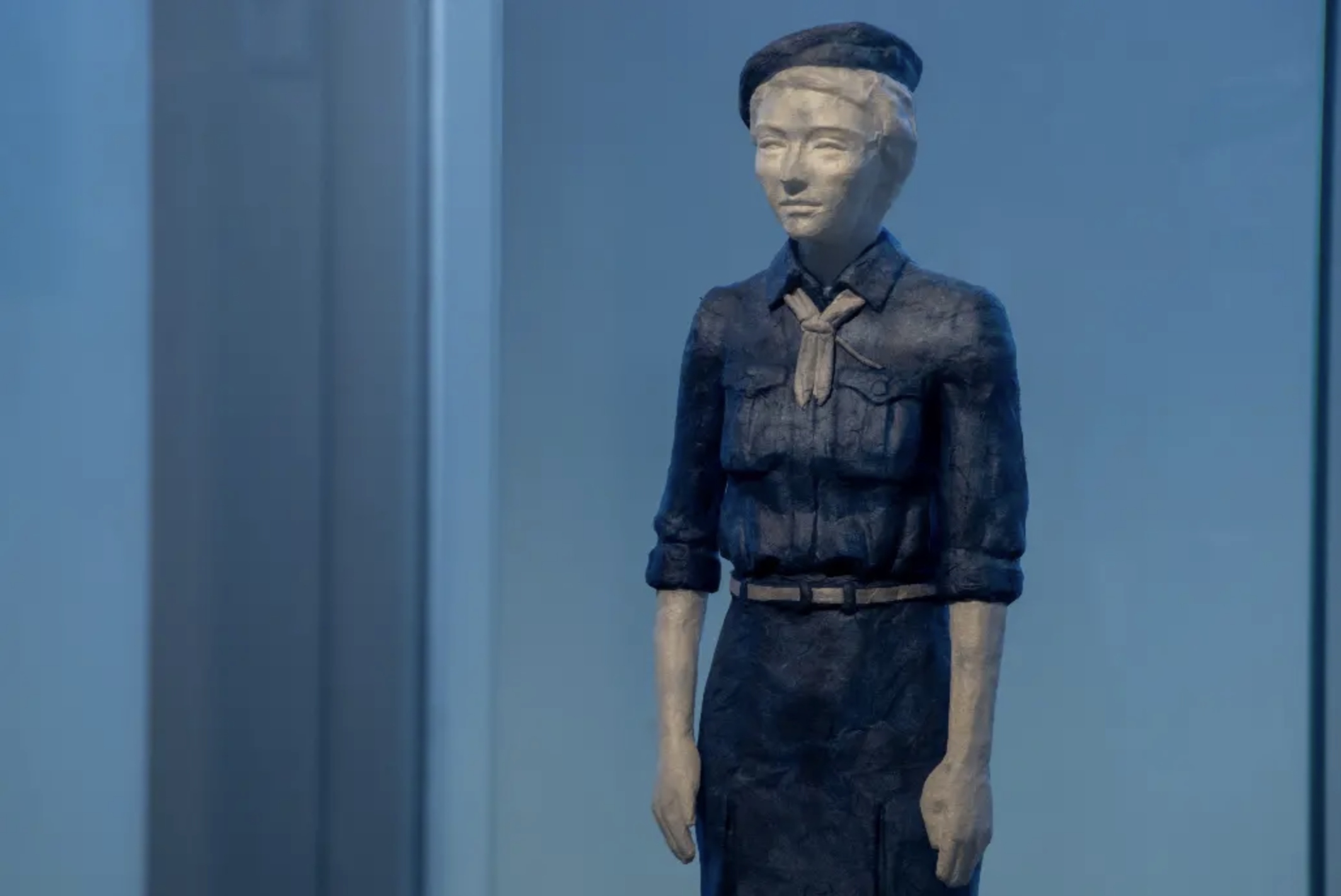
This article offers a critical examination of artist Mehtap Baydu’s sculpture Gökçen, from her Republic Women Series, which takes Sabiha Gökçen as its subject, through the perspectives of Kurdish history and feminist art criticism. When it comes to Sabiha Gökçen, Baydu’s creative method, centered on the fluidity of identity and cultural translation, encounters a fundamental ethical dilemma. Regardless of Baydu’s intentions, incorporating Gökçen into her own performative system of “body-clothing-identity” objectively depoliticizes the figure, contributing to the production of a new form of memory. This production erases Gökçen’s position as a perpetrator in the Dersim military campaign and normalizes the myth of the female hero constructed by Turkish national feminism. From the perspective of feminist art criticism, this case reveals how a narrative of gender empowerment loses its critical edge when confronted with state violence, and how this process is naturalized through art, moreover, through the work of a Kurdish artist.
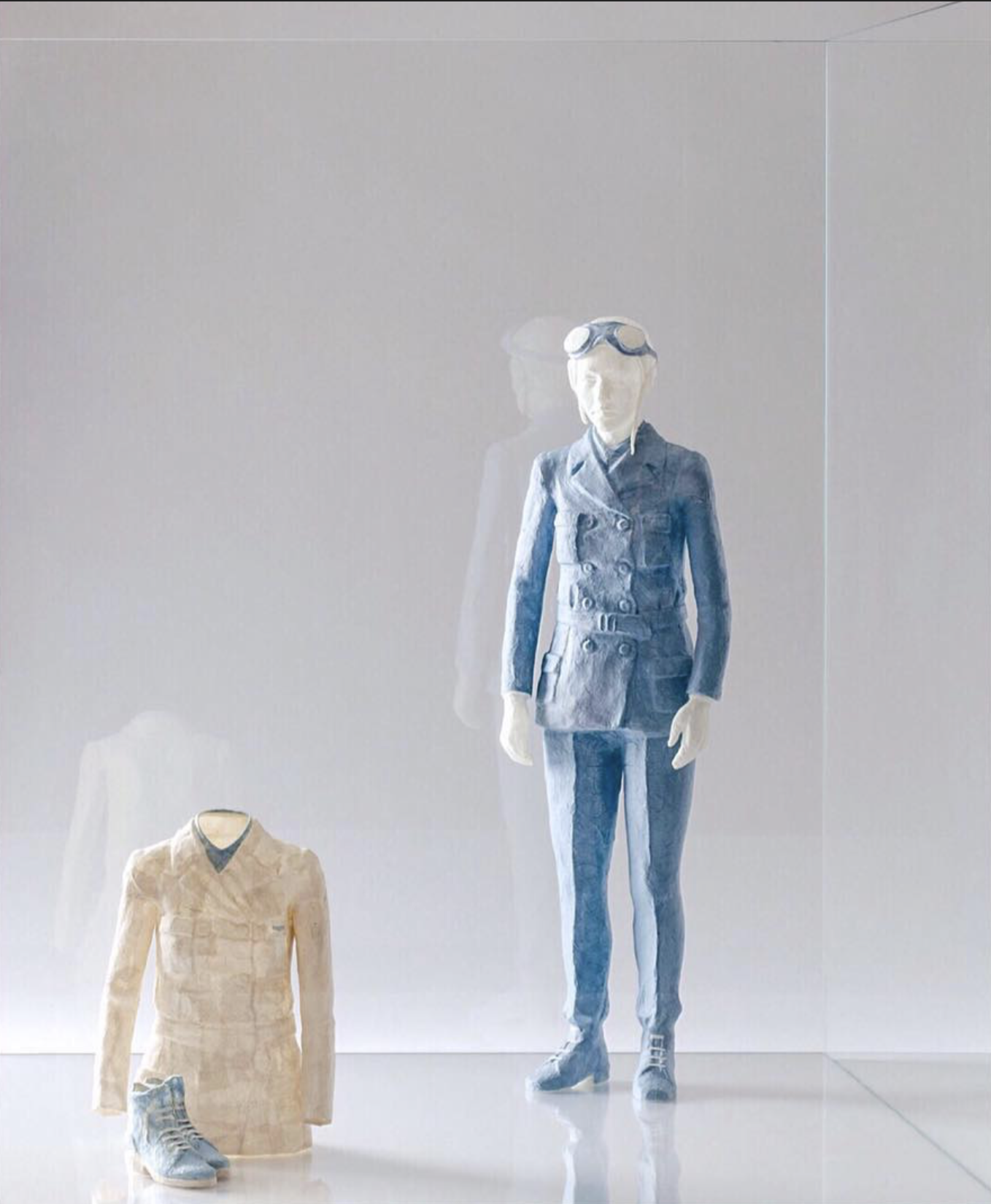
Mehtap Baydu, Women of the Republic Series, Handmade Translucent Paper, 2015.
Mehtap Baydu’s artistic practice is grounded primarily in performance, sculpture, and installation. At the center of her work are the fluidity of identity, the permeability of cultural boundaries, and the disciplinary mechanisms of social roles. Born in Bingöl, Baydu studied art in Ankara and Kassel and currently lives in Berlin. Her cross-cultural experience, by its very nature, encompasses possibilities for diversity, questioning, and debate. Art critics generally position Baydu as “a critical artist who explores the tensions between the self and the other, the individual and the norm” through the body and clothing. Considering Baydu’s body of work, the question worth asking is: “What happens when the artist’s performance of identity encounters symbols that carry a specific ethno-historical trauma?” To put it more concretely, can a work that takes as its subject or source of inspiration Sabiha Gökçen, Atatürk’s adopted daughter, Turkey’s first female military pilot, and a direct participant in the 1937–1938 Dersim military campaign, maintain or establish the critical distance characteristic of Baydu’s broader artistic practice?
Baydu’s artistic practice and discourse encounter a fundamental contradiction when confronted with the figure of Gökçen. Her artistic language, which encompasses the liberation of the body and debates around identity, reproduces the very logic of power it normally seeks to dismantle when it encounters a historical figure constructed by Turkey’s national discourse as the “Representation of the Modern Turkish Woman.” This contradiction opens up an area of aesthetic and political debate from the perspective of historical feminism. To understand the symbolic tension within Baydu’s work, it is first necessary to briefly consider who Gökçen is.
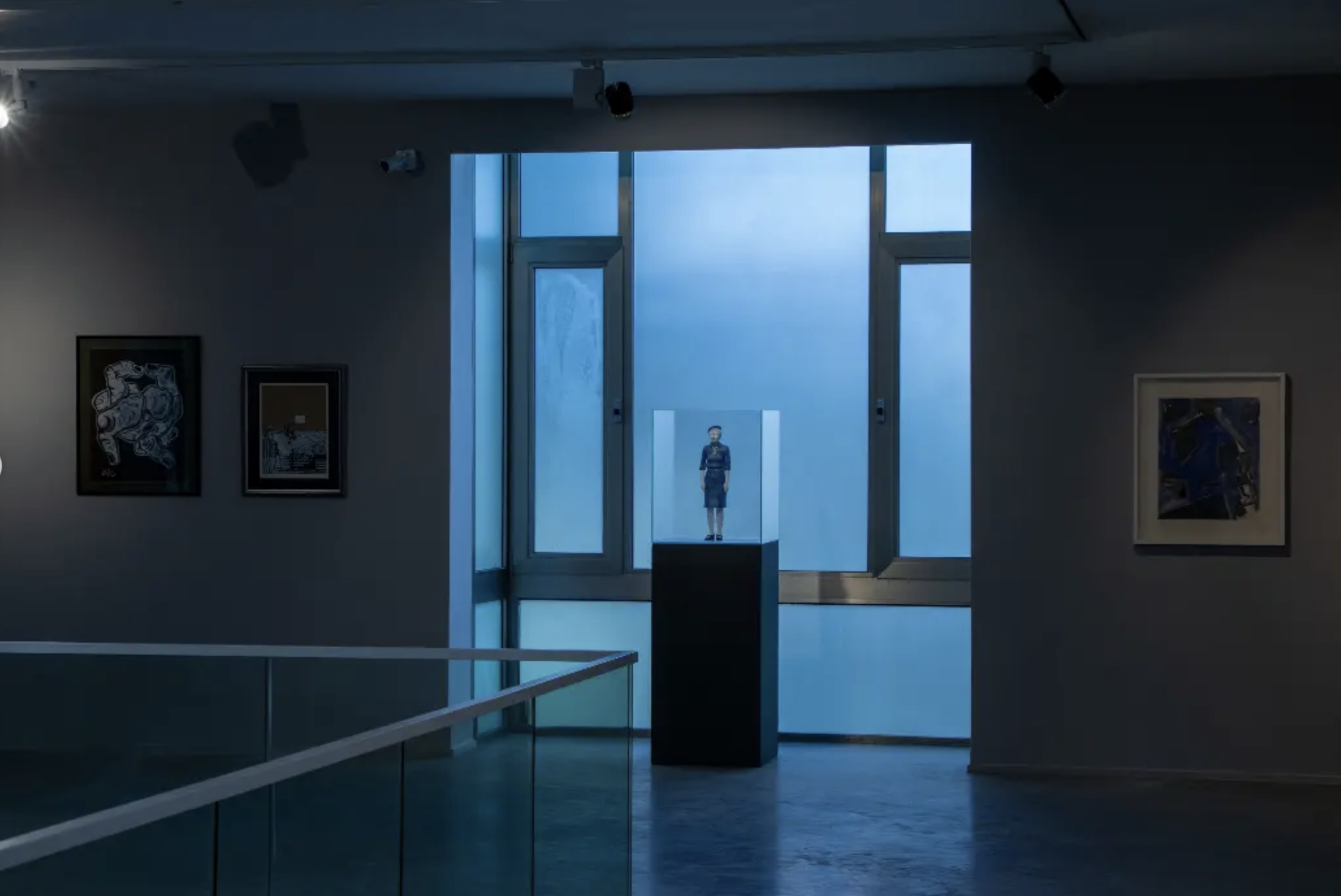
Mehtap Baydu, Women of the Republic Series, Handmade Translucent Paper, 2015.
In the official Turkish narrative, Gökçen is an important symbol of the educational opportunities Republican modernism afforded women and of the gains represented by women’s right to vote and stand for election. As a Muslim girl rescued from an orphanage by Atatürk, she came to be described as the world’s first female fighter pilot. Her portrait has been displayed in airports, schools, and public spaces, and Istanbul’s second-largest international airport bears her name. At the political level, this narrative presents the Republic of Turkey’s achievements in the sphere of gender as markers of its modernization project and reinforces an understanding that situates women’s emancipation within a state-centered narrative of progress and continuity. However, the other side of this narrative is Dersim. In 1937–1938, the Turkish army carried out a large-scale campaign of military repression and operations against the Kurdish-Alevi community in the Dersim region (present-day Tunceli). As a fighter pilot at the time, Gökçen played an active role in military operations conducted in the region. In an interview with the newspaper Tan, she stated: “I cannot forget the excitement of the first bombardment in Dersim. Dropping bombs on live targets on the battlefield gives one no sense of pity.” It is also clear that Gökçen’s role in Dersim has been transformed by official Turkish historiography into a symbol of women’s empowerment, thereby serving to obscure the violent nature of the military campaign. This process not only corresponds to the mechanisms of national feminism but also positions women symbolically as bearers of the national modernization project. Positioned in opposition to this modernization project, Kurds simultaneously occupy the position of the “internal other” constructed by national discourse. As Taha Baran’s research demonstrates, the othering of Kurdish women from Dersim as “Eastern women” also corresponds to an Orientalist perspective, since the representation of woman as the Other intersects with the representation of the East as the Other (Baran, 2014). The manner in which Kurdish women from Dersim are incorporated into the Turkish national body constitutes, in itself, a sexualized policy of assimilation. Dersim women are defined as subjects expected to purge themselves of their Kurdishness by giving birth to Turkish children through marriage. Within this framework, Gökçen cannot be regarded as a passive symbol. She is an active and resolute subject. She is a pilot with a strong sense of duty who experienced excitement while carrying out state violence. This reality can neither be erased on account of her gender nor can she be absolved on the grounds that she herself was also a victim of patriarchal structures. The task of Kurdish feminist critique, then, must not merely be to challenge national feminism’s narrative of empowerment, but to ask: Whose liberation? At whose, or at what, expense?
Baydu’s artistic language has several distinctive features. She uses edible dresses made from dried fruit pulp (particularly pestil) and allows members of the audience to bite pieces from them; she casts the lips of twenty-one women in gilded bronze and explores the gender politics between speech and silence; she collects the clothing of women from different professions, wears the garments layered one over another, and then attempts to free herself from them. The power of these works lies in their exposure of the social disciplining of the body. In his essay on Mehtap Baydu, Süreyyya Evren writes, “For Erika, clothing is a symbol of independence, but at the same time, it represents an identity that remains beyond her reach” (Evren, 2026). Evren’s observation reveals the central place that questions of entrapment and identity occupy in Baydu’s artistic practice. Questions of how posture and language form the skin of gender roles, and how art might become an act of peeling away that skin, open up various possibilities for discussion within Baydu’s practice. Yet these practices have an inherent limitation. Baydu’s works tend to approach power relations as fluid, transgressible, and negotiable layers of identity. They repeatedly reveal how the individual attempts to escape social norms through changing clothes, shedding skin, and transformation. Yet this approach proves insufficient in the face of state violence.
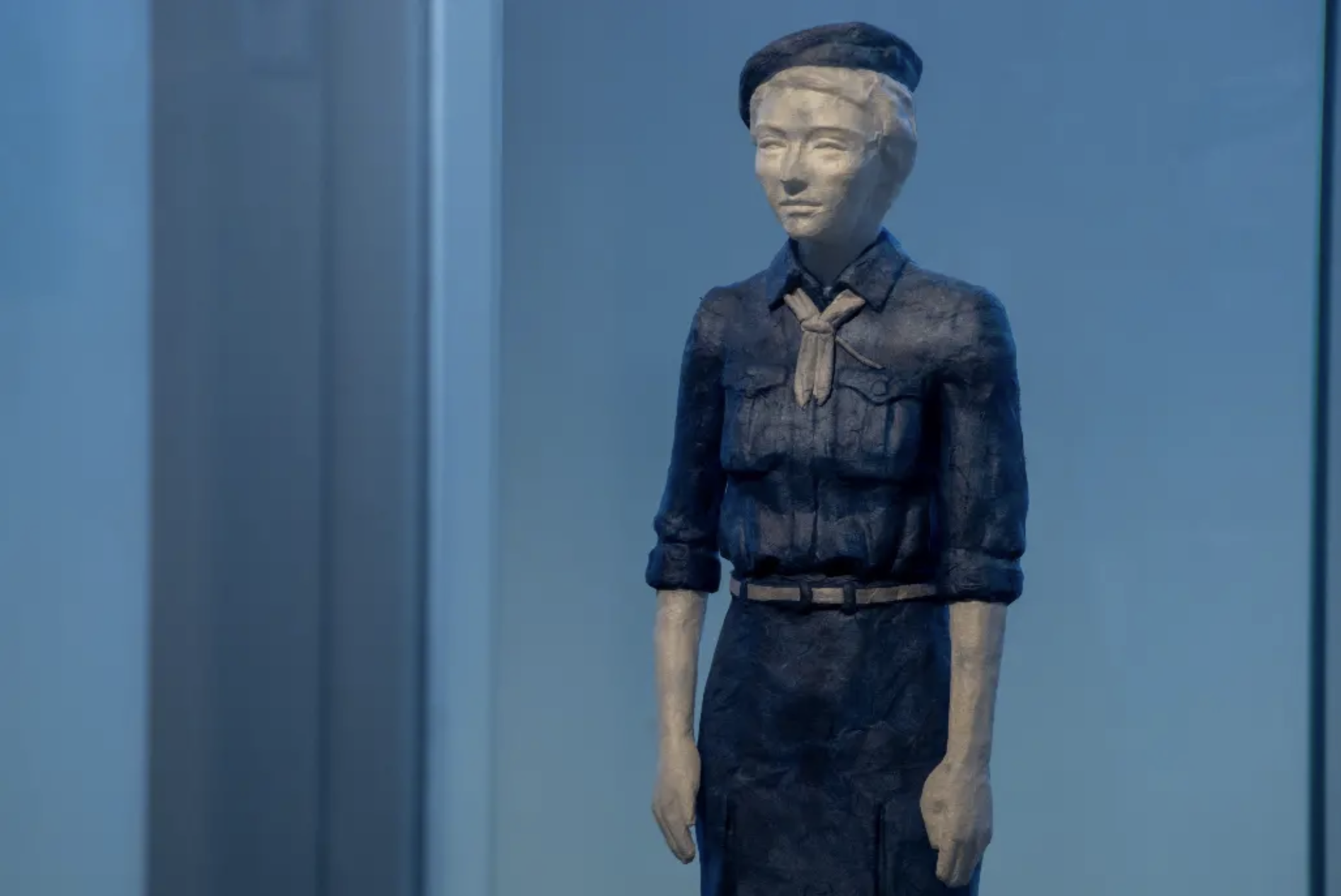
Mehtap Baydu, Women of the Republic Series, Handmade Translucent Paper, 2015.
It is precisely at this point that the contradictions become clear. The problem is not that Baydu misunderstands Gökçen. The problem is that when she brings Gökçen into the field of her artistic inquiry, the artistic language she employs fails to distinguish between two fundamentally different performances of identity. One is a performance developed by the oppressed as a means of survival in everyday life; the other is a performance of domination enacted by subjects acting in the name of state violence. Within Baydu’s framework, both can be reduced to a general proposition about how social roles shape the body. Yet for the survivors of Dersim and their descendants, Gökçen’s role is not an abstract norm; it involves military actions that resulted in actual deaths. Baydu’s Gökçen sculpture was, after all, created as part of the Republic Women Series to question social memory, representations of womanhood, and the construction of identity. At this point, questions concerning the responsibility of art and the ethics of memory come to the fore. Baydu herself is not a Turkish nationalist artist, nor does her artistic practice conform to the narratives and discourse of official history. Political art, however, does not acquire meaning solely through the artist’s intentions. From the moment an artwork enters the public sphere, its encounter with existing structures of power, social formations, and audiences becomes inevitable. It is important to remember that these encounters can produce meanings that exceed the artist’s intentions. Gökçen continues to embody a rigid nationalist structure. To incorporate Gökçen into a universal framework of art before her historical role has been fully exposed and confronted is to risk serving the existing political discourse. When Baydu’s cross-cultural position is also taken into account, a serious contradiction emerges within her critical artistic discourse. Revealing how discourses that shape gender roles are constructed is just as important as critically examining how those same discourses are reproduced through female figures who serve state violence.
BIBLIOGRAPHY
ALTUĞ, E. (2017, 12 10). Gazete Duvar. Gazete DUVAR: Retrieved from https://www.gazeteduvar.com.tr/yazarlar/2017/12/10/mesafenin-iyilik-anlari
BARAN, T. (2014). 1937-1938 Yılları Arasında Basında Dersim. Istanbul: İletişim.
BİANET. (2013, 10 31). BİAMAG. Sabiha Gökçen: Hedef Doğrudan Dersim idi: Retrieved from https://bianet.org/haber/sabiha-gokcen-hedef-dogrudan-dersim-idi-118256
BURULDAY, S. (2019, 4 17). Mehtap Baydu’nun “Eat Me, Meet Me” Performansı Üzerine. Birikim: Retrieved from https://birikimdergisi.com/guncel/9449/mehtap-baydunun-eat-me-meet-me-performansi-uzerine
EVREN, S. (2026, 10 2). Unlimited. Unlimited: Retrieved from https://www.unlimitedrag.com/post/sikismisliklar-delmeler-ve-donusumler-mehtap-baydu-yapitindan
Gazetesi, S. (2012, 12 24). SABAH GAZETESİ. Retrieved from https://www.sabah.com.tr/aktuel/2012/12/24/sabiha-gokcen-neden-tartisiliyor
Nezahat GÜNDOĞAN, K. G. (2024). Dersim'in Kayıp Kızları. Istanbul: İletişim. Şey, B. v. (2017). Galeri Nev Yayınları. Retrieved from https://galerinev.art/tr/mehtap-baydu
YÜCEER, S. (2021, 2 26). Atatürk Ansiklopedisi. Sabiha Gökçen (Esiner) (1913-2001): Retrieved from https://ataturkansiklopedisi.gov.tr/detay/199/Sabiha-G%C3%B6k%C3%A7en-(Esiner)-(1913-2001


Comments (0)