
Editorial Note
Our article on Hayv Kahraman will be published in two parts. Taking as its point of departure the artist’s exhibition What cannot be said will be wept, on view at Pilar Corrias Gallery in London from June 5 to September 5, 2026, the first part focuses on Kahraman’s recent work and examines questions of the body, memory, migration, loss, and representation. The second part focuses on a question that emerges from the text itself: What happens when beauty is displaced? In Kahraman’s paintings, the conventional relationship between beauty and elegance, harmony, and aesthetic pleasure is transformed in the face of the body, violence, trauma, and history. Drawing on the artist’s practice, the second part examines this transformation.
PART 1
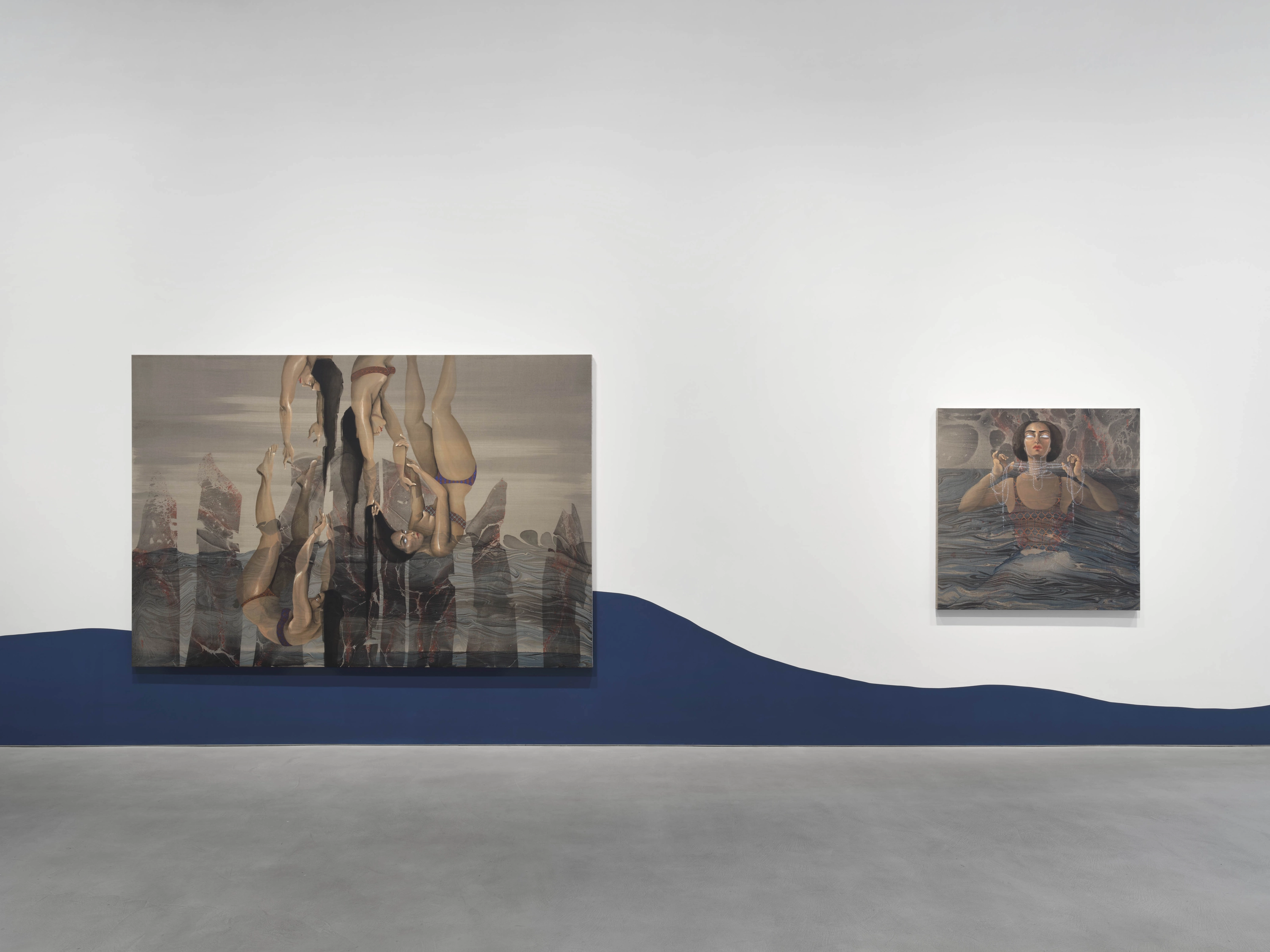
Taking place at Pilar Corrias Gallery in London from June 5 to September 5, 2026, What cannot be said will be wept brings together a selection of Hayv Kahraman's recent paintings. The exhibition places the artist's loss of her home in the 2025 Los Angeles wildfires alongside the forced displacement she experienced in childhood, bringing these two experiences into a shared conceptual framework. Together, they form the backdrop for a broader inquiry into the divisive logic of modernity, which separates human beings from the land, from place, from their sensory worlds, and from their ecological surroundings. Kahraman revisits this logic through tears, ebru (paper marbling), Eastern textile traditions, and embodied memory. She treats these elements as painterly possibilities through which relationships between the body, the environment, and cultural memory might be reassembled. Throughout nearly two decades of artistic practice, while deconstructing established modes of representing the female body, Kahraman has developed a relational field of existence at the intersection of art history, memory, biology, ecology, and visual culture. Within this field, the figure emerges as a carrier of historical experience, cultural transmission, and ecological interconnectedness. In this sense, What cannot be said will be wept offers an opportunity to reconsider, through the artist's most recent works, Kahraman's long-standing engagement with figuration, body politics, and her critical dialogue with art history.
Pilar Corrias exhibition space
To fully understand Hayv Kahraman's approach to painting, it is first necessary to clarify the distinction between the classical regime of representation and the visual logic through which modern painting transformed that regime. Institutionalized during the Renaissance and rooted in the Greco-Roman ideal, the classical conception of representation understood the body through anatomical unity, measure, and proportion. Space, in turn, was organized as a coherent domain within which the figure was situated, structured through perspective and governed by hierarchical relations among its constituent elements. Within this representational system, line defined form by delineating the boundaries of objects, while color largely functioned to reinforce the visibility and volumetric presence of those forms. With the Copernican Revolution*, the belief that the Earth occupied the center of the universe, and therefore that humanity held a privileged position within the cosmic order, was fundamentally shaken. This shift marked the beginning of a broader epistemic rupture that would gradually transform how humanity understood its place in the universe and framed its perception of the world. As this new conception of the world developed alongside modern science, it eroded the certainties that underpinned the Renaissance vision of a centered, measurable, and ordered cosmos, while simultaneously laying the groundwork for a renewed questioning of the ways in which art represents reality.
In modern painting, this transformation becomes apparent as the relationship between figure and space gradually moves away from the hierarchical order established through perspective. Surface, form, and color emerge as autonomous yet interdependent elements organized through their reciprocal relations. Consequently, the figure is no longer understood as a self-contained entity but as a relational structure shaped in conjunction with the other elements that constitute the pictorial surface. In Édouard Manet's paintings, the figure is constructed through direct relationships of color and form on the picture plane. The sharp contours of his figures, expansive areas of color, and their proximity to the surface transform the materiality of the canvas into an active component of the composition. In Paul Cézanne's work, nature and the figure are reconstituted through structural relationships among volume, color, and surface. The equilibrium established among forms and the reciprocal relationships of colors across the picture plane become fundamental elements in determining the painting's internal organization. In Vincent van Gogh's paintings, line and brushwork function not only to define form but also as active pictorial forces that convey the movement, rhythm, and intensity of the surface. Henri Matisse treats color as a compositional value independent of the natural appearance of the object; color assumes a decisive role in the very construction of figure and space. In the Cubist works of Pablo Picasso and Georges Braque, multiple views of an object are organized simultaneously on a single surface. As a result, the relationships between figure, object, space, and surface collectively determine the fundamental structure of the painting.
From the second half of the nineteenth century onward, European painting became a new site of encounter with visual forms circulating from different parts of the world. Following Japan's opening to Western trade in 1853-54, Japanese prints, textiles, ceramics, and decorative objects began to reach Europe in increasing numbers. The 1867 Paris Exposition Universelle further heightened the visibility of Japanese art across Europe. The impact of this circulation on European painting is particularly evident in Édouard Manet's Portrait of Émile Zola(1868). By placing a print by Utagawa Kuniaki II and a Japanese folding screen on the wall behind Zola, Manet incorporated Japanese art into the composition as an integral component of his own pictorial vocabulary. The framing strategies, surface organization, and color relationships characteristic of Japanese prints provided an important context through which Manet reconsidered the relationship between the figure and the picture plane. This encounter subsequently took different forms in Van Gogh's direct engagement with ukiyo-e prints, in Gauguin's dialogue with diverse cultural visual repertoires, and in Matisse's development of a conception of surface informed by Eastern decorative traditions. By the final quarter of the nineteenth century, European modernism had ceased to be the internal development of a single artistic tradition and had instead become a composite pictorial field shaped by the encounter of forms, techniques, and ways of seeing circulating across different geographies. As a result of these developments, the pictorial surface, line, color, mark, geometric form, rhythm, and void came to function as elements that directly shape the organization of the composition rather than merely supporting the appearance of objects. Painting increasingly turned toward investigating how vision and images are organized across the surface. With the questioning of anatomical unity and the separation between figure and space, the surface itself became an active field that renders its own material and formal relationships visible.
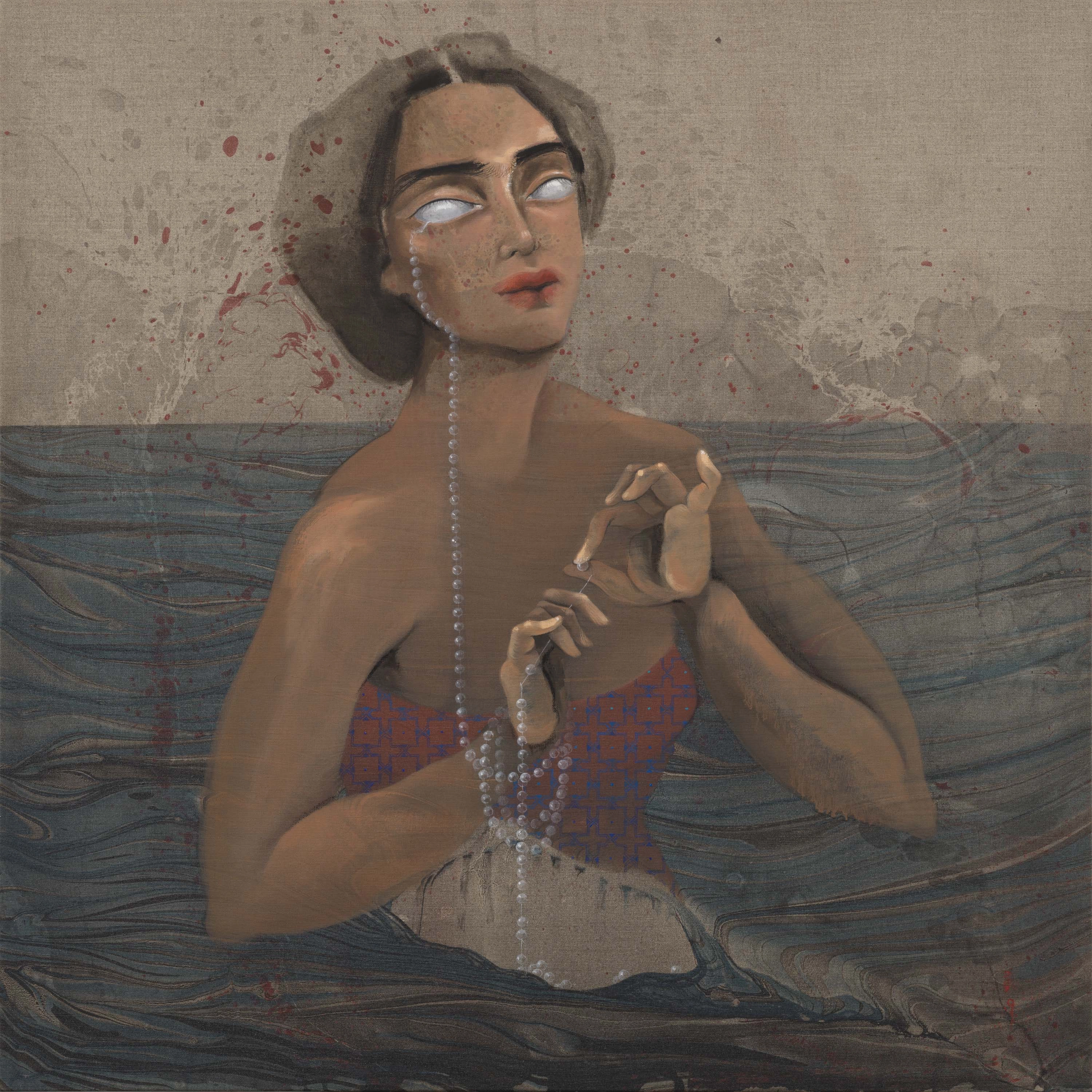
Figure Threading Tear Beads, 2026 Oil and acrylic on linen, 88.9 x 88.9 cm, 35 x 35 in
The Transformation of the Figure into Typology: Marbling, Tears, and Textile
Hayv Kahraman's paintings reorganize the relationships between surface, line, and color inherited from modern painting through a contemporary understanding of figuration. Figure Threading Tear Beads (2026) is among the works that crystallize the defining characteristics of the figural typology the artist has developed over nearly two decades of practice. In Kahraman's paintings, the female figure is frequently constructed through a recurring physiognomy: black hair, thick arched eyebrows, almond-shaped eyes emptied of pupils, porcelain-like matte skin, cherry blossom-colored lips, and elongated bodily proportions form the principal elements of this visual type. Through repetition, the figure does not become the portrait of a particular woman, nor a self-portrait; rather, it articulates an Eastern female typology that the artist reconstructs through an engagement with diverse historical and cultural visual sources. Black hair functions as a particularly significant visual marker within this formation. Two opposing images at the end of Paul Celan's Todesfuge (Death Fugue), contrasting Margarete's "golden hair" with Sulamith's "ashen hair," demonstrate how hair can operate as a vehicle for the condensation of historical and cultural meanings within the female figure: "your golden hair Margarete/ your ashen hair Shulamith" In Kahraman's paintings, the persistent recurrence of black hair functions as a repeated formal element that stabilizes the figure's visual association with the East. Together with the thick eyebrows, almond-shaped eyes, matte skin, and stylized lips, the face becomes a shared physiognomy that reappears across different contexts throughout the artist's work. This physiognomy is accompanied by garments covered in rhythmic patterns derived from ornamental traditions and by bodily proportions governed by principles of formal continuity. As a result, the figure's face, body, and clothing become complementary layers of a single visual typology.

Figure Threading Tear Beads, 2026 Oil and acrylic on linen, 88.9 x 88.9 cm, 35 x 35 in, Detail
Kahraman's use of color is likewise one of the defining components of this pictorial organization. Her palette is structured through the interplay between the nearly monochromatic skin tones of the figures, the balanced and restrained use of color associated with Eastern textile traditions in their garments, and the fluid chromatic transitions that characterize marbling-like surfaces. While the colors and geometric ornamentation of the garments establish a regular rhythm that accentuates the figure's skin, colors within the marbled surfaces converge, disperse, and blur their boundaries. These two distinct modes of chromatic organization generate a sustained tension between the stillness of the body and the dynamism of the surface. The color relationships in the background further deepen this tension through continual transitions between order and disorder. Controlled bodies, measured gestures, and nearly immutable facial expressions produce a sense of calm, while the repetition of patterns and the flow of color across marbled surfaces guide the viewer's gaze throughout the composition. Color thus brings together the texture of textile, the fluid movement of marbling, and the rhythm of the body within a single visual system. As the eye moves among fields of color, ornamental motifs, textile textures, and fluid stains, it simultaneously becomes aware of the material density of the surface itself.
The phrase "Threading Tear Beads" in the title refers directly to the material construction of tears within the composition. The figure's pupil-less eyes, suspended in an almost fixed state, become the site at which weeping is formally concentrated. The whiteness occupying the center of the eye alters the nature of the gaze, emphasizing the threshold through which tears pass from the interior of the body into visibility. Rather than dispersing across the face, the liquid descending from the eyes moves downward in a sequence of small circular forms, assuming the appearance of a string of pearl-like beads. The figure's hands are positioned around this chain; the movement of the fingers gathers and directs the flow emerging from the eyes and determines its rhythm. A continuous line of movement is thereby established between eye, hand, and tear. As this trajectory leads the gaze across the painting's surface, it generates a perceptual field structured through line, repetition, rhythm, and tactile associations. The succession of beads, the delicate gestures of the fingers, and the movement of the tears across the surface draw the viewer's attention toward minute details, granting the painting an almost tangible material presence. Operating within the calm and controlled physiognomy of the figure, this movement transforms weeping into an active compositional force. The tear thus emerges as a material trace that moves between body and surface, taking form and acquiring rhythm as it does so.
Kahraman's ornamentation is also a defining component of her figural typology. The garments worn by her figures are covered with patterns composed of regularly repeated geometric motifs. The recurrence of the same motifs across the surface of the garment establishes a continuity between pattern and body, while the scale of the motifs and the intervals between them reinforce the figure's calm and measured appearance. Without entirely obscuring the body's anatomical structure, these repetitions accentuate particular areas of it, shaping the figure's presence on the pictorial surface. When these ordered motifs encounter the downward movement of tears and the fluid colors of the marbled ground, they bring different historical rhythms into the same composition. Ornamentation thus functions as a cultural form that actively shapes both the body's appearance and its rhythmic presence within the work. As the regular structure of the motifs operates in conjunction with the anatomical continuity of the body, it reinforces the figure's composed and controlled appearance. At the same time, the rhythmic repetitions of these patterns come into contact with the flow of tears and the dynamism of the marbled surface. Ornamentation therefore becomes, alongside color, line, rhythm, and surface, an active structural element in the construction of the figure's visual coherence. Drawn from historical textile repertoires, these motifs are reconfigured in Kahraman's paintings through their relationship to the figure's Eastern physiognomy, the movement of tears, and the fluidity of the surface. For this reason, the relation established between the order of ornament and the sensory presence of the body prevents Kahraman's figures from functioning merely as images that refer to a particular cultural visual tradition. Instead, they become a generative typology in which different formal elements converge and mutually reinforce one another across the same pictorial surface.
Four Figures Kneeling, 2026 Oil and acrylic on linen, 231.1 x 180.3 cm, 91 x 71 in
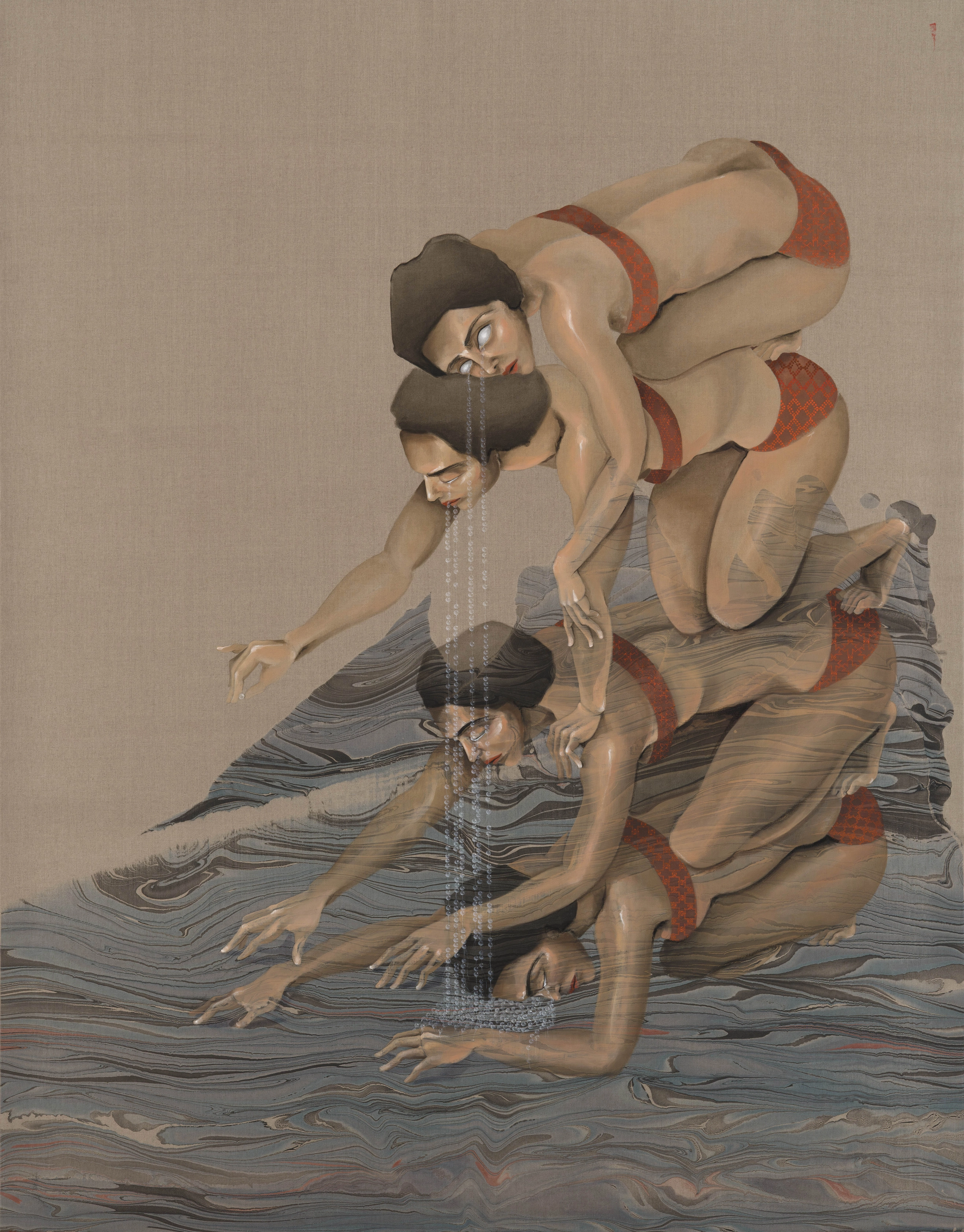
Hayv Kahraman does not restrict this visual continuity to the physiognomy of her figures alone. In Four Figures Kneeling (2026), the same female figure folds back onto itself, multiplying four times and stacking one body upon another. Within this sequence, which presents multiple manifestations of a single body, one figure's shoulder connects to another's torso, while an arm supports the weight of a neighboring body, transforming repetition into a relational structure grounded in physical contact. The body of the lowest figure, extending toward the fluid surface of the marbled ground, forms the compositional foundation that supports the accumulated weight of the figures above. The tears, flowing downward in the same rhythm across each figure, further emphasize this process of multiplication. Figure and tear become two distinct visual units that proliferate, accumulate, and extend across the composition according to a shared logic of repetition.

Four Figures Kneeling, 2026 Oil and acrylic on linen, 231.1 x 180.3 cm, 91 x 71 in, Detail
The figures function as successive variations of the same formal type. Although each retains the same physiognomy and a comparable bodily structure, it occupies a different position and enters into a distinct relationship of weight and contact. Particularly striking is the close correspondence between the multiplication of the figures and the formation of the tears. Just as the small rounded tears descending from the eyes are arranged like a string of pearls composed of identical units, the female figures likewise proliferate as successive visual units sharing similar physiognomies, garments, and bodily configurations. In both cases, a singular form is transformed through repetition into a compositional material. The stacking of the figures treats the body as a form capable of multiplication, transmission, and reconstruction in different configurations. This mode of proliferation recalls Marcel Duchamp's Nude Descending a Staircase, No. 2 (1912); however, the principle of superimposition functions quite differently in the work of the two artists. In Duchamp, the successive appearances of the figure fragment time and render different moments of movement simultaneous on a single surface. Within this fragmentation, the body partially relinquishes its sense of weight and acquires an almost ephemeral quality of motion, yet it remains tied to the logic of time, space, and movement in the external world. In Kahraman's work, by contrast, the repeated stacking of the same female figure does not represent successive phases of movement or time. The simultaneous multiplication of a single body distances the figure from the causal structures of the real world and shifts the pictorial field onto the plane of speculative construction. Here, superimposition signifies accumulation and proliferation rather than movement. The female figure is transformed into a plural idea of womanhood, a multiplicity that acquires existence within this speculative pictorial realm.
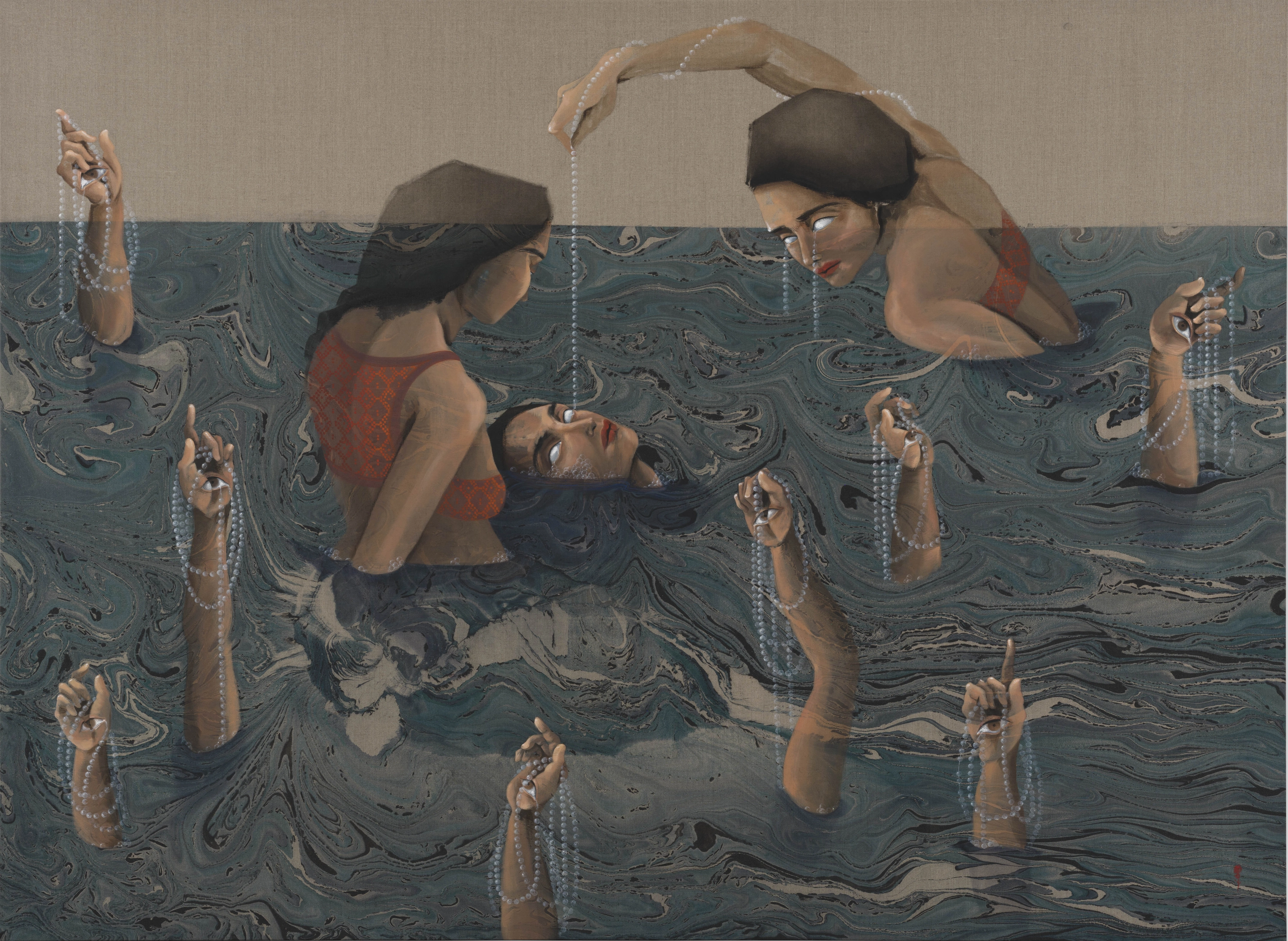
Eyes in Waters, 2026, Oil and acrylic on linen, 139.7 x 190.5 cm, 55 x 75 in
Figure and Surface: The Permeable Body
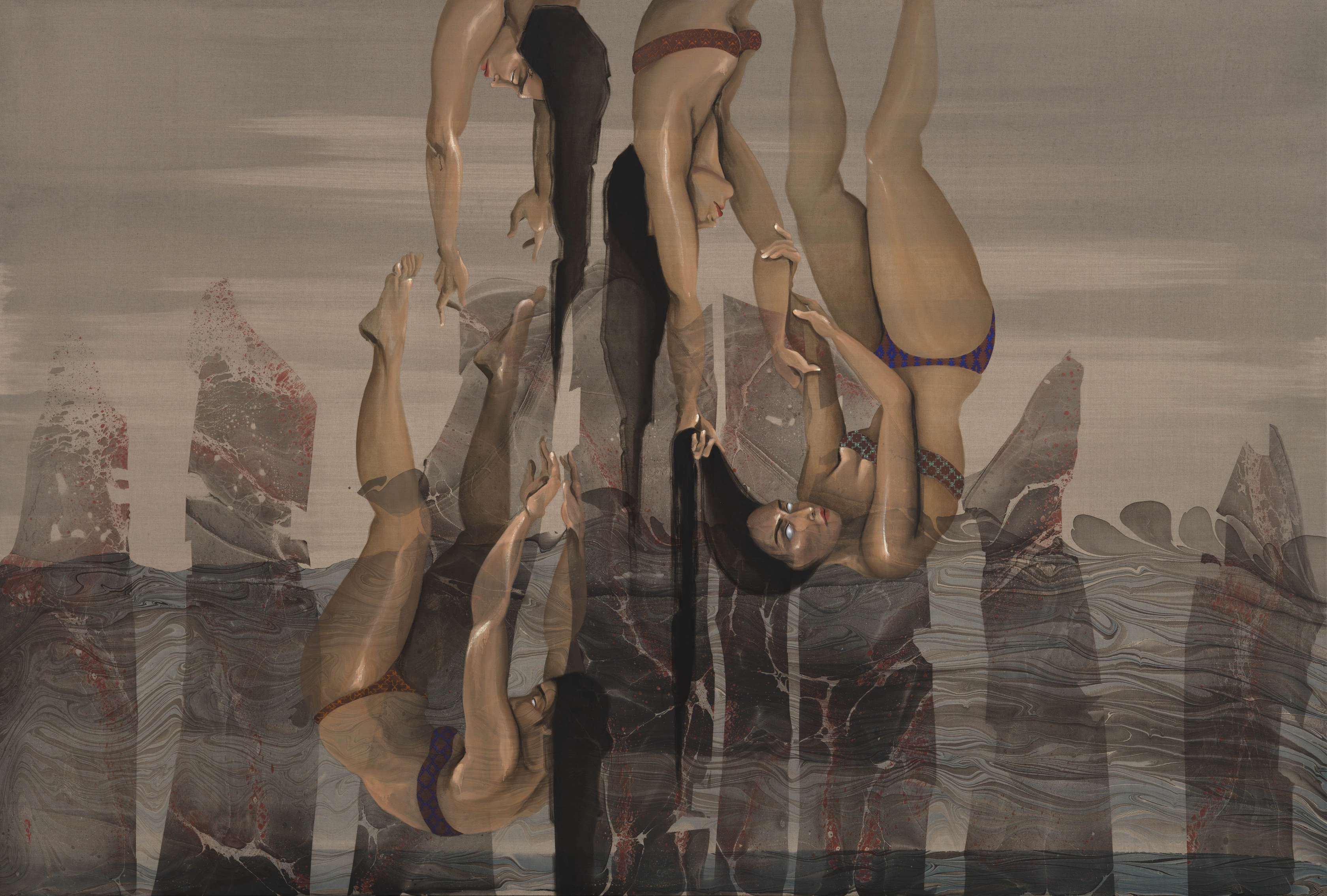
In Kahraman's paintings, marbling (ebru) constitutes one of the principal pictorial surfaces through which the space and spatiality of the world inhabited by her figures are constructed. Streets, landscapes, seas, and environmental terrains intermingle within the fluid structure of marbling, appearing as a chaotic field of becoming that is continuously taking shape yet never fully resolves into fixed form. The figures emerge through the movement of this surface, and the relationship between body and environment is likewise articulated through its flow. In Eyes in Waters (2026), where this relationship reaches a particular intensity, figures and hands appear within the marbled ground, while eyes emerging from the palms and tears flowing from those eyes extend the boundaries of the body into the fluid surface that surrounds it. Pearl-like tears, rendered as solidified forms, become integral components of this visual structure. Eye, tear, pearl, and marbling function as interconnected forms that generate the rhythm of the composition. The tear thus exceeds the limits of the body and becomes a pictorial element integrated into the material fabric of the marbled surface. This visual configuration carries the bodily trace of individual mourning into a broader environmental field. The figures, hands, and eyes that emerge within the constantly shifting surface of marbling acquire an additional historical resonance when considered in relation to contemporary experiences of migration across the sea. While the sea continues to function as a vast route of movement connecting different geographies, it has also become a contemporary site marked by death, loss, separation, and uncertainty in the context of forced displacement. In Kahraman's paintings, this dual historical character of water becomes visible through the positioning of figures within the marbled surface.

Eyes in Waters, 2026, Oil and acrylic on linen, 139.7 x 190.5 cm, 55 x 75 in, Detail
In Eyes in Waters, this relationship becomes even more pronounced through the ornamentation concentrated on the figures' garments. The geometric motifs carried by these figures constitute a fundamental formal category situated upon the textile surface and directly involved in the pictorial construction of the body. The repetition and ordering of these motifs extend beyond the boundaries of the fabric, approaching the anatomical contours of the figure. In certain areas, they intersect and disrupt these contours, blurring the distinctions between figure and garment, garment and surface. Ornament thus becomes a surface that does not merely cover the body but actively shapes the conditions of its appearance. In Kahraman's figures, ornamentation also functions as one of the primary visual structures through which social and cultural codes are articulated. Rather than relying on individualized markers of identity, the patterns borne by the figures determine the historical and cultural visual repertories through which the body is perceived and interpreted. The order produced by geometric repetition becomes a structuring principle that organizes the body's visibility, its modes of perception, and its position within the painting. The material history of textile likewise assumes particular significance here. Motifs carried on fabric accompany the body, migrate across different surfaces, and acquire new meanings through processes of use and circulation. In Kahraman's paintings, this mobile repertoire is transferred onto the pictorial surface and incorporated into the very construction of the figure. As the motif becomes detached from the material and functional contexts of textile, it assumes a new role within the painting, establishing the conditions through which the body becomes visible. Kahraman's ornaments should therefore be understood as visual structures through which cultural memory and social codes become materially inscribed upon the body.
It acquires a broader significance when considered through the problem of content and form, a question that occupies a central place in Hegel's philosophy of art. For Hegel, content and form are not two independent elements within a work of art. Artistic form is the mode through which content becomes sensuous and visible. The conceptual content of a work therefore reveals itself directly in the organization of its form. From this perspective, the rhythmic repetitions of marbling (ebru), geometric motifs, tears, and bodily organs in Kahraman's paintings should not be understood merely as references to the past; rather, they are formal structures through which historical and cultural meanings become visible. Hegel's reflections on Eastern art, discussed throughout his Lectures on Aesthetics under the category of symbolic art, are particularly significant in this regard. In his Aesthetics, Hegel describes symbolism as follows: "Within this form, the Idea finds its shape outside itself; in the sensuous material from which the process of formation begins and to which it remains attached in its appearance. Natural objects are left, on the one hand, as they fundamentally are; yet at the same time the substantial Idea is imposed upon them as their meaning, so that they acquire the task of expressing the Idea and must therefore be interpreted as though the Idea itself were present within them" (p. 76). In discussing different historical forms of art, Hegel places under the heading of symbolism those instances in which conceptual content has not yet achieved complete correspondence with its sensuous form. Form becomes a structure that does not directly coincide with the meaning it bears but instead seeks it out, surrounds it, and strives to render it visible. It functions as a formal system that participates in the sensuous organization of meaning through repetition, rhythm, symmetry, and geometric order. What is particularly significant in Kahraman's practice is her transplantation of this repertoire of historical repetition, together with its formal logic, into the construction of the contemporary figure.
From a Hegelian perspective, what matters here is that form and content cease to exist as external categories. In Kahraman's paintings, marbling, ornament, tears, organs, and the body do not function as independent signifiers. Each becomes a relational element that transforms the meaning and formal character of the others. The fluidity of marbling renders the boundaries of the body permeable, while the repetition of geometric motifs introduces order into that fluidity; the tear, meanwhile, moves from the body toward the surface, traversing the boundary between interior and exterior, between individual experience and historical memory. Form thus becomes the site in which the body's historical, cultural, and sensory experience takes shape. The integrity of the figure in Kahraman's work is likewise dissolved through these relationships. The body merges with the marbled surface; ornament does not merely rest upon the body but participates in its construction; the tear leaves the body and materializes on the surface; and the surface, in turn, folds back into the body. These reciprocal movements establish a continually renewed and permeable relationship between figure and surface. Consequently, the forms inherited from the past are reworked through marbling, ornamentation, and bodily imagery, becoming material manifestations of memory, loss, and female experience in Kahraman's paintings.
Footnote: Copernicus’s heliocentric cosmology unsettled the established cosmological view, supported by sensory experience, that the Earth occupied the center of the universe. In the preface to the second edition of the Critique of Pure Reason, Kant uses this transformation as an analogy for his own epistemology: instead of assuming that knowledge must conform directly to objects, he foregrounds the relation between the conditions of the subject’s cognition and the possibility of objects becoming knowable in experience. In this sense, Kant’s “Copernican turn” refers not to the astronomical model itself, but to a shift in perspective concerning the constitution of knowledge.

info@firezz.com


Comments
00