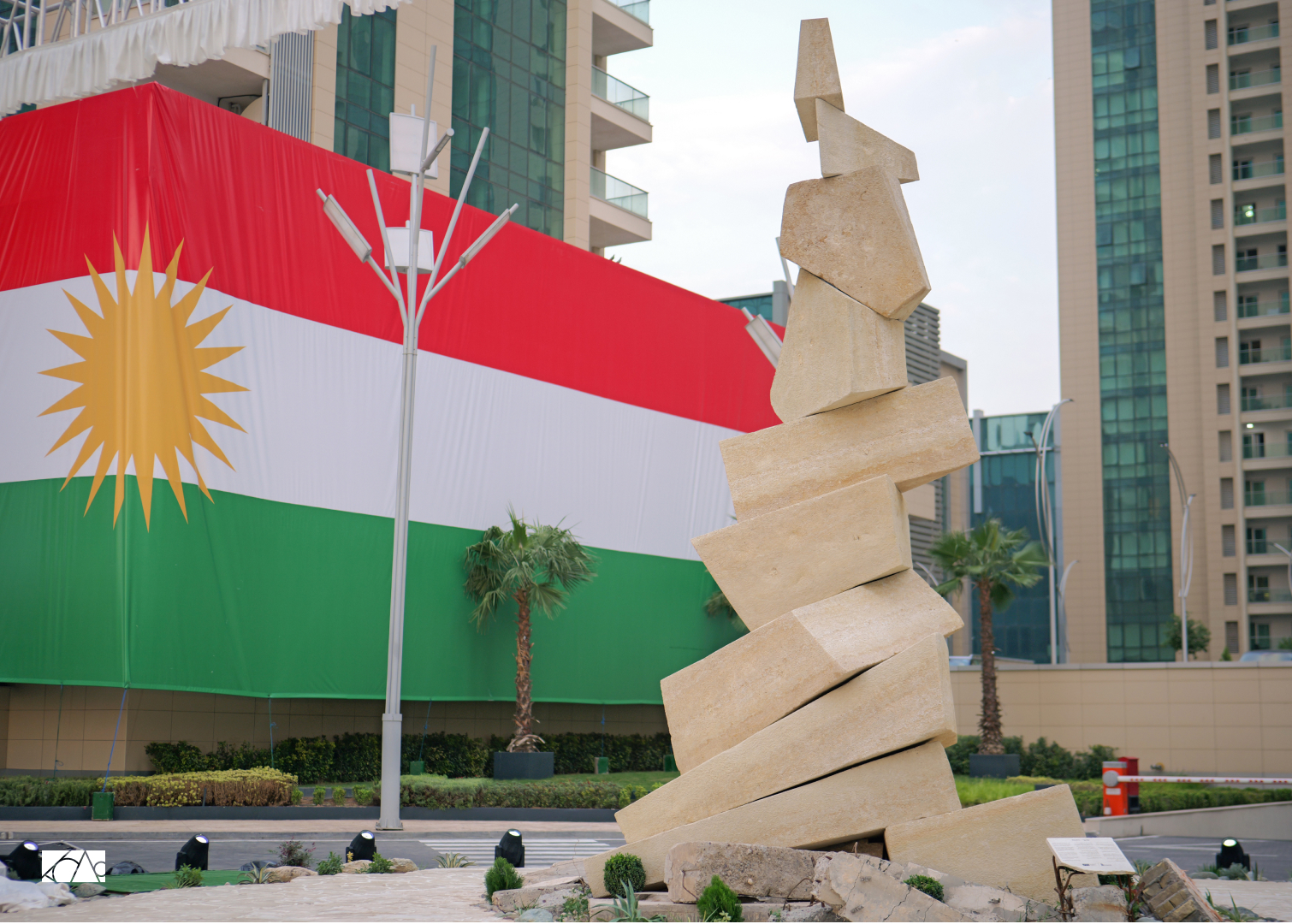
The sculpture Jînwa, designed by contemporary Kurdish artist Walid Siti, was unveiled on October 29, 2026, as a permanent public monument at the Empire World complex in Erbil. Realized through the initiative of Barav Barzani and Roj Peshraw Agha, the work was created in memory of Peshraw Dizayee, his daughter Jina Dizayee, Karam Mikhail, and Michelle Mendoza, who lost their lives in a missile strike on a family home in Erbil on January 15, 2024. The project began when Roj Peshraw Agha approached the Kurdistan Culture and Arts Center (KCAC) with a request to develop a permanent public monument commemorating those who lost their lives in the attack. Subsequently, KCAC began working with Walid Siti to develop the monument's conceptual framework. On June 25, 2025, Siti met with Roj Peshraw Agha and Barav Barzani, founder and president of KCAC, to discuss the project's conceptual foundations and the initial design proposal. During the meeting, Agha expressed his wish for the monument to embody a sense of continuity associated with the ideas of faith, determination, and hope. Accordingly, Siti was asked to develop a conceptual design incorporating debris from the attacked family home as part of the monument's material composition. (1) The monument was designed by Walid Siti and physically realized by sculptor Ghazi Abdal Al-Berwari. The project was directed by Spêde Mizuri, who serves as Public Impact Director at KCAC.
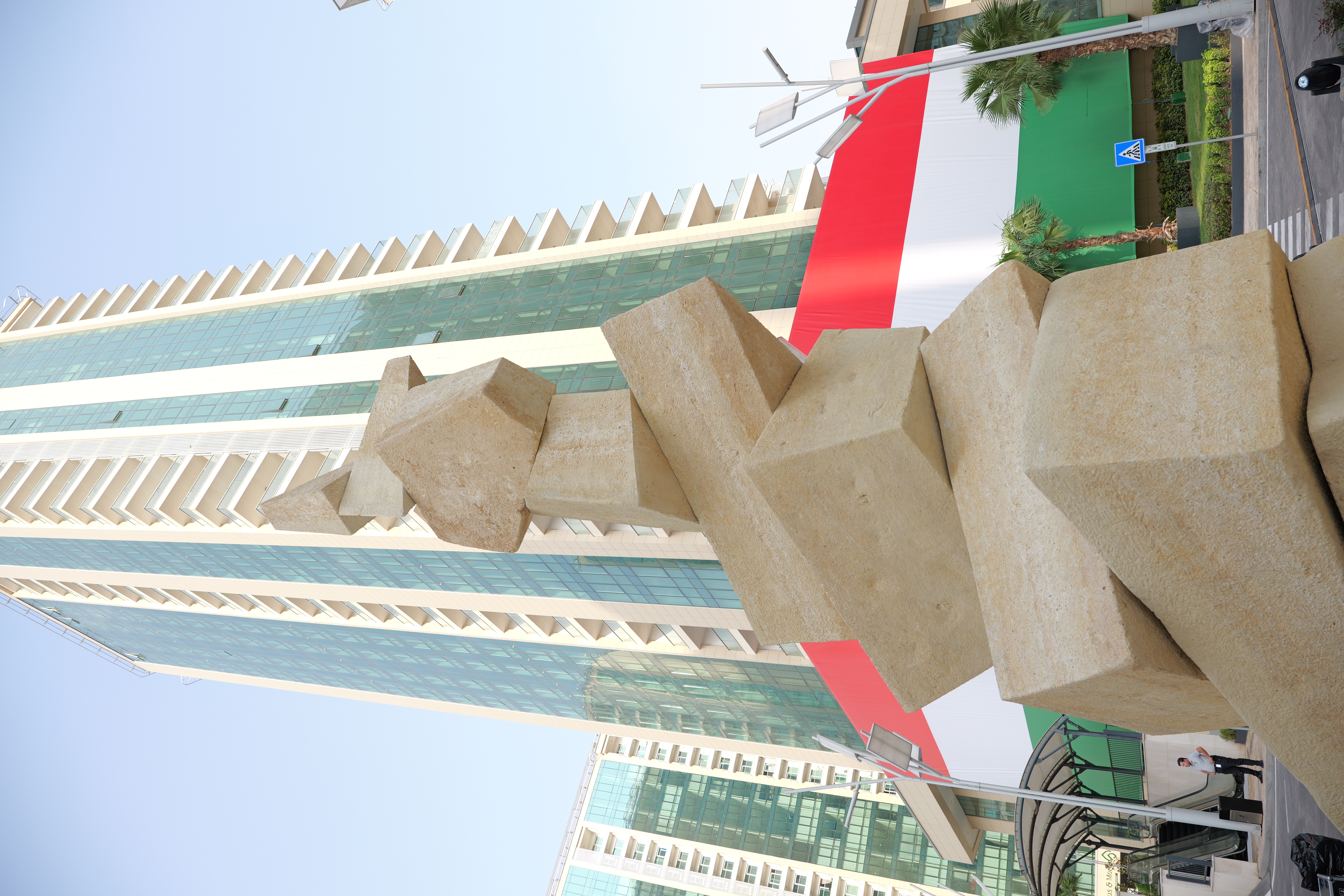
Walid Siti, Jînwa, 2026
Walid Siti’s sculpture Jînwa is a vertical structure formed by stacking stone blocks of varying sizes and geometric shapes atop a mound of rubble. However, this arrangement does not follow the conventional monumental order in which stones gradually diminish in size from bottom to top, forming a regular pyramid with its weight balanced along a central axis. From the very base of the structure upward, the blocks are positioned without fully aligning with one another, jutting out in different directions and displaying no clear correspondence between their contact surfaces. A diagonal movement catches the eye, creating the impression that each block is slightly slipping over the mass beneath it. While one edge of certain blocks extends beyond the boundaries of the stone below, the other recedes; in this way, each successive block transfers its weight onto the preceding mass at a different point, introducing a new deviation into the structure's vertical axis. Each block assumes a distinct angle and orientation in relation to the one beneath it, thereby altering the direction of the ascent. Rather than producing a continuous upward movement through orderly stacking, the structure's vertical trajectory emerges from a search for equilibrium among masses that appear on the verge of sliding off one another. The inclination generates the formal movement that makes the sculpture's ascent possible while simultaneously exposing it to the possibility of collapse. This tension becomes increasingly pronounced toward the upper sections; the uppermost mass marks both the culmination of the ascent and the structure's most precarious point in terms of weight distribution. As each block supports the one above it, it also transmits the deviation created by its own position to the structure as a whole. Consequently, the viewer's attention is drawn less to how the stones are assembled than to how this precarious, shifting arrangement manages to remain standing.
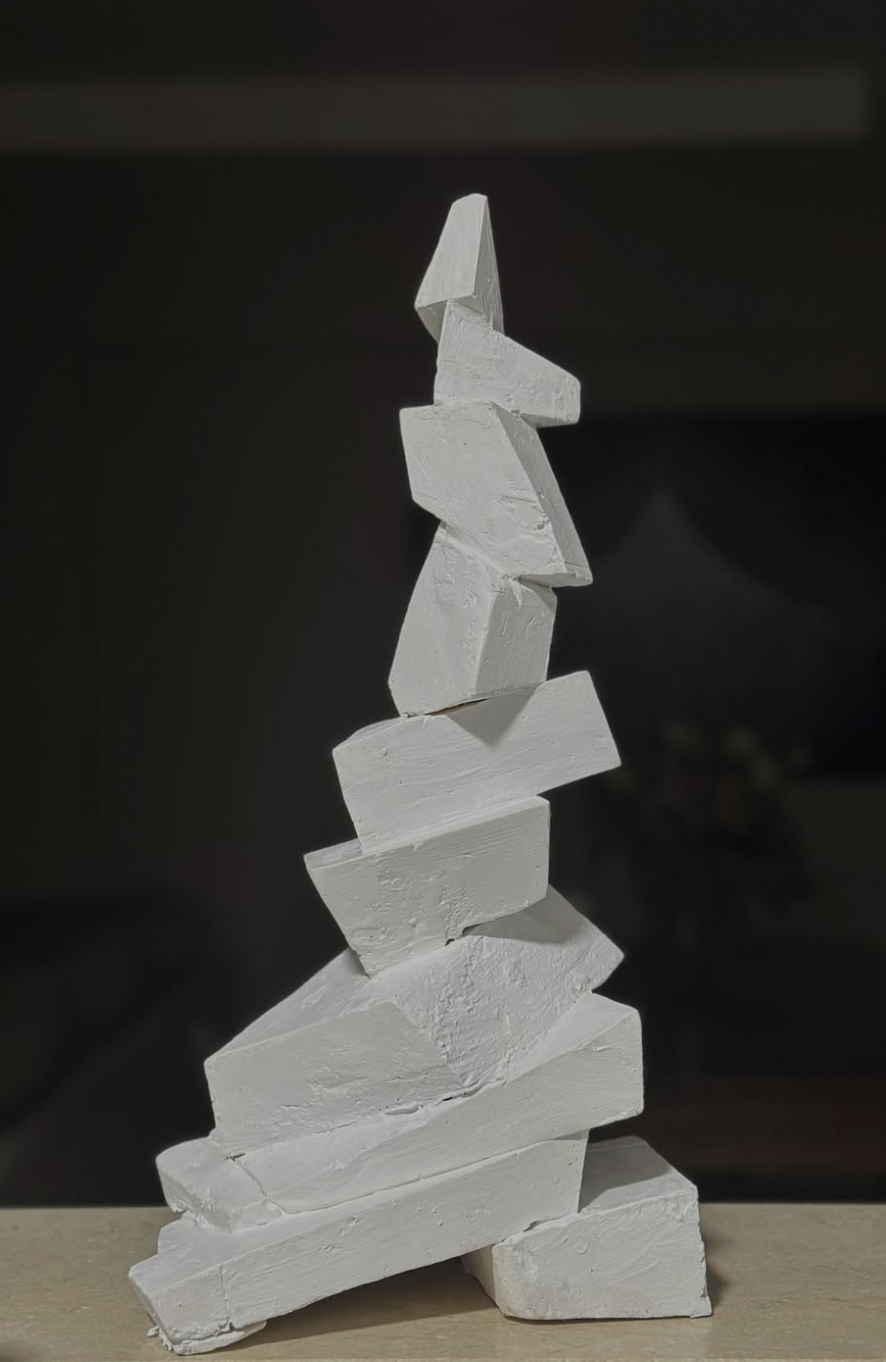
Another element shaping the sculpture's formal construction is the nature of the ground from which it rises. Jînwa is not placed on a levelled surface or a conventional pedestal that separates the structure from its surroundings. At its base, concrete fragments, broken stones, and rubble left behind by the bombing of the family home form the ground on which the sculpture rests. A broken table placed among these fragments also becomes part of the artwork's material composition, serving as an object that remains from the home's everyday life. Thus, the rubble does not remain merely a historical document displayed around the sculpture or an independent object recalling the destruction; instead, it becomes the very ground from which the stone construction rises. This choice also transforms the monument's relationship with the pedestal. In conventional monumental arrangements, the pedestal grants the sculpture a privileged position by separating it from the everyday ground. In Jînwa, however, this distinction disappears. The sculpture constructs its own pedestal from the remains of the destroyed house. The rubble therefore ceases to function as a narrative element subsequently added to the artwork's meaning and instead becomes integral to its material composition, ground, and spatial configuration. Rather than leaving the traces of destruction behind and rising from solid ground, the monument derives its very support from the rubble itself.
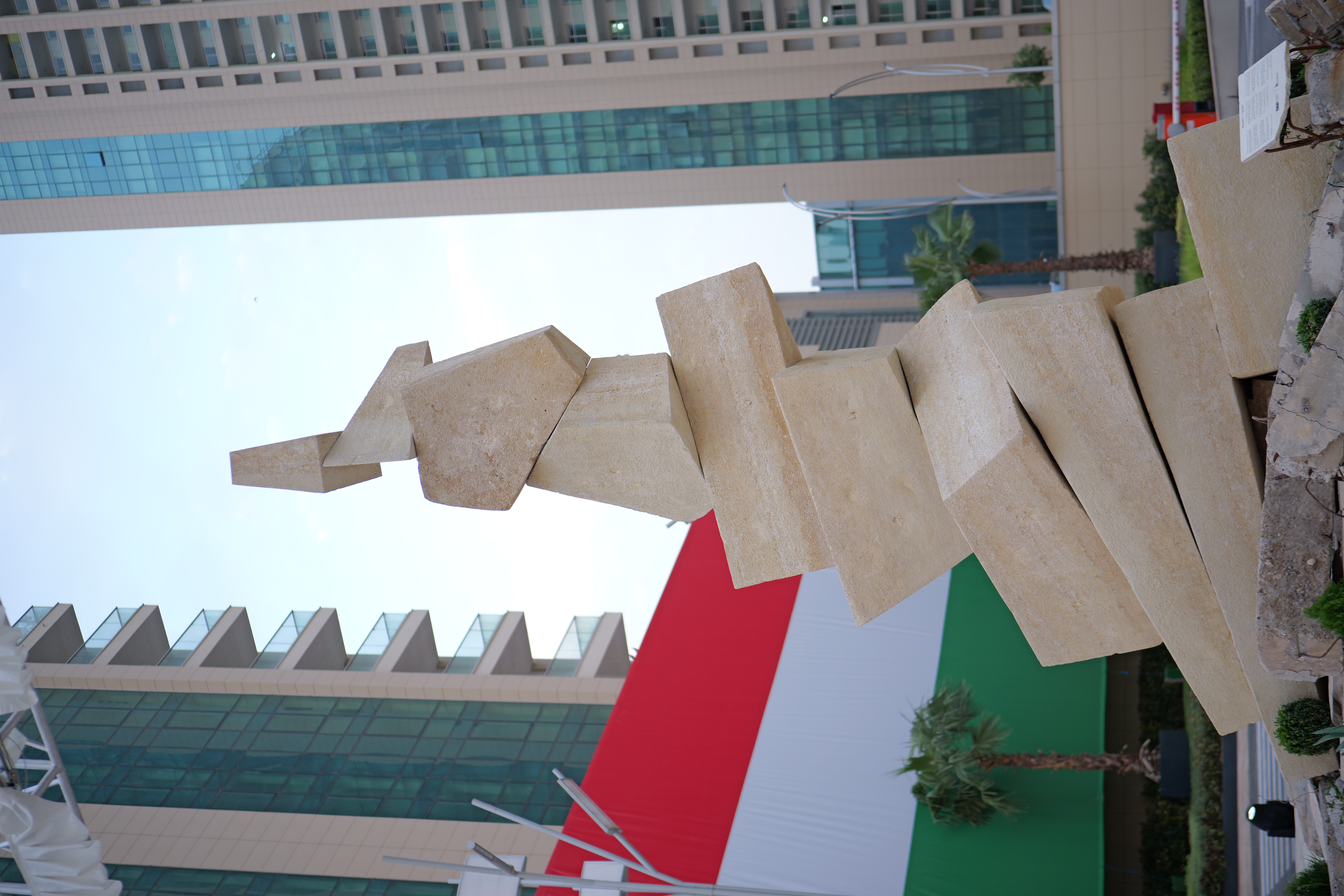
Walid Siti, Jînwa, 2026
In this respect, Jînwa emerges as a structure that challenges traditional monumentality, which is founded on formal harmony and geometric coherence. The relationship that enables the stone blocks to remain together rests on their capacity to support one another while preserving their differences. Unity here takes the form of a tension-filled relationship in which distinct parts sustain one another without converging into a common form or relinquishing their individual characteristics. Moreover, this relationship acquires a broader compositional dimension as the rubble itself becomes part of the sculpture's structural system. Rather than fixing the life, individual, or community it represents within a closed and complete image, Siti questions the very notion of wholeness on which the monument is founded through the construction of its form. Walid Siti's formal decisions in shaping the sculpture acquire another layer of meaning when considered alongside his reflections on social relations. The artist describes this relationship as follows: "I feel that people are trapped in these cities, within the systems they represent. People become part of this structure and increasingly distance themselves from the idea of community. Fragmented into small groups, detached from social cohesion, people submit to hierarchies of power. The order of a historically mature city can symbolize a place that enables individual development and the self-realization of society. Architectural structures within our cultural heritage, such as pyramids, ziggurats, and minarets, give form to this idea. The relationships shaped within our culture reflect a layered social structure. For this reason, I have maintained my interest in historical sites, buildings, and monuments throughout the Middle East. I want to understand the historical context, in the hope that it might shed light on contemporary history..." (2)
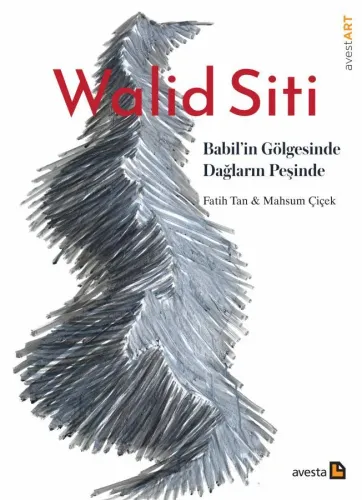
In this statement, the artist associates historical architecture with the idea of a space in which social relations take shape and collective life can develop. As M. Çiçek and F. Tan observe, "From the outset, Walid Siti's artistic practice draws on the lived experiences of the great masses of people who work, suffer, and fight, and who appear to be subject to history but are, in fact, its makers" (Çiçek & Tan, 2025, p. 85). (3) From this perspective, pyramids, ziggurats, and towers also represent the spatial articulation of social order and collective life. Siti's interest in historical architecture extends beyond the formal characteristics of these structures; it stems from a desire to understand the social relations and historical conditions from which this architecture emerged. In Jînwa, however, these historical architectural references are reconsidered through the irregularity and imbalance produced by the arrangement of the stones. The stone blocks come together to form a vertical whole while retaining their formal differences; yet these differences do not give rise to any inherent harmony among them. As each block becomes part of the structure as a whole, it simultaneously occupies a position that puts its balance under strain. The rubble at the base, too, remains an integral part of this fragmented configuration: by becoming the sculpture's foundation, it enters into the load-bearing relations that sustain the whole. In this sense, the sculpture's fragmented construction establishes a formal affinity with the ideas of social fragmentation, individualization, and the erosion of solidarity addressed by the artist. The coming together of different parts does not, in itself, guarantee the formation of a common whole; the conditions of this coexistence and the tensions inherent in it are felt throughout the structure.
The tension in Jînwa becomes apparent in the relationship between its vertical ascent and the fragmented, precarious ground that makes this ascent possible. On the one hand, through its verticality, which evokes pyramids, ziggurats, and towers, the monument references historical architecture's aspiration toward permanence and social order. On the other, it exposes its own fragility through the unstable relationships between the stones and the rubble that forms its foundation. In this way, Siti reconsiders the ideas of solidity and continuity traditionally associated with monuments by foregrounding the precariousness inherent in the sculpture's own formal construction. In Jînwa, ascent does not entail the achievement of a stable, unified whole; rather, it becomes an effort to sustain a structure in which differences, incongruities, and the traces of destruction are held together.
Walid Siti's Approach to Sculpture
Traditional monumental forms such as pyramids, ziggurats, and towers organize vertical ascent through geometric order and hierarchy. In these structures, successive layers are arranged to converge toward a predetermined apex, while the differences between individual components are incorporated into an architectural order that ensures the stability of the whole. The ideal represented by the monument becomes visible through this geometric coherence. Walid Siti's monuments, however, question the assumptions underpinning this representational order. His work Monument to the Unsung takes the form of a mountain-like construction composed of approximately fifty-five blocks. By inscribing common Kurdish women's names onto these blocks, Siti critically addresses the monumentalization of men within narratives of war and heroism, drawing attention to how women's resistance and historical roles have largely remained invisible in public memory. Women's names bearing meanings derived from nature, such as Kani (spring) and Ronahî (light), create a space of remembrance that evokes the burdens borne by mothers, sisters, daughters, and wives in the face of war, forced displacement, loss, and humiliation. In this way, Siti reconfigures the monument's repertoire of heroism and representation through women's life experiences, which have so often gone unrecorded. Yet the inscription of names onto stone blocks does not render individual life stories visible one by one; rather, it brings them together within a shared space of remembrance. While each name retains its individual meaning, the ensemble formed by the approximately fifty-five blocks points beyond individual lives toward a collective presence of women.
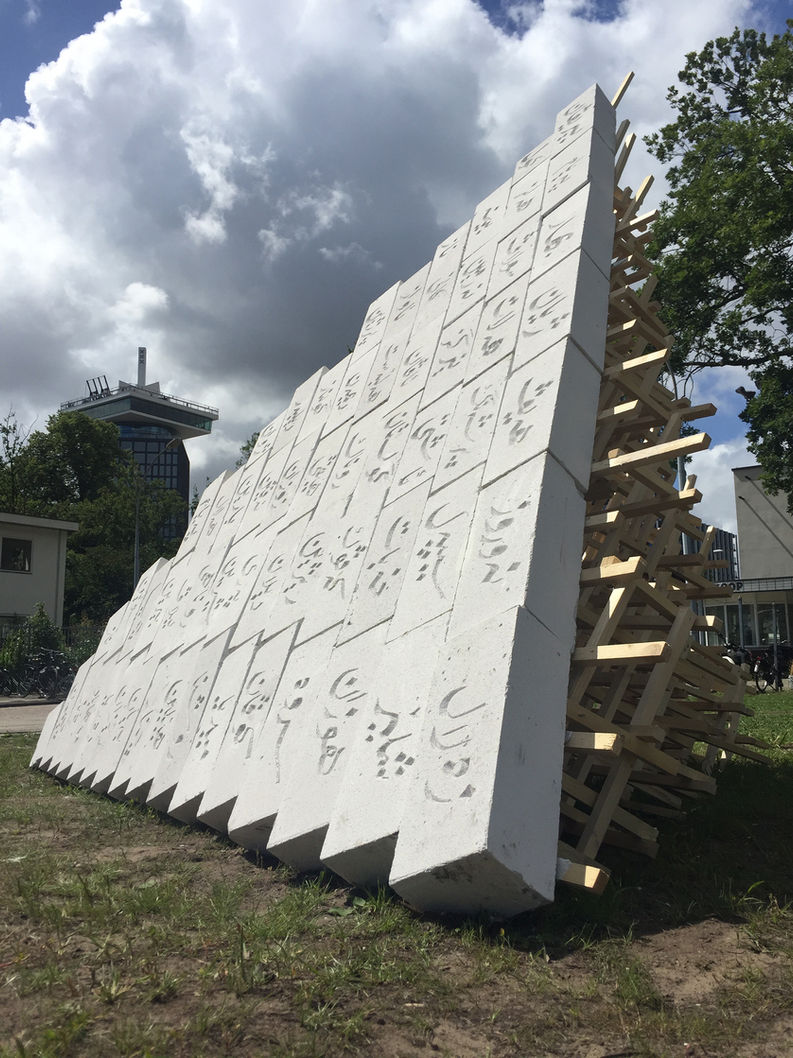 Detail, Monument to the Unsung, 2018 Aerated cement block & pine wood, 300x400x300cm
In Strike a Pose, Siti interrogates the representational order of the monument through the relationship between the head and a pedestal that represents a people. In the busts depicting tyrannical figures, the head does not occupy the highest point of the monument as the crowning element of a coherent whole. Instead, the formal and semantic correspondence between the head and the pedestal is disrupted across different variations. The relationship between the position of the head and the pedestal intended to support it remains unsettled. This disjunction undermines the mode of representation through which figures of power use monuments to glorify and immortalize themselves. Although Monument to the Unsung and Strike a Pose approach the subject from different directions, both point to a common question underlying Siti's understanding of monumentality: Whom does a monument make visible, on whose behalf does it speak, and whose lives does it exclude from public memory? While Siti makes the often-overlooked social presence of women the subject of the monument, he undermines the monumental coherence of power through the incongruity between the tyrant's head and its pedestal. In both works, the monument ceases to be a closed form that perfectly corresponds to the person or community it represents. Instead, it becomes a space in which the relationships between visibility, representation, and power are reconsidered.
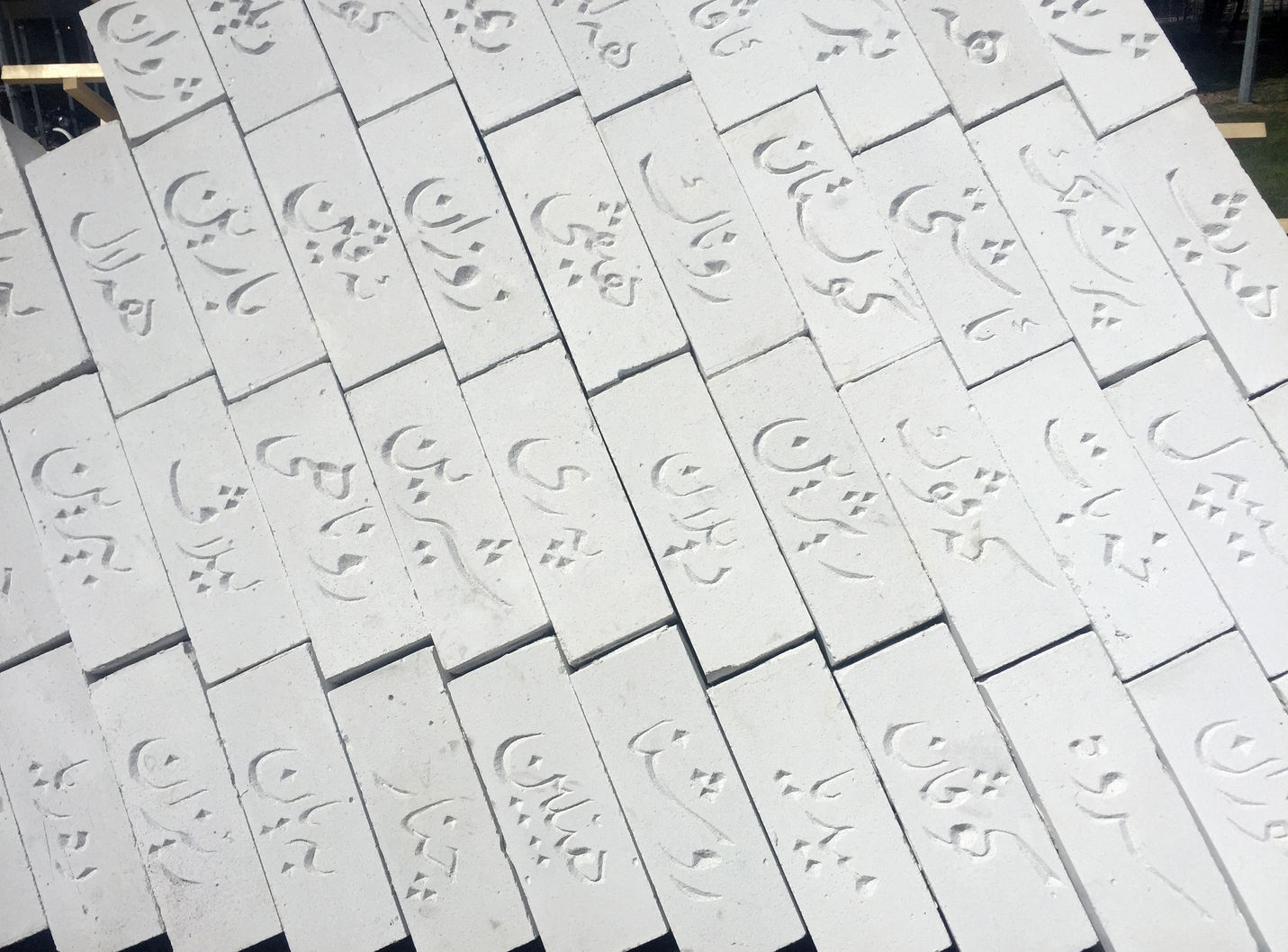 Detail, Monument to the Unsung, 2018 Aerated cement block & pine wood, 300x400x300cm
The monumental force of Jînwa emerges not from representing the Kurdish people as a harmonious and completed whole, but from incorporating the historical tensions inherent in their collective existence into the sculpture's formal construction. In Siti's approach to monumentality, unity is not achieved through the homogenization of its constituent parts or the subordination of differences to a common geometric order. The stones support one another despite never fully aligning; as the structure rises, it retains its internal imbalance. Rather than eliminating the contradictions inherent in coexistence, this arrangement transforms them into the very structural relations that hold the sculpture together. In this context, the concept of aporia provides a useful framework for examining the sculpture's formal and intellectual construction in conjunction. In its philosophical sense, aporia refers to an impasse in which thought cannot resolve a problem through existing conceptual frameworks or find a definitive way forward among competing directions. Aporia, therefore, signifies more than the mere coexistence of opposing conditions; it points to a knot of thought that requires a reorientation of thinking precisely where contradictions resist reconciliation. In his book Disagreement, Rancière draws attention to such knots arising from philosophy's encounters with politics, art, science, and other forms of intellectual activity: “Philosophy has its singular objects, its knots of thought, born of an encounter with politics, art, science, or some other thinking activity, bearing the mark of a specific paradox, conflict, or impasse (aporie/aporia).” (Rancière, 2005, p. 11) (3) In Jînwa, this knot of thought becomes apparent in the relationships between remaining together and remaining different, rising and bearing the possibility of collapse, permanence and fragility. The sculpture does not resolve these contradictions by subsuming them into a higher harmony. Instead, it keeps each of them active within its structural composition, confronting the viewer with the question of the conditions under which standing together might be possible. Unity, therefore, departs from the harmony imposed upon individual parts by a predetermined whole. What emerges is a form of collective existence in which differences sustain one another without any of them becoming identical to the other. The monumentality of Jînwalies precisely in making this unresolved tension visible as one of the constitutive conditions of communal life, rather than seeking to eliminate it.
This formal impasse acquires another dimension when considered in relation to the historical and social existence of the Kurdish people. The fact that Kurds share a common historical and geographical past does not mean that this past has been experienced under the same conditions everywhere, nor that their social existence has been unified under a single identity or form of political representation. The division of Kurdistan among four states; the impact of borders on family ties, language, culture, and social relations; the policies of oppression and assimilation implemented under different administrations; forced migration and displacement; and the new conditions of life shaped by the diaspora have all shaped Kurdish society's historical experience in divergent ways. Kurmanji, Sorani, Zazaki, and other forms of linguistic and cultural expression, alongside different beliefs, local affiliations, and political orientations, constitute the internal diversity of this social fabric. The bond with a shared history and geography does not, therefore, erase differences in experience. Commonality and difference, coexistence and division, displacement and attachment to the land cannot be understood independently of one another in the historical experience of the Kurdish people. This historical configuration also brings the relationship between equality and inequality into focus. The bonds Kurds have forged around a shared history and geography do not require different social experiences and political orientations to be subsumed under a single identity. The demand for equality here rests on the possibility of these differences existing as equal subjects. Borders, political powers, and mechanisms of representation, however, continually constrain this possibility by assigning unequal positions within the shared space of social life. In Rancière's political thought, equality emerges not from accepting the positions allocated by the existing order, but from questioning the relations of inequality that determine those positions. The formal construction of Jînwa can also be read in this light: the way the stones support one another while retaining their distinct dimensions and orientations suggests that the constituent parts of a common structure need not be homogenized for that structure to be founded on equality. Without directly depicting this historical reality, the stone construction Siti creates in Jînwa invites reflection on its formal counterpart. The way the stones jut out in different directions, fail to fit perfectly together, and yet remain part of a single structure establishes a connection with the collective existence that Kurdish society sustains across diverse historical experiences. The remains of the destroyed house and the broken table at the sculpture's base lend this relationship a material dimension: here, the social reality of the Kurds moves beyond an abstract narrative of identity and encounters material experiences such as home, everyday life, loss, and destruction. Siti's artistic strength lies not in producing a ready-made image to represent this historical existence, but in constructing a form capable of sustaining its unresolved contradictions.
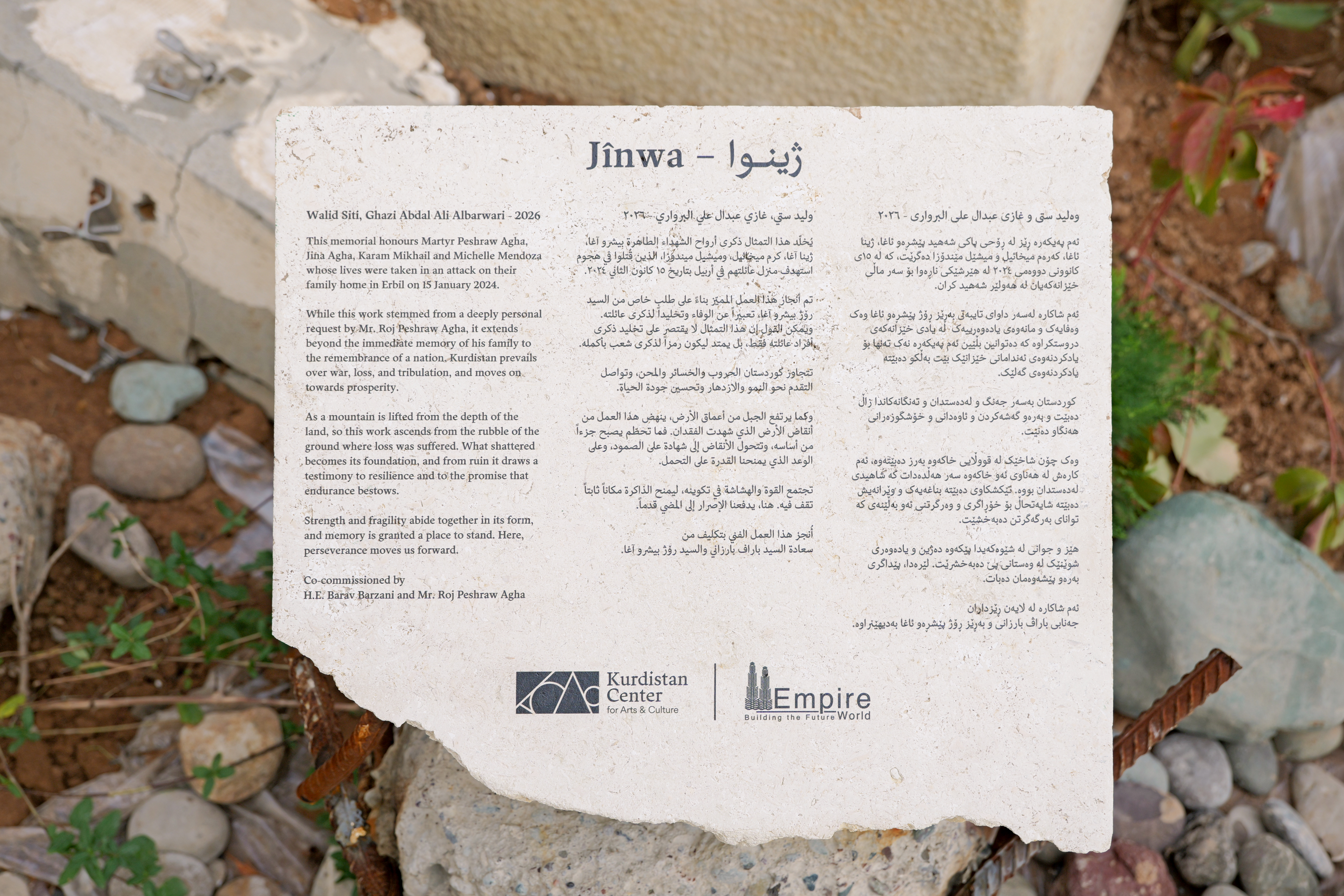
Walid Siti, Jînwa, 2026
Walid Siti’s artistic trajectory offers an important point of reference for considering the relationship between visibility in the international art world and the conditions of public art production in Kurdistan. Siti, who has exhibited internationally for many years, realized public art projects in different countries, and gained recognition for his work, has now brought Jînwa into being as a permanent public monument in Erbil. This is significant in that it allows his artistic practice to find a public presence in his own geographical and cultural context. An artist's ability to realize a permanent public artwork in their own region depends not only on the quality of their artistic production but also on the existence of institutions, exhibition opportunities, public spaces, and cultural policies that support it. Kurdistan's political and administrative fragmentation, the development of art institutions under different governance structures, and the fragmented nature of public cultural spaces and sustained support mechanisms make it difficult for contemporary Kurdish art to establish lasting institutional relationships within its own geographical context. Under these conditions, many artists who gain visibility in international art circles may find it difficult to establish sustained connections with exhibition spaces, museums, archives, and public art venues through which they can bring their work into contact with their own communities. Siti's Jînwa, realized as a permanent public monument in Erbil, is significant in that it translates the formal and intellectual approach he has developed within the international art world into a public artwork in his own geographical context.
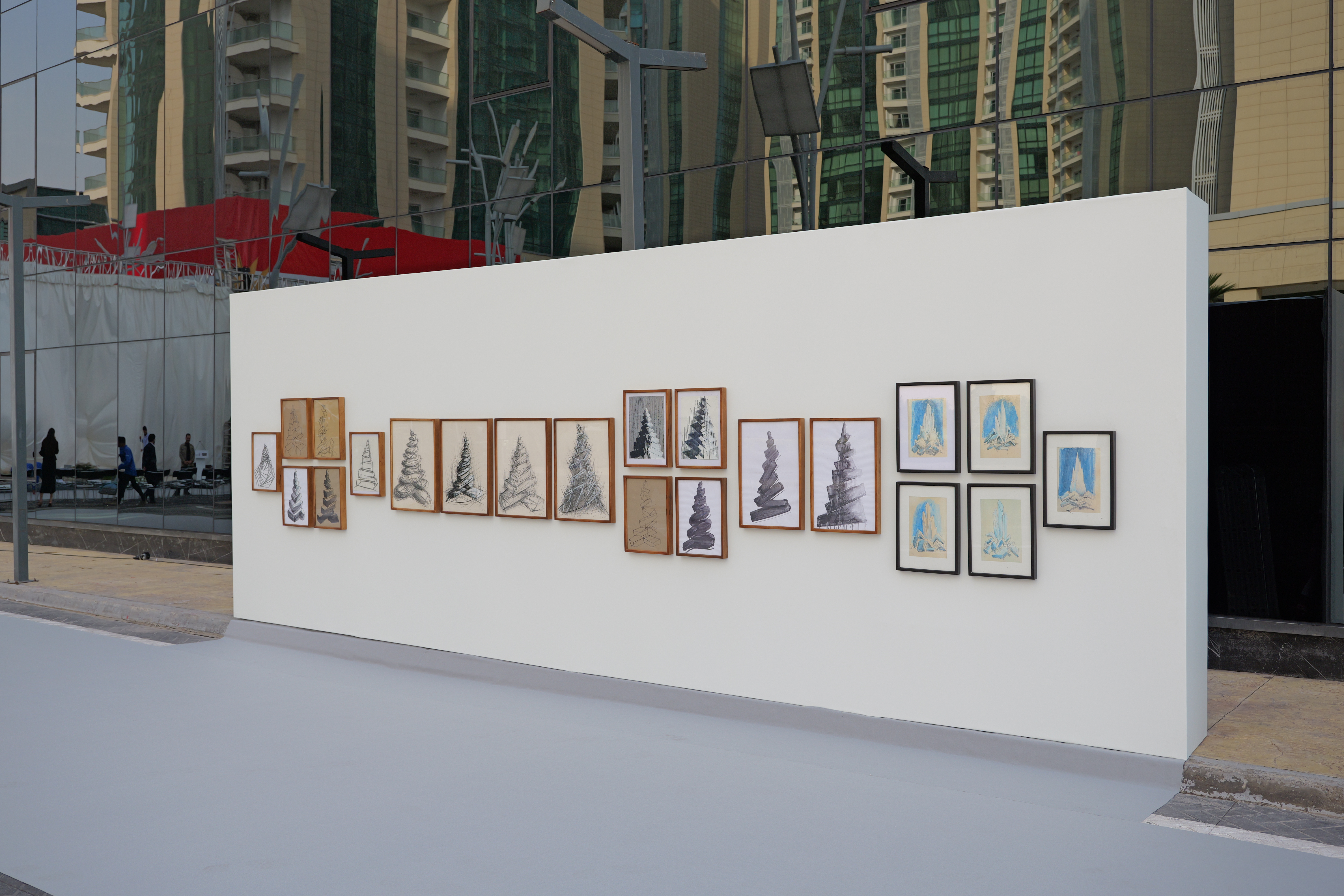
Through its role in bringing the Jînwa project to fruition, the Kurdistan Culture and Arts Center (KCAC) provides a concrete example of the kinds of institutional relationships that contemporary Kurdish art needs. The relationship established among the artist, the family whose loss the monument commemorates, the cultural institution, and the public space demonstrates how the process of bringing an artwork from the design stage into the public realm can take shape through the contributions of different actors. KCAC's contribution is significant in that it brought together Walid Siti's artistic design, the family's participation, and the realization of the work in the public space within a collaborative project. Such institutional initiatives can help ensure that the visibility artists gain in the international art world also finds resonance within their own social and geographical contexts, creating opportunities for lasting relationships and new forms of artistic production. At this point, the concept of the sensorium acquires a public dimension. The continuity of the shared field of sensation emerging among artistic practices shaped by diverse historical and social experiences depends on the existence of spaces, institutions, and channels of circulation through which these works can encounter audiences. Rather than fixing this shared field of sensation within a single aesthetic or political framework of representation, institutions can create the conditions for encounters in which different artistic practices become visible and establish connections with one another. In this respect, Jînwa constitutes a permanent point of encounter where shared historical experiences can be sensed and brought into public discussion.,
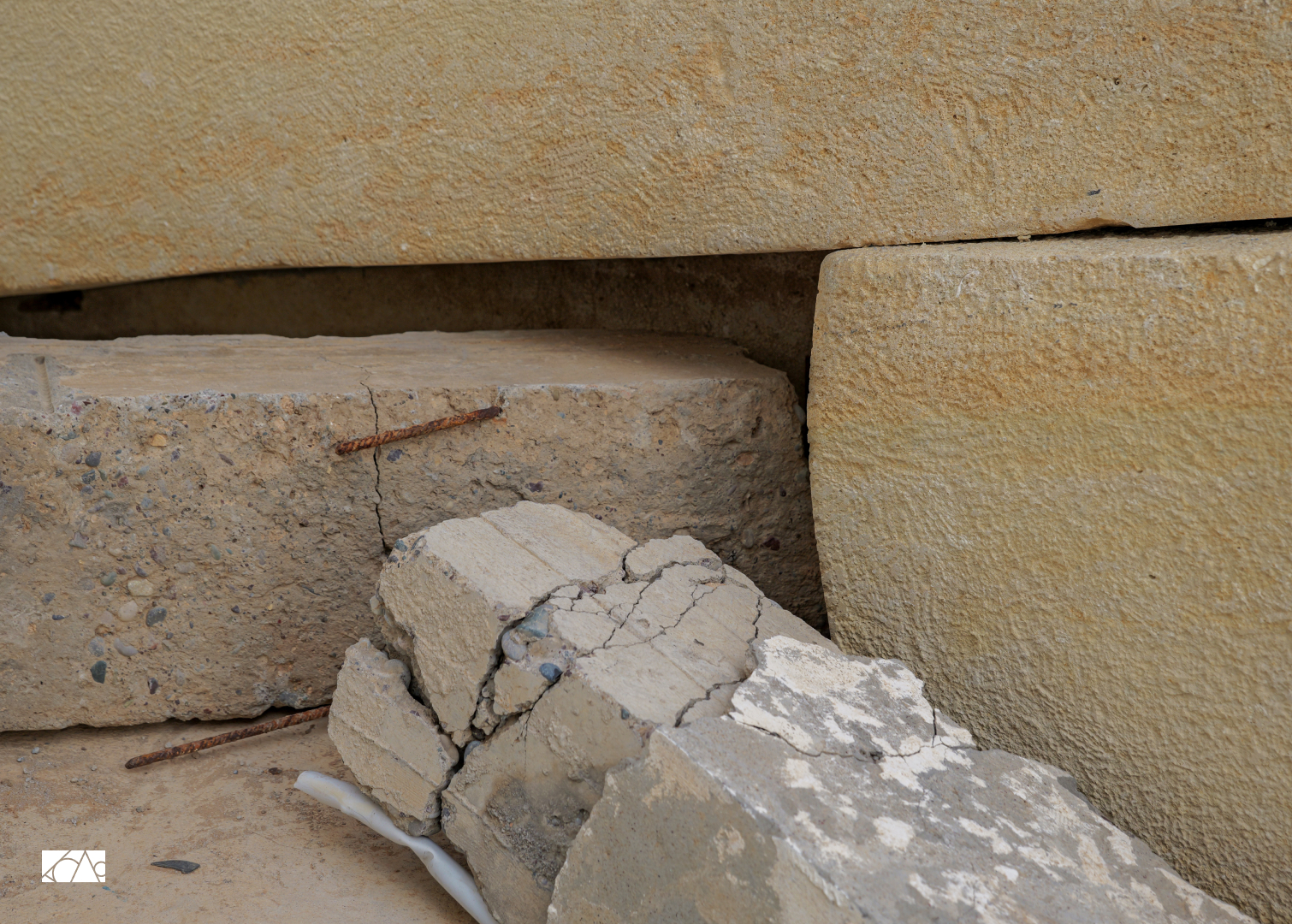
Walid Siti, Jînwa, 2026
Jînwa emerges as a work that invites a reconsideration of the relationship between form, history, and social existence within Walid Siti's understanding of monumentality. The monument's strength lies in making the historical contradictions inherent in collective existence visible and perceptible, without subsuming the community it represents under a unified and completed identity. The form of Jînwa suggests that living together does not automatically produce a harmonious whole; rather, it takes shape through differences, encounters, and conflicts. In this respect, Jînwa draws the multiple layers of the Kurdish people's historical experience into the construction of a single structure. The remains of the destroyed house, objects left behind from everyday life, and the tense relationships between the stones carry the monument's meaning beyond an abstract narrative of identity. While aporia opens up the unresolved historical and political tensions of this collective existence to critical reflection, the sensorium enables us to understand the shared field of sensation that emerges across different artistic practices. At the intersection of these two conceptual frameworks, Jînwa proposes a form through which commonality can be established without erasing differences. The monument's permanent presence in the public realm brings this formal and intellectual proposition into everyday life. Thus, while preserving the memory of those who lost their lives, Jînwa does not merely confront viewers with an act of destruction that took place in the past; it also brings into the present the question of the conditions under which communal life can be established. Siti's understanding of monumentality becomes particularly evident here: rather than freezing the past within an immutable representation, it keeps the relationship with the past open and active in the present. The ascent of Jînwa, therefore, embodies the possibility of a shared life that sustains itself through its differences and tensions.
Footnotes
-
Taken from the text on the monument's plaque.
-
Çiçek, M., & Tan, F. (2025). Walid Siti Babil’in Gölgesinde Dağların Peşinde. Avesta Publications.
-
Rancière, J. (2005). Uyuşmazlık [Disagreement] (H. Hünler, Trans.). Ara-lık Publications.


Comments
00