
Focusing on memory, loss, everyday life, and practices of resistance in the work of Kurdish artists, the group exhibition ENDURANCE has opened at The Street Gallery, part of the Institute of Arab and Islamic Studies (IAIS) at the University of Exeter, UK. Curated by Niga Salam, the exhibition approaches endurance through the diverse historical experiences of Kurdistan, presenting it as a concept that reveals how life continues in the Proxy of war. Salam’s words clearly articulate the exhibition’s point of departure: “ENDURANCE was not created to explain everything about Kurdistan, but to open a door. People learned new things, some were deeply moved, and some were inspired.” This approach invites audiences to encounter a range of lived experiences. Moving beyond the images of war commonly circulated in the media, the exhibition foregrounds the ruptures accumulated within everyday life, the persistence of a shared but remote memory, and the ways in which life is rebuilt and sustained.
The exhibition features works by Faek Rasoul, Hardi Kurda, Ahmed Najm, Sarina Panahideh, Kamaran Najm, Bzhwen Jamal, Awaz Suad, Baha Yasir, and an essay by Hoshang Bahjat. Bringing together artists from different generations and disciplines, ENDURANCE was realized in collaboration with the Sulaymaniyah-based Metrography Agency. Incorporating photography, video, installation, sound, and archival materials, the exhibition examines the long-term effects of war and its aftermath. In this context, the title ENDURANCE points to resilience as a form of resistance: one that carries memory, reorganizes life, and enables cultural continuity. Experiences such as loss, forced migration, war, and displacement are understood not as isolated events, but as elements of a shared memory transmitted across generations, of ways of life continually reconstructed through everyday practices, and of an enduring cultural continuity.
Faek Rasoul – Depleted in Memory
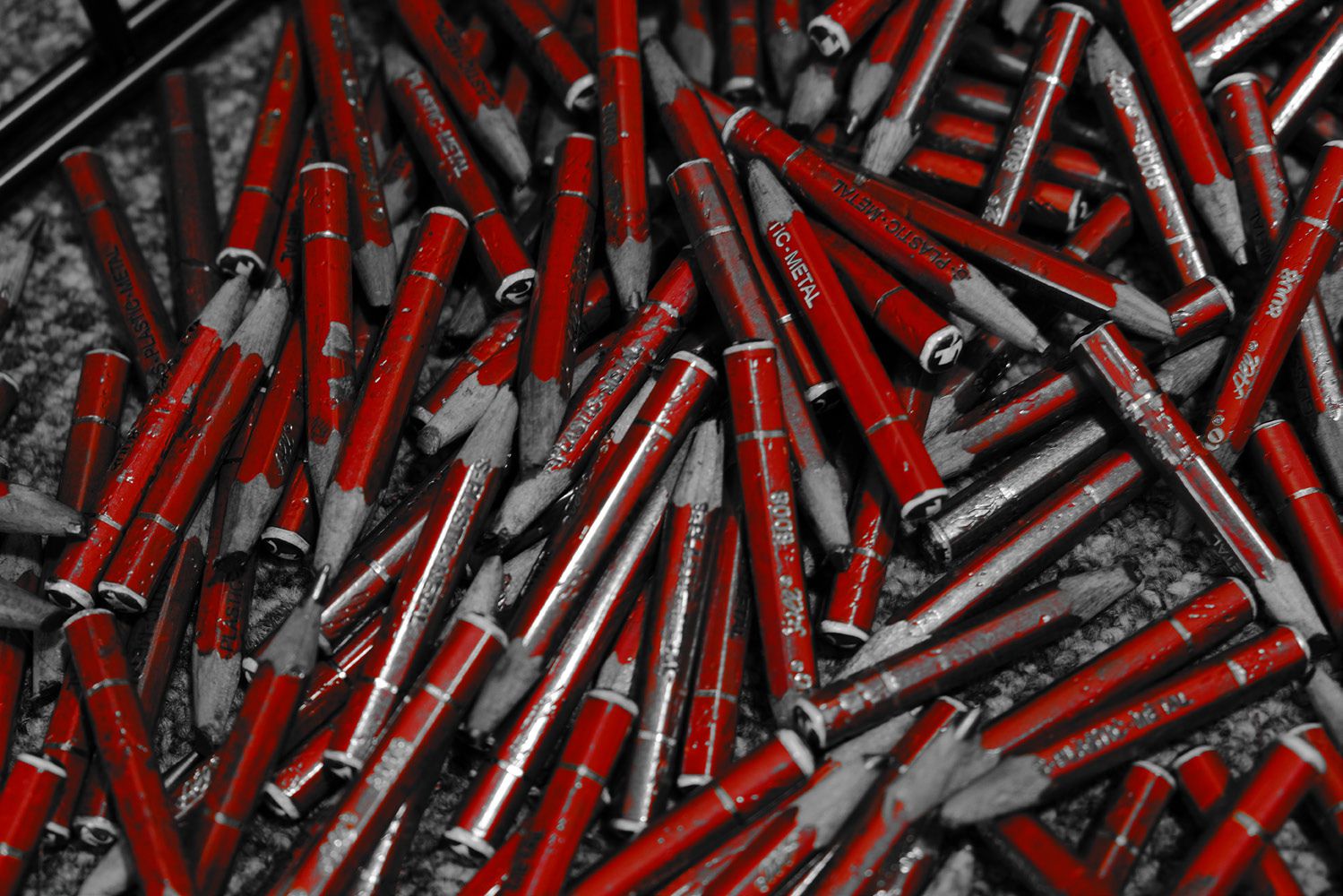
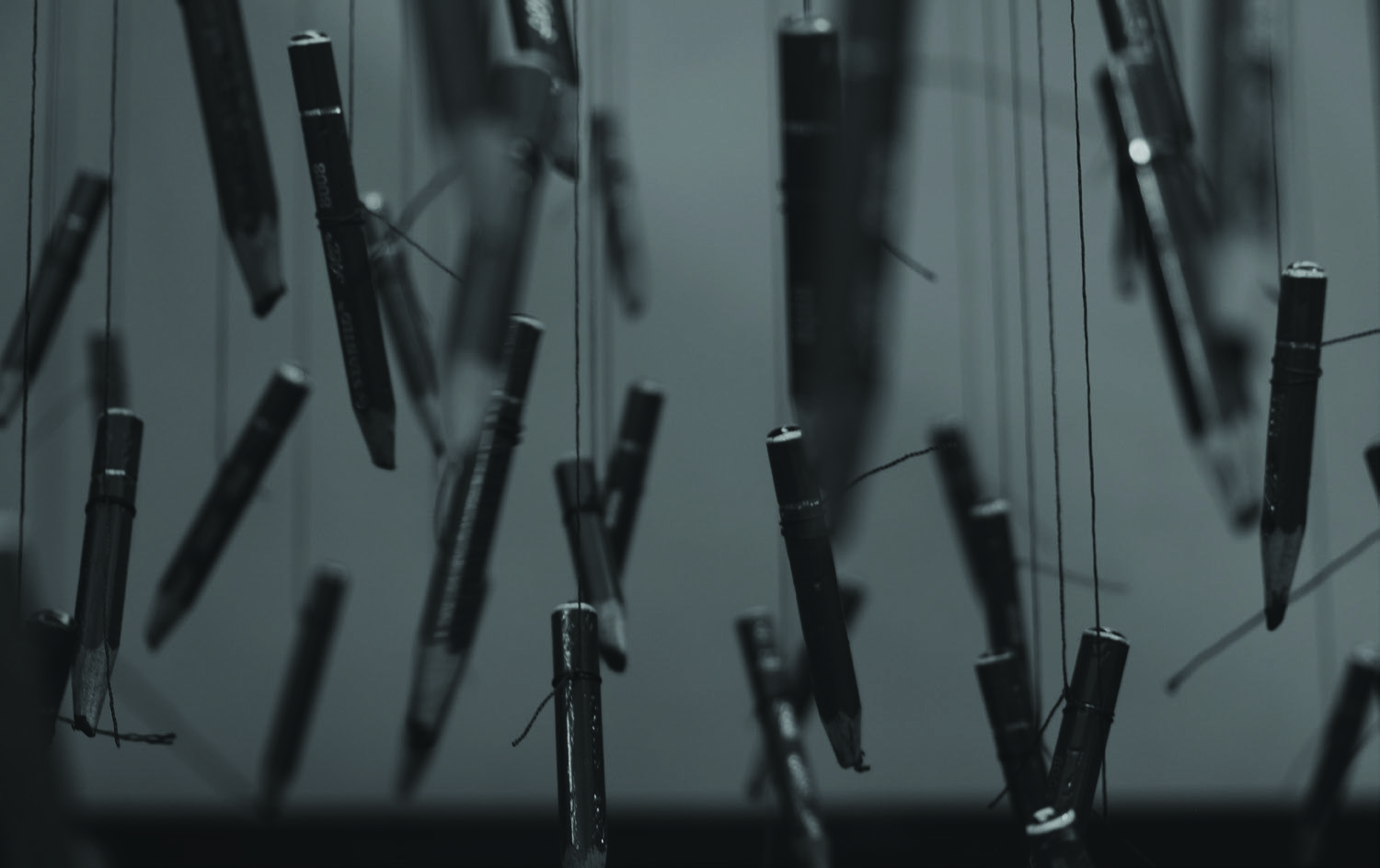
One of the exhibition’s most compelling works is Faek Rasoul’s installation Depleted in Memory. By arranging thousands of used pencil stubs collected over the years on a metal grid, Rasoul transforms the remnants of the creative process into the primary material of the artwork. Left behind through acts of drawing layers of pencil strokes, these small fragments cease to function as the discarded residue of completed works and instead become material traces carrying the accumulation of time, labour, and memory. As the artist notes in the accompanying text, his drawing practice is grounded in repetition, mark-making, and the continuity of memory. In this installation, that same process becomes visible through the worn and shortened pencil stubs themselves. Suspended and pointing downward, the pencil tips evoke a sense of threat or aggression, while simultaneously bearing the marks of time, pressure, and continuous creative production. Rasoul regards the thousands of pencil stubs accumulated in his studio as the remaining fragments of a creative process shaped by the effort either to suppress intense memories or to confront them directly. The displayed pencil stubs are a mere part of the collected stubs over the years. As the Kurdish expression goes: it but a fistful from a winnowing (مشتێکە لە خەرمانێک)
Baha Yasir – The Weighted Strand
Another notable work featured in the exhibition is Baha Yasir’s The Weighted Strand. Yasir approaches endurance as a vehicle of historical continuity. Spanning the gallery wall, the large-scale installation brings together the artist’s text and a chronological timeline extending from 1916 to the present. Along a red line, historical events, treaties, massacres, migrations, and political ruptures unfold not as a simple sequence of dates but as an interconnected fabric of memory. Here, chronology ceases to function as a neutral tool for organizing the past and instead becomes a visual expression of historical experience shaped by interruption, repetition, and accumulation.
Selected Works by Kamaran Najm
Photographer Kamaran Najm explores war, its aftermath, and resilience through the lens of everyday life. The photographs presented in this selection reveal fragile yet hopeful moments that persist even under the shadow of conflict. The image of a smiling woman on a swing, set against the presence of military figures in the background, evokes a sense of humanity and joy that endures even amid war. Najm approaches endurance not through narratives of heroism, but through the quiet forms of resistance embedded in ordinary moments. His photographs become visual testimonies that document both the traumas of life in Kurdistan and the hopes continually rebuilt in their wake.

Ahmed Najm – Abdi’s Route
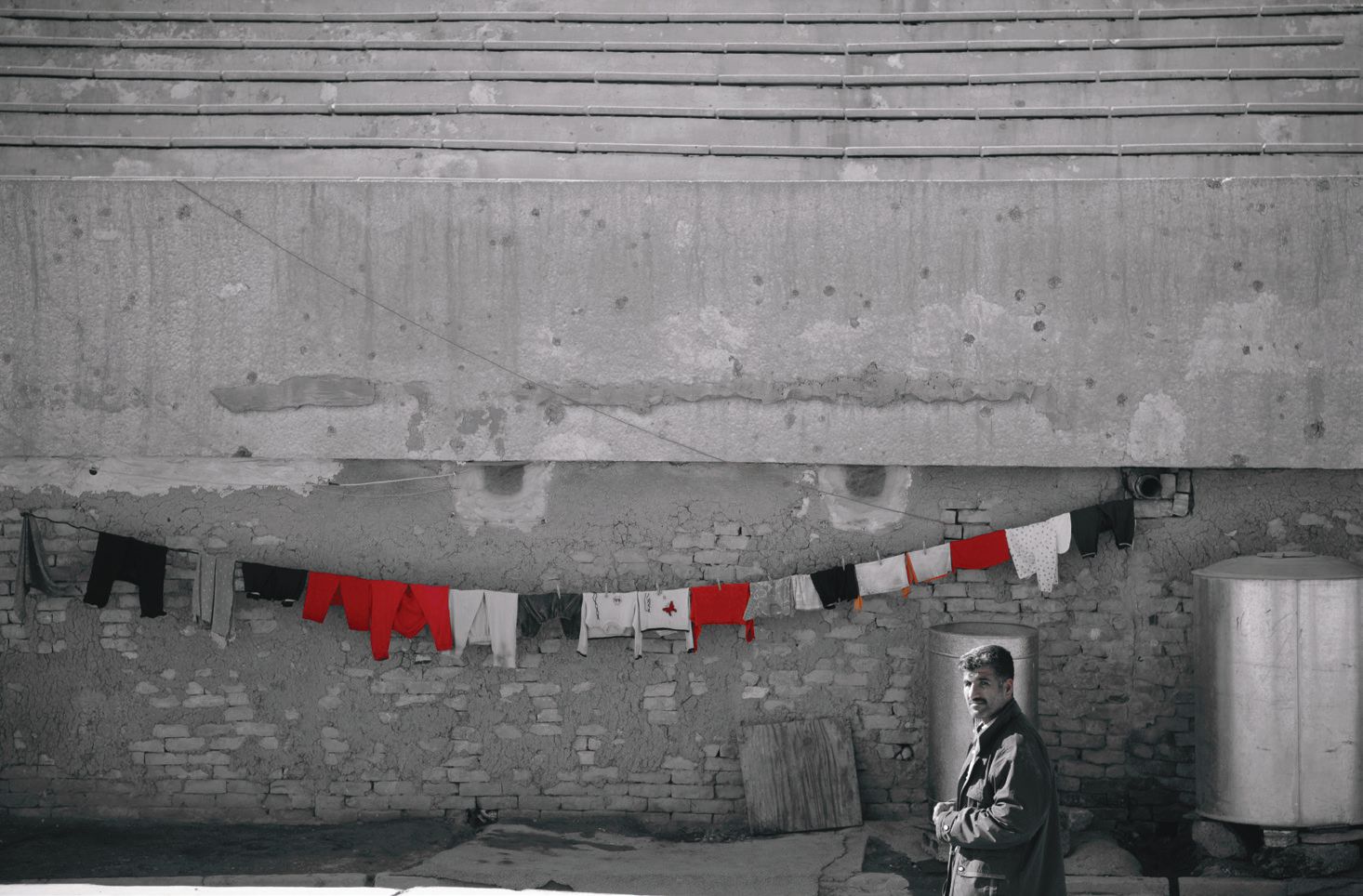
Photographer and Metrography Agency Director Ahmed Najm participated in the exhibition both as an exhibiting artist and as a speaker representing the agency. Moving beyond the dominant media representations of war, Najm’s work focuses on documenting overlooked stories and quieter forms of witnessing. In his photographs, conflict emerges not only as a site of destruction but also as a space where human dignity and resilience endure. Najm’s contribution to the exhibition takes shape through the screening of a documentary that explores the life and story of Mazlum Abdi’s father in Rojava. Through the lens of an individual life story, the film examines the intersections of family, memory, identity, and the social and political realities of Rojava. By tracing the story of Mazlum Abdi’s father, the documentary reveals how personal memory intersects with broader historical and collective narratives, creating a layer that complements the exhibition’s core themes of identity, belonging, and memory. More broadly, Najm’s contribution extends the testimonial power of documentary photography into a conceptual framework. Considered alongside the historical timeline presented in the exhibition, his work contributes to the reconstruction of Kurdish collective memory as a visual archive. This approach closely aligns with the central premise of ENDURANCE: endurance is not merely a form of physical resistance, but also an act of remembering, preserving, and narrating.
Kamaran Awards
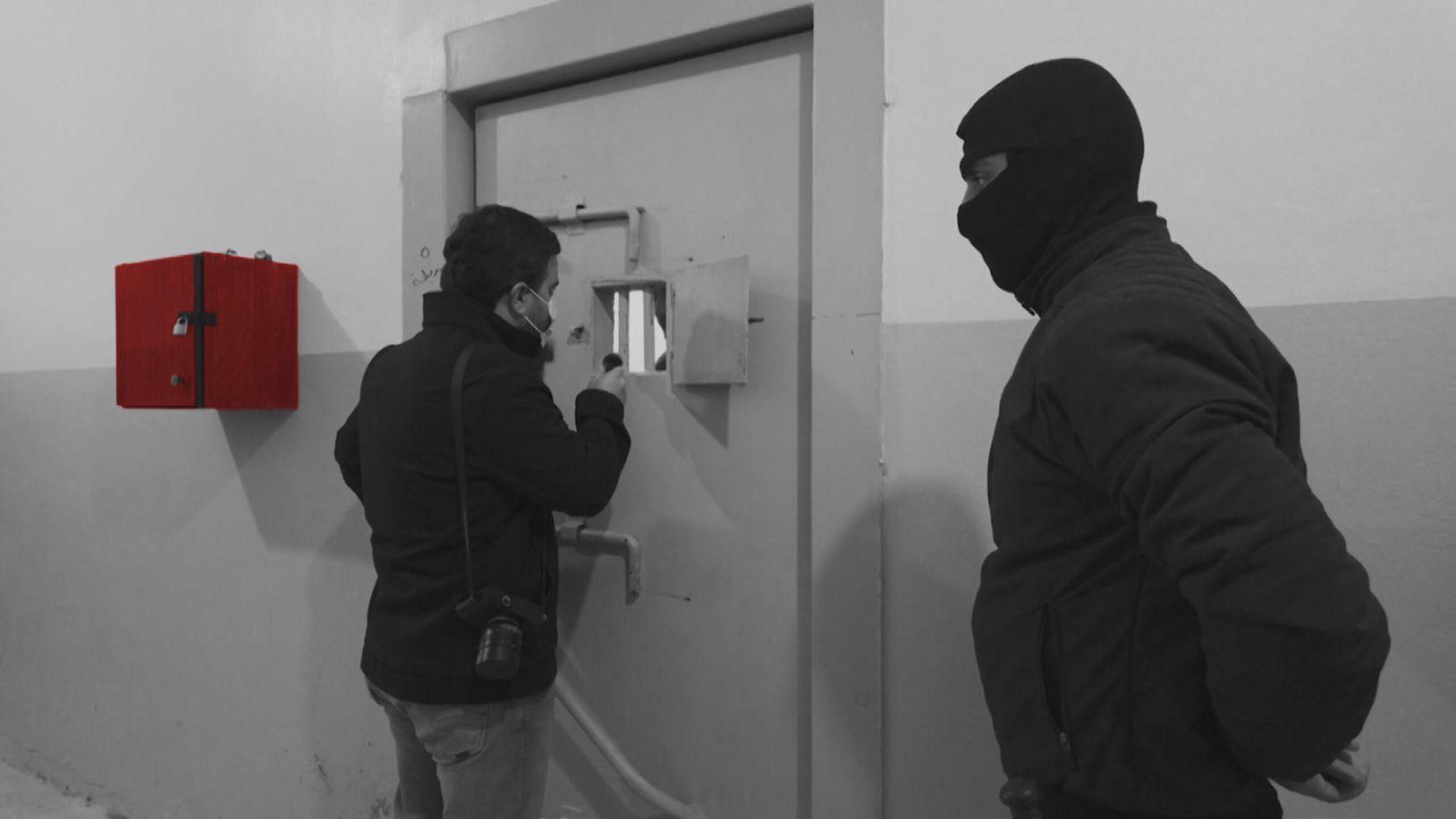
Metrography Agency, represented by Ahmed Najm, is an independent Iraqi photography agency dedicated to bringing visual testimonies from Kurdistan and Iraq to international audiences. The agency also administers the Kamaran Awards, a programme established in memory of co-founder Kamaran Najm, who disappeared in 2014 while covering clashes between ISIS and Peshmerga forces in Kirkuk. This prestigious journalism and memorial award is presented annually to photographers and journalists working in conflict zones, honouring their courage, commitment to bearing witness, and efforts to preserve collective memory.
Sarina Panahideh – On My Way
Panahideh’s multi-channel video work places the body at the centre of a visual narrative shaped through textiles, knots, covering, and movement. Moving between interconnected scenes of piled fabrics, a head bound with thick ropes, a figure whose face is obscured, and fragmented views of the body, the work constructs a shifting and layered visual language. Here, the body is not presented as a fixed identity but as a site that is continually reshaped and subjected to external forces. The recurring imagery of textiles and knots opens up a complex field of meanings that oscillates between protection and restriction, belonging and displacement. From another perspective, On My Way is a performance-based work presented through documentary recordings. The performance begins with the artist in a bound state and gradually evolves into a process of dance and movement through which the body frees itself. While this transformation represents a process of struggle and liberation, the emphasis placed on the sounds and vocal expressions produced by the artist during the performance constitutes another conceptual layer of the work. Sarina’s work explores the experience of womanhood through its multiple dimensions, while also considering questions of personal and national identity as integral aspects of that experience. In short, rather than directly representing the exhibition’s theme of endurance, On My Way approaches it through the transformations, vulnerabilities, and ruptures experienced by the body.


Hardi Kurda – Illegal Frequencies
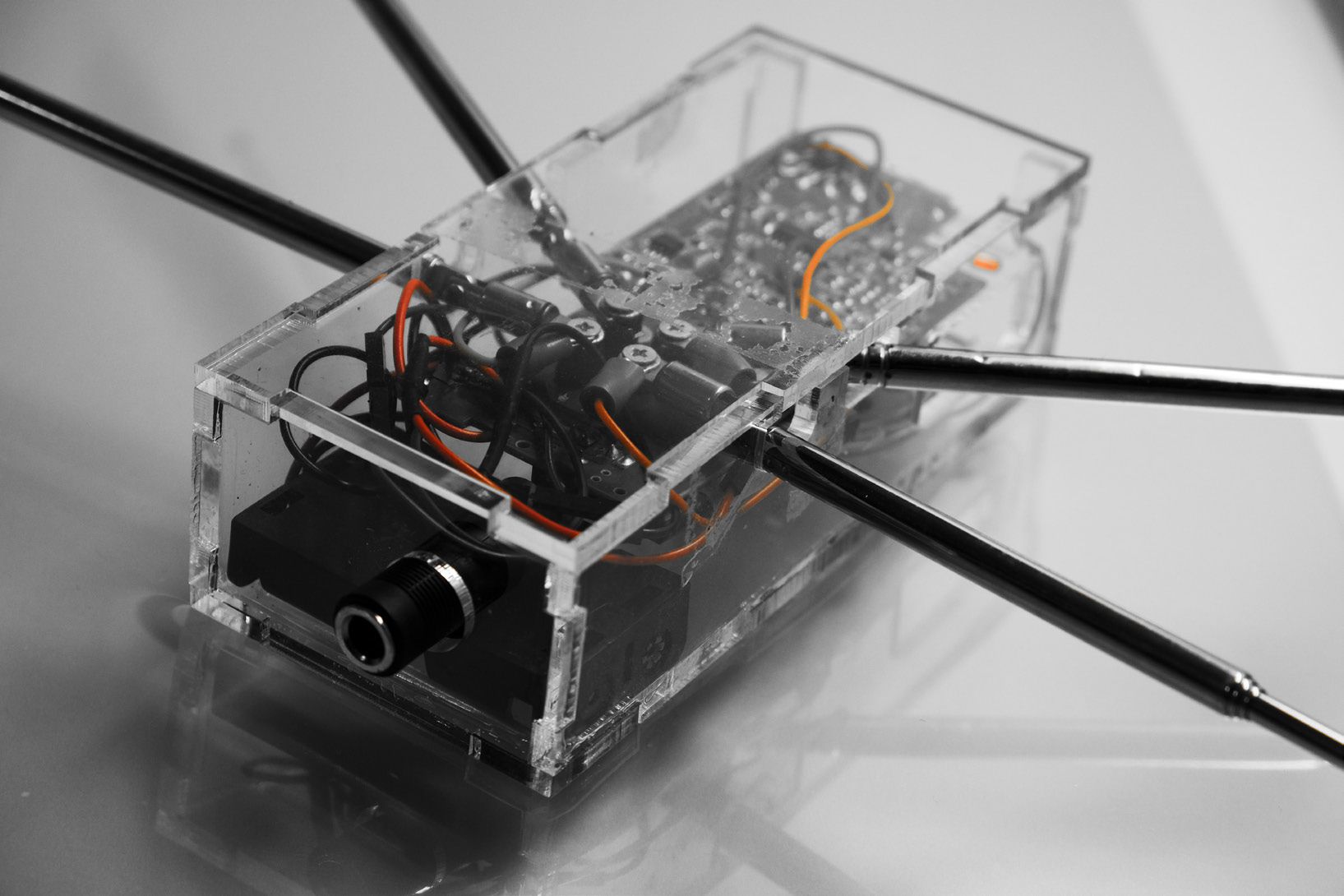
Sound artist Hardi Kurda is known for works that investigate migration, displacement, and memory through listening as an embodied experience. Drawing on radio frequencies, environmental sounds, electromagnetic interference, and the often-overlooked sonic layers of everyday life, Kurda turns listening into a field of inquiry that is as political as it is aesthetic. Illegal Frequencies connects the exhibition’s theme of endurance to the artist’s long-standing exploration of sound, memory, and displacement.
Bzhwen Jamal – Charred Stumps in Two Meter Wide Crater
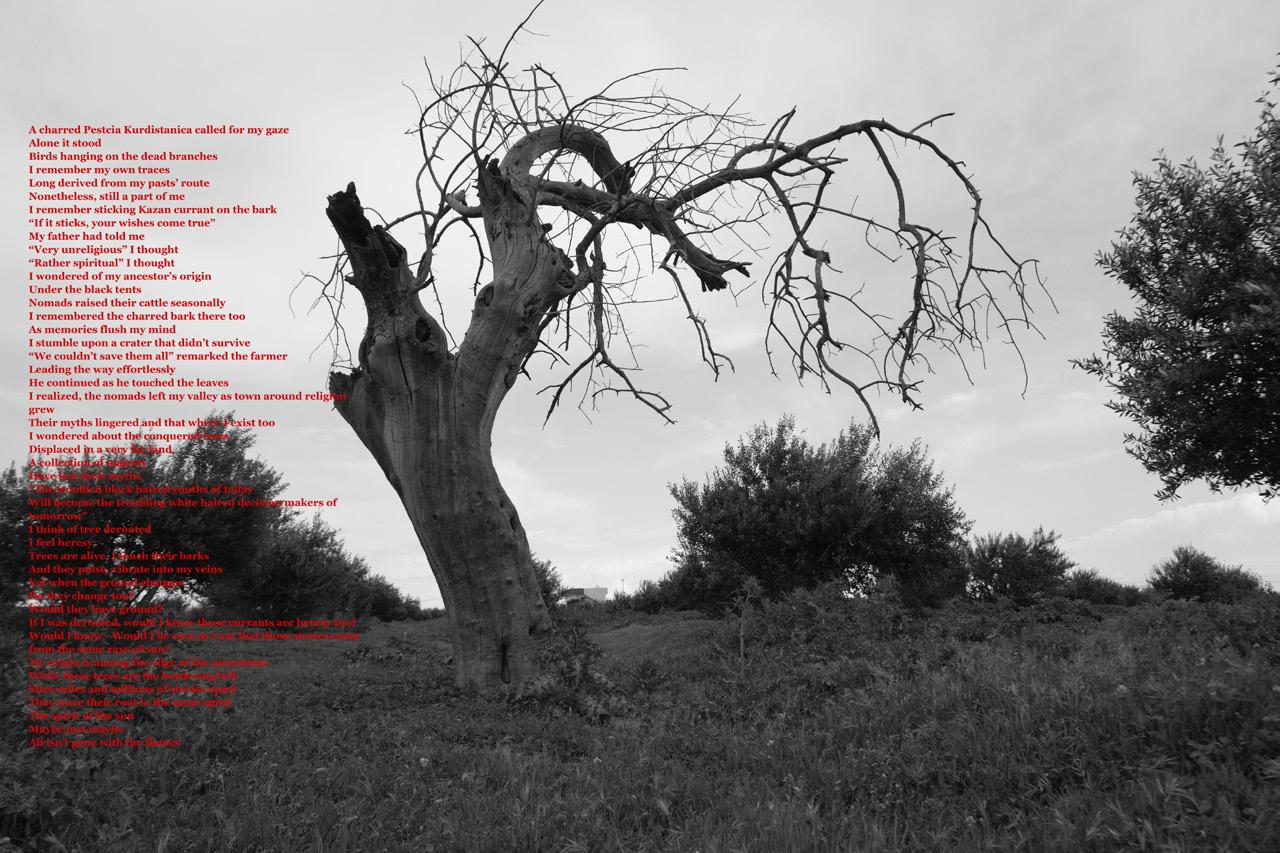
Jamal’s photographs focus on landscapes transformed by the aftermath of war. Solitary trees, dried trunks, and sparse vegetation dominate the frame, presenting nature as an environment that has lost its former coherence. Rather than depicting destruction directly, the artist traces the remnants of conflict embedded in the silence of the landscape. The work focuses on the story of Bashiqa (Ba’shiqa), a Kurdish Êzidî town located between Mosul and Hewlêr (Erbil). It addresses the burning of olive trees, considered sacred by Êzidî farmers, by ISIS during its occupation of and withdrawal from the town. The destruction of these trees is approached not merely as an act of physical devastation, but as a direct assault on the religious and cultural values of the Êzidî community. The photographs are accompanied by poems that recount this story, bringing visual and literary narratives together and enabling the trauma experienced by the community, along with its collective memory, to be expressed across multiple layers. In doing so, the work invites viewers to consider nature as a site of memory that bears the enduring marks of violence and time.

Awaz Suad – Small Toys, Big Worlds
Suad’s project approaches the toy not simply as an object but as a child’s world, a place of security, and a repository of memories of home. In the photographs, children pose with their favourite toys against stone walls; each toy becomes evidence of how imagination can serve as a refuge even in the midst of war and displacement. The artist brings into focus both the quiet strength of childhood and the resilience of imagination. Small Toys, Big Worlds offers a visual journey that reveals how joy and play can endure even under the most challenging living conditions.


ENDURANCE was presented as part of REWORLDING, a series developed within the University of Exeter’s 2026 MA Curation programme. The exhibition was on view from 19 June to 1 August 2026.
info@firezz.com

Comments
00