

In my previous article on Tehsîn Baravî, I argued that the phenomenon of art is situated between Kant’s normative understanding of aesthetic judgment and Bourdieu’s approach to the social conditions of aesthetic experience. In that article, I used the following formulation: “The phenomenon of art moves back and forth between Kant’s normative judgment and Bourdieu’s sociological analyses.” In order to deepen this theoretical framework through a concrete exhibition experience, I will examine the exhibition João e Emblema, held at Galleria Solito in Naples between 21 May and 2 June 2026. Bringing together the practices of Francesco João and Salvatore Emblema within the same gallery space, the exhibition opens up for reconsideration the relationships that contemporary painting establishes with surface, object, space, and the viewer. Bringing together the works of two artists from different generations, the exhibition provides a critical ground for questioning the conditions under which pictorial experience emerges and how the relationship established with the artwork is shaped.

Francesco João, UNTITLED (SSD), 2025, 25 × 19, engraving on Brazilian Pink Cedar. This work was also used as the exhibition poster. © Courtesy of the gallery.
The exhibition reinterprets, within the framework of a dialogue between curator Massimiliano Scuderi and young artist Francesco João, works produced by Salvatore Emblema, who died in 2006, between 1969 and 1976 from a contemporary perspective. Emblema’s practice of investigating the relationship between surface, flexibility, pattern, and texture within the boundaries of the canvas is brought into dialogue with Francesco João’s works, which reconsider the materiality and spatiality of painting. Born in 1987 and living between São Paulo and Milan, Italian-Brazilian artist Francesco João describes painting, in the exhibition text published by Galleria Solito, as a conceptual field of inquiry that is continuously reproduced through time, knowledge, and economy: “To do something on the canvas means developing a set of ideas concerning time, knowledge and data: from time to the sublime, from data to economy and ultimately back to painting” (João e Emblema, Galleria Solito, 2026). João’s works presented in the exhibition, which depart from the traditional function of the frame, reconfigure the boundaries between painting and object, surface and space, and artwork and viewer, while establishing a conceptual dialogue with Emblema’s approach to the material properties of the canvas surface, the nature of pigment, and the physical presence of painting. Thus, bringing together the practices of two artists belonging to different periods and aesthetic approaches around a shared axis of inquiry, João e Emblema opens up a discussion of the ontological and experiential conditions under which painting acquires its existence today. In this context, it does not reduce aesthetic experience either to the subject’s perception of the artwork or to the social determinations of the art field; rather, it offers a comprehensive ground for thinking about aesthetics that considers these two dimensions together.

© Roberto Della Noce, 2026. Courtesy of the artist and the gallery.
This essay examines the exhibition João e Emblema through the concepts of the “primary scene” and the “secondary scene.” The primary scene is considered within the framework of Immanuel Kant’s conception of aesthetic judgment in The Critique of the Power of Judgment. For Kant, aesthetic judgment is associated with a feeling of pleasure that arises independently of conceptual knowledge, utility, or any determinate purpose. Although subjective in nature, this judgment lays claim to universality and is grounded, through the concept of sensus communis, in the assumption that others may likewise arrive at the same judgment. The primary scene therefore refers to the plane in which the relationship between the formal constitution of the artwork and the subject’s aesthetic judgment is examined. The secondary scene, in turn, is considered in accordance with Pierre Bourdieu’s approach to the social production of aesthetic judgment. From this perspective, the experience of art is not understood merely as a free choice based on individual taste, but as a social practice shaped by cultural capital, habitus, education, class position, and art institutions. Accordingly, aesthetic judgment is evaluated not only through the subject’s inner experience but also through the historical and social conditions that shape that experience.
The primary and secondary scenes are not employed in this essay as two mutually exclusive stages or as two stages integrated into a single explanatory model. Rather, they are approached as two analytical perspectives addressing different dimensions of aesthetic experience. For this reason, the aim of this study is not to produce a theoretical reconciliation between Kant and Bourdieu, but to open up a discussion of how aesthetic experience is constituted through both the dimensions of subjective judgment and social determination, as examined through the exhibition João e Emblema. Within this framework, Salvatore Emblema’s approach, which renders the pictorial surface permeable, moves the viewer away from the static structure of representation and shifts the relationship established with the artwork onto a plane where formal and material relations are evaluated. Therefore, Emblema’s practice will be considered within the framework of the primary scene, where aesthetic judgment is approached through the relationship between subject and artwork. By contrast, Francesco João’s practice, which foregrounds the structural components, objecthood, and potential uses of painting, will be examined in the context of the secondary scene, insofar as it questions the position of the artwork within the art institution, design practices, and cultural circulation.

© Roberto Della Noce, 2026. Courtesy of the artist and the gallery.
Primary Scene: Sensory Experience and the Formation of Aesthetic Judgment in Salvatore Emblema
In the João e Emblema exhibition, Salvatore Emblema’s works direct the viewer’s attention away from painting’s representational function and toward the material and formal constitution of the surface. Emblema’s canvas does not function merely as a passive ground that carries an image, as it does in traditional painting; rather, the relationships among material, color, texture, and space play an active role in the constitution of the work. Accordingly, in the encounter with the work, how the surface is assessed through its own formal relations becomes as important as what it represents or what conceptual content it refers to. At this point, the primary scene can be understood as the analytical plane concerned with the relation established with the formal constitution of the work, considered separately from the social and institutional circulation of aesthetic judgment.
This encounter can be considered through Kant’s conception of aesthetic judgment. For Kant, aesthetic judgment arises from the free play of the imagination and the understanding in response to the form of an object, without being grounded in a conceptual determination. What is decisive here is not the determination of what the object conceptually is, but rather the evaluation of its form within aesthetic judgment. As Kant states, “We have a purely aesthetic faculty of judgment that judges forms without any concept and takes a liking in the mere judging of them; at the same time, we make this the rule for everyone, without basing this judgment on any interest or producing any such interest.” (Kant, 2006, p. 168) Within this framework, the two works by Emblema considered here, both titled Senza Titolo / Untitled, can be approached in terms of how the relationships among material, color, texture, and space established on the surface become the object of aesthetic judgment prior to the meaning of any represented object.

SENZA TITOLO / UNTITLED, 1969, 180 × 160 cm, Colored earth on jute canvas. © Courtesy of the gallery.
On the surface of the first work, the relationship between the colored earth and the jute canvas is one of the fundamental elements determining the constitution of the painting. Rather than covering the texture of the jute, the homogeneous application of the earth pigment across the surface works in conjunction with it. As a result, color is not perceived merely as a visual field but together with the texture of the supporting material. The gaze moves from the distribution of color across the surface toward the physical structure of the material, and the effect of the painting emerges from the simultaneous experience of these two layers. The divisions created by the horizontal and vertical directions within the surface further accentuate this relationship. Rather than dividing the composition into closed and clearly defined sections, this linear arrangement allows the gaze to move across the surface. The transitions between color intensities, textural differences, and areas of empty space prevent the composition from being organized around a single focal point. The viewer thus does more than simply decipher a particular image; they actively follow how the relationships on the surface are constituted. At this point, Kant’s principle of “disinterestedness” in aesthetic judgment becomes significant. By not grounding the value of the work in any practical purpose or in a particular object it represents, this approach shifts attention away from the work’s use or represented object and toward its formal constitution. In Emblema’s work, aesthetic evaluation is directed not toward what color and texture represent, but toward the relationships these elements establish with one another within the work as a whole. The experience described by Kant continues in the second Senza Titolo / Untitled through a different material arrangement.

SENZA TITOLO / UNTITLED, 1969, 150 × 130 cm, Unweaving on jute canvas. © Courtesy of the gallery.
In the second work, alongside the effect of the mustard-colored pigment on the surface, the structural rhythm of the woven material itself becomes pronounced through the cross-shaped material at the center. The weave ceases to function merely as a support on which the painting is placed and becomes a fundamental element determining how the composition is perceived. Its repeated structure gives the surface a regular yet non-static rhythm; as the gaze follows this rhythm, it experiences the relationship between the material structure of the texture and the visual order. In this respect, the difference between the two works lies not only in the materials used. In the first work, the distribution of colored earth across the jute foregrounds the encounter between pigment and supporting surface, whereas in the second, the weave itself becomes the bearer of the visual order. In one, color transforms the surface through its encounter with the texture of the material; in the other, the rhythm of the weave directly determines the perceptual structure of the painting. Emblema thus approaches a similar aesthetic question through two different material configurations. Rather than merely producing an image on the surface, painting emerges as a structure that also determines how its own material is perceived.
This difference can be considered in relation to Kant’s concept of “purposiveness without purpose.” In both works, the composition is not directed toward any external purpose; nevertheless, the relationships among color, texture, line, and surface form a unity. This unity is not the result of reaching a predetermined concept. Without relating the relationships on the surface to a conceptual conclusion, the viewer mentally relates them to one another. The reflective movement that Kant emphasizes in his account of aesthetic judgment becomes important here: aesthetic judgment does not depend on knowing what the object is, but on evaluating formal relationships without reducing them to a conceptual determination. (Kant, 2006, p. 53) Therefore, in Emblema’s two works titled Senza Titolo / Untitled, the primary scene emerges as the analytical plane in which aesthetic judgment is examined through its relation to the formal constitution of the artwork. In the first work, the relationship between pigment and jute, and in the second, the rhythm of the weave, constitute different forms of this relationship. The historical, institutional, and social meanings of the artwork, by contrast, point to other dimensions of the aesthetic experience and are examined through a different analytical perspective. Thus, the Kantian character of the primary scene is grounded in the reflective evaluation of formal relations prior to represented content. Although this judgment is subjective in nature, it claims universal validity on the assumption that it can also be shared by others.

STRUTTURA, 1973, 100 × 80 × 30 cm, Colored earth on jute canvas and free-standing wooden frame. © Courtesy of the gallery.
Secondary Scene: The Social Circulation of Aesthetic Judgment in Francesco João
While aesthetic experience in Salvatore Emblema’s works is initially constituted through sensory encounter, Francesco João’s practice turns toward the material, institutional, and social conditions in which this encounter takes place. Rather than treating painting merely as a surface on which an image is located, João incorporates the frame, stretcher, support, and structural elements into the constitution of the work. In this way, painting ceases to be merely a surface bearing an image and becomes an art object perceived together with its own material structure and conditions of display. This approach suggests that aesthetic experience cannot be explained solely through the direct sensory relationship between the subject and the artwork; how a work is perceived, according to which criteria it is evaluated, and how it is positioned within the field of art are also related to social conditions.
Bourdieu’s theory of aesthetics provides an important explanatory framework at this point. According to Bourdieu, unlike the Kantian perspective, aesthetic judgment is not a subjective experience that, in itself, claims individual and universal validity; rather, it is a practice learned, shaped, and reproduced within social conditions. Taste is related to the cultural capital an individual possesses, their educational experience, habitus, and position within the field of art. Habitus is the set of durable dispositions that individuals internalize through their social experiences and that guide the ways in which they perceive, evaluate, and act in the world. In this context, aesthetic experience is not merely an immediate sensory response to a work, but a mode of perception shaped by historical and social conditions. For Bourdieu, social space is a field composed of different positions shaped according to the distribution of economic and cultural capital. Through habitus, these positions produce lifestyles, cultural orientations, and forms of taste; the distinctions between social positions are established and reproduced at the symbolic level through aesthetic preferences. (Bourdieu, 2015, p. 18)

UNTITLED, 2020, 145 × 100 cm, Acrylic on stretcher frames, tartalana fabric, and wood. © Courtesy of the gallery.
When João’s Untitled works in the exhibition are considered together, this approach becomes particularly evident in the way the relationship between frame, surface, and support is constructed. In the shared formal configuration of the works, wooden frames, canvas surfaces, horizontal and vertical elements, geometric divisions, and different areas of color do not remain independent elements. The frame ceases to be merely an external boundary surrounding the painting and becomes part of the perception of the composition. When the division of the surface, the distribution of colors, and the material texture of the wood are considered together, the viewer’s attention is directed not only toward the forms on the surface of the painting but also toward how the painting itself is constructed. This calls into question the notion of painting as an autonomous and complete image. In João’s Untitled works, painting does not emerge as an image detached from the structure that supports it; rather, it is encountered as a set of relations between frame, wood, canvas, paint, and empty space.

UNTITLED, 2020, 147 × 102 cm, Gouache on canvas, acrylic on wood. © Courtesy of the gallery.
Therefore, the aesthetic experience of the work does not consist solely in the perception of color and geometric arrangement; the material structure within which these forms emerge also becomes part of the experience. Here, the boundaries of the art object are defined through the relationship between the pictorial surface and the structure that supports it. This material configuration provides an important basis for a transition to Bourdieu’s reflections on the social conditions of aesthetic judgment. For the recognition of an object as a work of art is related not only to its physical properties but also to its position within the field of art and the aesthetic value attributed to it. As Bourdieu points out, the recognition of an object as art is not independent of the cultural capital possessed by the subject evaluating it or of the criteria of taste established within the field of art. The wood, canvas, paint, and frame that constitute the Untitled works are material elements that may have different functions in everyday life. However, when we encounter these elements arranged in a particular configuration within the gallery space, we evaluate them not merely as materials but as parts of a work of art. In other words, these canvases, which resemble windows, sieves, or everyday objects, are defined as works of art within the gallery space. Alongside visual perception, previously acquired cultural knowledge and modes of evaluation concerning the field of art also come into play. For Bourdieu, the perception of a work of art cannot be reduced to a universal aesthetic capacity naturally possessed by the individual. The viewer’s recognition of a work as art, evaluation of its formal properties, and attribution of aesthetic value to those properties require the acquisition of particular cultural codes. In this respect, the aesthetic experience of the Untitled works is shaped by the meaning that the formal relationships established on the surface acquire within the field of art. João’s Sculpture / Bench takes this relationship onto a different plane.

SCULPTURE / BENCH, 2026, 165 × 80 × 75 cm, Wood and metal. © Courtesy of the gallery.
Sculpture / Bench directly brings the distinction between the art object and the functional object into question. The structure, made of wood and metal, evokes the function of seating through its form and dimensions; however, it is encountered as a work of art within the gallery. In this case, the meaning of the object is not determined solely on the basis of its physical properties. While the same object may be used as a bench in an everyday setting, it may be regarded as a sculpture within the field of art. What changes is not the material structure of the object, but the context in which it is situated and the meaning attributed to it. This situation also reopens the distinction between aesthetic pleasure and use in Kantian aesthetics for discussion. For Kant, aesthetic judgment takes place independently of any specific purpose of use attached to the object. João’s Sculpture / Bench, however, does not completely exclude the possibility of use. Its form, which evokes the function of seating, adds a bodily and everyday dimension to the viewer’s relationship with the object. Yet the fact that the object possesses a functional quality does not eliminate its aesthetic status. On the contrary, it raises the question of how the boundary between use and art is established.
Here, Bourdieu’s concept of the field of art becomes decisive. In his canonical work Distinction (La Distinction), Bourdieu sociologically interrogates Kant’s conception of aesthetic judgment and approaches the field of art as an institutional space and network of social relations in which aesthetic value is produced, legitimized, and circulated. Institutions and actors such as museums, galleries, curators, critical institutions, and academic discourse function as structures that shape how works of art are perceived and according to which criteria they are evaluated. (Bourdieu, 2015, p. 53) From this perspective, the evaluation of Sculpture / Bench as a work of art cannot be explained solely by its formal properties. Its exhibition within the gallery, its association with the artist’s name, and its presentation within an artistic context are among the conditions that shape how it is perceived. Accordingly, aesthetic value acquires meaning not only through the physical properties of the object but also through the position it occupies within the field of art. Bourdieu’s concept of cultural capital, meanwhile, explains the viewer’s side of this process. According to Bourdieu: “a work of art can be meaningful and interesting only to someone who possesses the cultural competence, that is, who knows the language in which the work is encoded. Possessing this code, in other words, cultural capital, is the result of an accumulation produced through a long process of acquisition or inculcation: the pedagogical activity of family or group members (family education), the pedagogical activity of educated members of the social formation (informal education), and the pedagogical activity of social institutions (institutionalized education).” (Bourdieu, 2023, p. 19)

UNTITLED, 2020, 145 × 100 cm, Acrylic on stretcher frames, tartalana fabric, and wood. © Courtesy of the gallery.
From this perspective, an important commonality emerges between Untitled and Sculpture / Bench. While the distinction between frame, support, and pictorial surface is questioned in the Untitled works, the boundary between the functional object and the art object is brought into question in Sculpture / Bench. In the former, the question “What is painting?” comes to the fore, while in the latter, the question “Under what conditions is an object accepted as a work of art?” becomes central. In both cases, the physical existence of the object alone is insufficient; how it is positioned within the field of art and according to which cultural codes it is evaluated by the viewer become decisive. For this reason, in João’s practice, the Secondary Scene refers to the social circulation of aesthetic judgment. While in the Primary Scene, aesthetic judgment is considered through the sensory encounter and formal experience of Emblema’s works, João’s practice comes to the fore with the question of how this experience is recognized, legitimized, and evaluated within the field of art. The questioning of the material constitution of painting in the Untitled works and the blurring of the boundary between use and art in Sculpture / Bench demonstrate that aesthetic value does not derive solely from the formal properties of the object. Thus, aesthetic judgment ceases to be merely an individual matter of taste and becomes a practice shaped by cultural capital, institutional context, and social relations within the field of art. Therefore, the formation of aesthetic judgment should be considered as a two-stage process extending from the initial encounter with the work to its social and cultural interpretation.

UNTITLED, 2020, 147 × 102 cm, Acrylic on stretcher frames, canvas, and wood. © Courtesy of the gallery.
Between the Primary and Secondary Scenes: The Two-Stage Structure of Aesthetic Judgment
Within this dual structure, aesthetic judgment is approached not as a closed act taking place on a single plane, but as an activity unfolding across two distinct and irreducible stages. On the one hand, there is the primary plane, which refers to the subject’s immediate encounter with the aesthetic object; on the other, there is the secondary plane, in which this encounter is conceptualized, interpreted, and enters into social circulation. Nevertheless, throughout the text, these two planes have been addressed through the concepts of the primary scene and the secondary scene, and an attempt has been made to explain the relationship between the formation of aesthetic judgment and its social interpretation through this distinction.
To recall these two planes, the primary scene is the plane that explains the formation of aesthetic judgment in the Kantian context. At this stage, judgment emerges through the subject’s relation to the appearance of the aesthetic object, without relying on any conceptual determination, historical knowledge, or external function. The naming, classification, or placement of the object within particular frameworks of meaning is not yet decisive. Aesthetic judgment proceeds not primarily from knowledge of what the object is or what it represents, but from the sensory assessment of the object’s formal constitution. For this reason, the primary scene corresponds to the plane that accounts for the formation of aesthetic judgment in Kantian aesthetics. The secondary scene, by contrast, is the plane in which this initial encounter acquires meaning within social, cultural, and institutional contexts. Here, aesthetic judgment itself is not reconstituted; rather, it is interpreted, conceptualized, shared, and put into circulation. The secondary scene explains not the source of aesthetic judgment, but the ways in which it becomes visible, recognized, and legitimated. Thus, the relationship between the two scenes rests on an analytical distinction between different levels at which the same aesthetic phenomenon is examined. This dual structure establishes an analytical distinction between the formation of aesthetic judgment and its social functioning. In short, while the primary scene considers aesthetic experience as an encounter independent of representation, function, and social determinations, the secondary scene considers the same experience within discursive, institutional, and cultural frameworks. Nevertheless, the secondary scene cannot be explained solely through mechanisms of class distinction in the Bourdieusian sense. The entry of aesthetic judgment into social circulation does not, in every case, take place through cultural capital, hierarchies of taste, or social classifications. In a broader sense, the secondary scene refers to the analytical level at which aesthetic judgment is intellectually elaborated, interpreted, and opened to circulation within the public sphere.
Therefore, the Bourdieusian approach can be positioned not as a model that explains the constitutive principle of aesthetic judgment, but rather as an approach that explains the processes through which it achieves social recognition and legitimacy. In other words, Bourdieu’s analysis is concerned less with the question of how aesthetic judgment is possible than with the question of under what social and institutional conditions it acquires validity. For this reason, the formation of aesthetic judgment and its entry into circulation can be considered together within the same theoretical framework without reducing one to the other.
The critical point is this: Bourdieu’s judgment concerning aesthetics is not constitutive, but conditional, reductionist, and interpretive. However, with reference to Rancière’s characterization, the sociologist king treats this general interpretation as a constitutive activity and, moving from the primary scene toward the field of art, directly reduces aesthetics to cultural and class codes. Yet Bourdieu’s analyses implicitly presuppose and rely on the existence of Kantian judgment—that is, the primary scene. For what is socially interpreted, institutionally recognized, and brought into cultural circulation is, first and foremost, the judgment that emerges within the aesthetic encounter. Bourdieu, however, leaves this plane in the background and treats art, aesthetics, and creation (poiesis) as an external domain; he places sociological codes and cultural layers before them, regards these as constitutive conditions of aesthetic judgment, and attempts to analyze it accordingly.
Yet the relationship between these two planes should not be understood as an opposition in the sense proposed by Bourdieu, but rather through the different modes of visibility of aesthetic experience. In my view, the Kantian reading is constitutive and necessary insofar as it explains the primary scene, that is, the moment of the viewer’s first encounter with the work of art; however, it is not sufficient on its own and must be expanded. The Bourdieusian approach, by contrast, does not produce a constitutive account of judgment; rather, it has an explanatory function at the second stage, where aesthetic judgment enters into social circulation. Let us clarify this distinction more clearly through two different readings of the same example:
The Kantian Perspective (Primary Scene): A viewer stands before Composition VIII for the first time. They do not know Kandinsky and have no prior knowledge of abstract art. Nevertheless, the balance of colors, the rhythm of the lines, and the visual unity created by the geometric forms affect them, leading them to think, “This painting gives me a powerful sense of pleasure.” This aesthetic judgment is based not on historical or conceptual knowledge, interest, or purpose, but on the direct sensory encounter with the work.
The Bourdieusian Perspective (Secondary Scene): Later, the same person learns that the work is regarded as one of Kandinsky’s most important contributions to the development of abstract art, occupies a particular position in the history of modern art, and is highly valued by art institutions. They also become aware of how people with formal art education interpret the work and what meanings critics and museums attribute to it. At this stage, aesthetic judgment is not constituted anew; rather, the judgment formed during the initial encounter is interpreted and acquires meaning within the framework of social factors such as cultural capital, knowledge of art history, institutional recognition, textual analysis, and, today, social media platforms.

Vasily Kandinsky, Composition VIII, July 1923. Oil on canvas, 55 ¼ × 79 inches (140.3 × 200.7 cm), Solomon R. Guggenheim Museum, New York. Solomon R. Guggenheim Founding Collection, acquired through donation. © 2023 Artists Rights Society (ARS), New York/ADAGP, Paris.
Bourdieu’s fundamental claim at this point is that even the Kantian aesthetic judgment thought to be formed during the initial encounter—even the simplest aesthetic response, such as “This painting gives me a powerful sense of pleasure”—is shaped by social, class-based, and cultural conditions. For this reason, according to Bourdieu, the recipients of high art and those of popular or everyday (kitsch) art are already differentiated according to their social and economic positions before the aesthetic experience itself takes place. Yet, precisely because of this, if one insists on an intellectual reading of a work of art, class-based and cultural differences become more pronounced, inequality is reproduced, and Bourdieu’s approach is thereby confirmed.
It is precisely at the intersection of these two different approaches that Jacques Rancière’s analyses of the aesthetic regime offer an intermediary field and a conceptual opening through which the relationship between the two scenes can be reconsidered. Rancière reinterprets the formation of Kantian aesthetic judgment within a historical, social, and political regime of the sensible. This approach demonstrates that aesthetic judgment cannot be reduced either to a purely subjective experience or solely to social determinations. Rancière’s contribution is not to invalidate the primary scene we have proposed—that is, Kantian aesthetic judgment—but rather to open up for discussion the forms that aesthetic experience takes within different historical and social contexts. At the same time, the Rancièrean approach does not entirely exclude the Bourdieusian analysis; rather, it helps to redefine its limits. Yet this redefinition, just as in Bourdieu’s theoretical polemic with Kant’s conception of the judgment of taste, takes shape within a similar polemical relation in Rancière’s aesthetic debate with Bourdieu.
Indeed, 1979 was a critical period marked by significant ruptures in French intellectual debates. That same year saw the publication of Jean-François Lyotard’s The Postmodern Condition and Pierre Bourdieu’s La Distinction. Jacques Rancière also draws particular attention to this historical moment from his own perspective. He states that, after reading Bourdieu’s La Distinction, published in 1979, he began to focus more intensively on aesthetics and developed his own approach to aesthetics largely through his theoretical polemic with Bourdieu. Thus, while the secondary scene proposed in relation to Bourdieu explains the processes through which aesthetic judgment achieves social recognition, institutionalization, and circulation, Rancière argues—particularly in Malaise dans l’esthétique (Aesthetics and Its Discontents) and Le Philosophe et ses pauvres (The Philosopher and His Poor)—that these processes cannot be adequately understood solely through class distinctions and cultural capital. Moreover, he argues that Bourdieu’s classification does not merely explain the social conditions of aesthetic judgment, but also establishes a hierarchical structure that reproduces the inequalities determining those very conditions. In other words, for Rancière, Bourdieu becomes, in a sense, an agent of the very condition he criticizes. Likewise, Rancière interprets Kant’s conception of aesthetic judgment within a historical, social, and political aesthetic regime by bringing it into relation with Schiller’s rethinking of the relationship between the sensible and rational faculties through the play drive, and situates aesthetic experience within the framework of the “distribution of the sensible.” It is precisely from this point that my own argument departs. I am attempting to establish a similar position through the argument of the “Three Scene Regime,” drawing on the aesthetic approaches of these thinkers as points of reference while departing from them whenever necessary. From my perspective, the starting point of aesthetic judgment is a Kantian one. In other words, what is decisive is the perceptual and sensory condition of the viewer standing before the medium. Yet, paradoxically, this condition is also related to the artist’s act of creation. For ultimately, it is the artwork’s unique and autonomous structure that shapes the viewer’s perceptual and sensory experience. By contrast, a significant portion of art criticism and academic discourse operates, often without recognizing it, within the framework of cultural capital identified by Bourdieu. Moreover, many who adopt this approach are not even aware that their mode of aesthetic evaluation corresponds to the perspective Bourdieu describes. According to this view, the viewer is expected to enter the museum or gallery equipped with a certain degree of prior knowledge and cultural competence, and then evaluate the work through the artist’s identity, artistic practice, and position within art history. In this framework, an artwork is thought to reveal its elusive “true” meaning only through the knowledge and cultural codes one possesses.However, by classifying aesthetic taste into distinct categories, this approach reproduces hierarchies, reinforces the normative structure of cultural capital, and perpetuates forms of inequality. Starting from a Kantian perspective, I therefore argue, much like Rancière, that aesthetic experience cannot be limited by prior knowledge or cultural competence. This view frees the viewer from the obligation of possessing a particular body of knowledge in order to make sense of a work. Nor does the viewer have any such obligation. What the viewer sees, feels, and perceives are already constitutive elements of aesthetic experience itself. For this reason, if an artwork, regardless of the viewer’s social or cultural position, is capable of dislocating their sensory condition from established assumptions and representational realities and transporting it toward other fields of perception, then art has taken place.
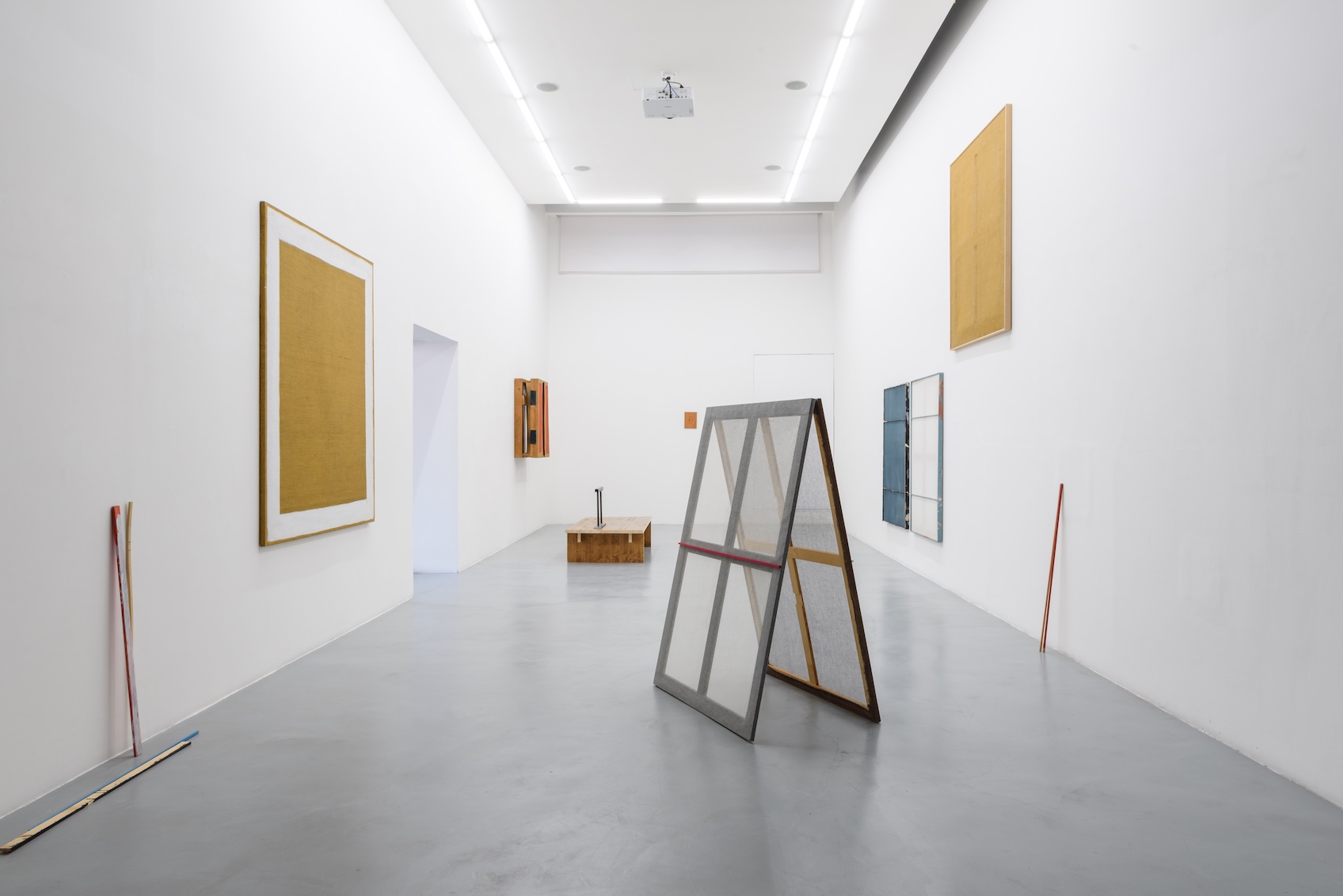
© Roberto Della Noce, 2026. Courtesy of the artist and the gallery.
It is precisely this theoretical framework that explains why the João e Emblema exhibition cannot be understood merely as a formal transformation. The exhibition opens up a consideration of the transformation of contemporary painting together with the question of the conditions under which aesthetic experience is constituted. While the practices of Francesco João and Salvatore Emblema redefine the relationships between the pictorial surface, objecthood, space, and the viewer within the context of contemporary art, they also suggest that aesthetic judgment is constituted at the intersection of the formal qualities of the work and the processes through which it is experienced, interpreted, and brought into circulation. For this reason, the exhibition moves the practices of the two artists beyond a historical comparison and establishes a critical relationship between different planes in which aesthetic judgment is constituted. The João e Emblema exhibition demonstrates that these two planes are not mutually exclusive structures; rather, they operate simultaneously within contemporary artistic practice. In this context, the “crisis of painting” articulated in contemporary painting emerges as a broader problem that questions the historical, social, and institutional conditions under which aesthetic judgment is constituted. Painting ceases to be a closed surface positioned before the viewer and becomes an open aesthetic field shaped by the relations between object, space, body, and institutional context.
In conclusion, this text argues that the distinction between the primary and secondary scenes provides a functional analytical framework for examining the practices of João and Emblema. Alongside a definitional discussion of what aesthetic judgment is, this approach focuses on the conditions under which it emerges, acquires meaning, and enters into circulation, thereby aiming to contribute to contemporary debates in aesthetics.
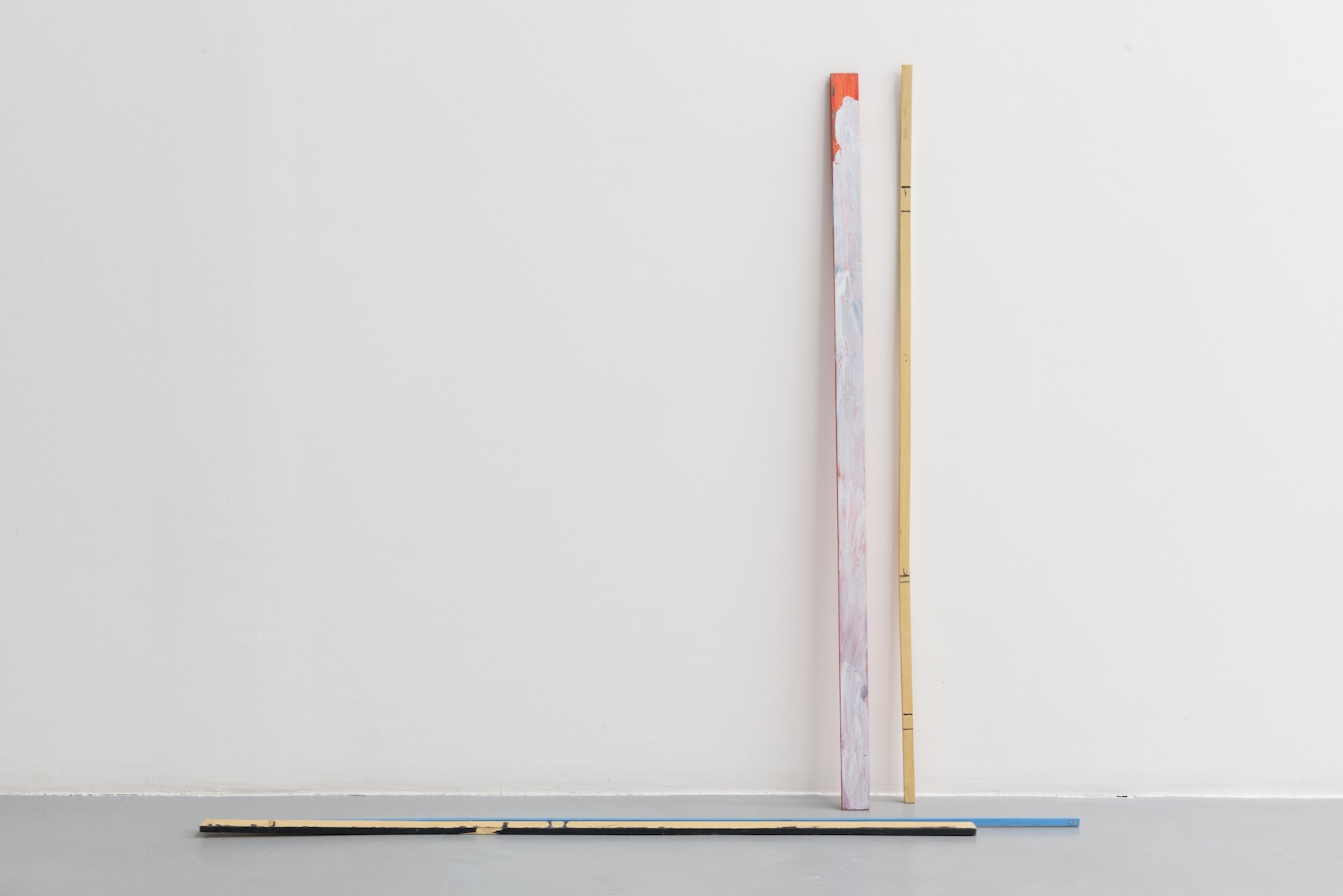
© Roberto Della Noce, 2026. Courtesy of the artist and the gallery.
Salvatore Emblema (1929–2006) was a contemporary Italian painter born in Terzigno, near Naples. He moved to Rome in the early 1950s, where he began his artistic career. In his early period, Emblema produced collages and later developed an original approach to painting through the use of materials such as volcanic soil, natural pigments, stone, and burlap, exploring the relationship between nature, light, and space. His encounter with Mark Rothko in the United States in 1957 and his relationship with the art historian Giulio Carlo Argan were decisive in shaping his artistic vision. Through the detessitura technique he developed in the 1960s, the artist unraveled the weave of burlap, making light an active element of the pictorial surface and transforming painting into a spatial experience. Having participated in the Venice Biennale in 1980 and 1982, and with his self-portrait entering the collection of the Uffizi Galleries in 1981, Emblema is regarded as one of the distinctive figures of contemporary Italian art for his innovative approach to light, emptiness, and transparency.
Francesco João (b. 1987) is an Italian-Brazilian contemporary artist who lives and works between São Paulo and Milan. He studied at the Brera Academy of Fine Arts in Milan and is known for works that reconsider the boundaries of painting in relation to the object, architecture, and space. By transforming fundamental components of painting such as canvas, stretcher, frame, and color, João extends painting beyond the two-dimensional surface; while investigating the relationships between time, knowledge, economy, and materiality, he redefines painting as a field for critical thought. He has held solo exhibitions in São Paulo, Milan, Brussels, Paris, London, and Rome. His notable exhibitions include Extra DRY (Peep-Hole, Milan, 2014), Everything Tends to Ascend. Or Not. (Pivô, São Paulo, 2016), Donkey Man (Mendes Wood DM, São Paulo, 2017), and Seven Segment Display (Fondazione Zimei, Rome, 2023). His works have also been presented at Art Brussels, Kunsthalle São Paulo, and various international group exhibitions.
Notes:
Pierre Bourdieu, Ayrım: Beğeni Yargısının Toplumsal Eleştirisi. Trans. Derya Fırat & Günce Berkkurt. Ankara: Heretik Publishing, 2015.
Pierre Bourdieu, Kültür Üretimi. Trans. Zeynep Yardımcı & Elçin Gen. Istanbul: İletişim Publishing, 2023.
Immanuel Kant, Yargı Yetisinin Eleştirisi. Trans. Aziz Yardımlı. Istanbul: İdea Publishing, 2006.
Massimiliano Scuderi. João e Emblema. Galleria Solito, 2026. https://galleriasolito.com/exhibitions/jo%C3%A3o-e-emblema?hsLang=it-it

info@firezz.com



Comments
00