
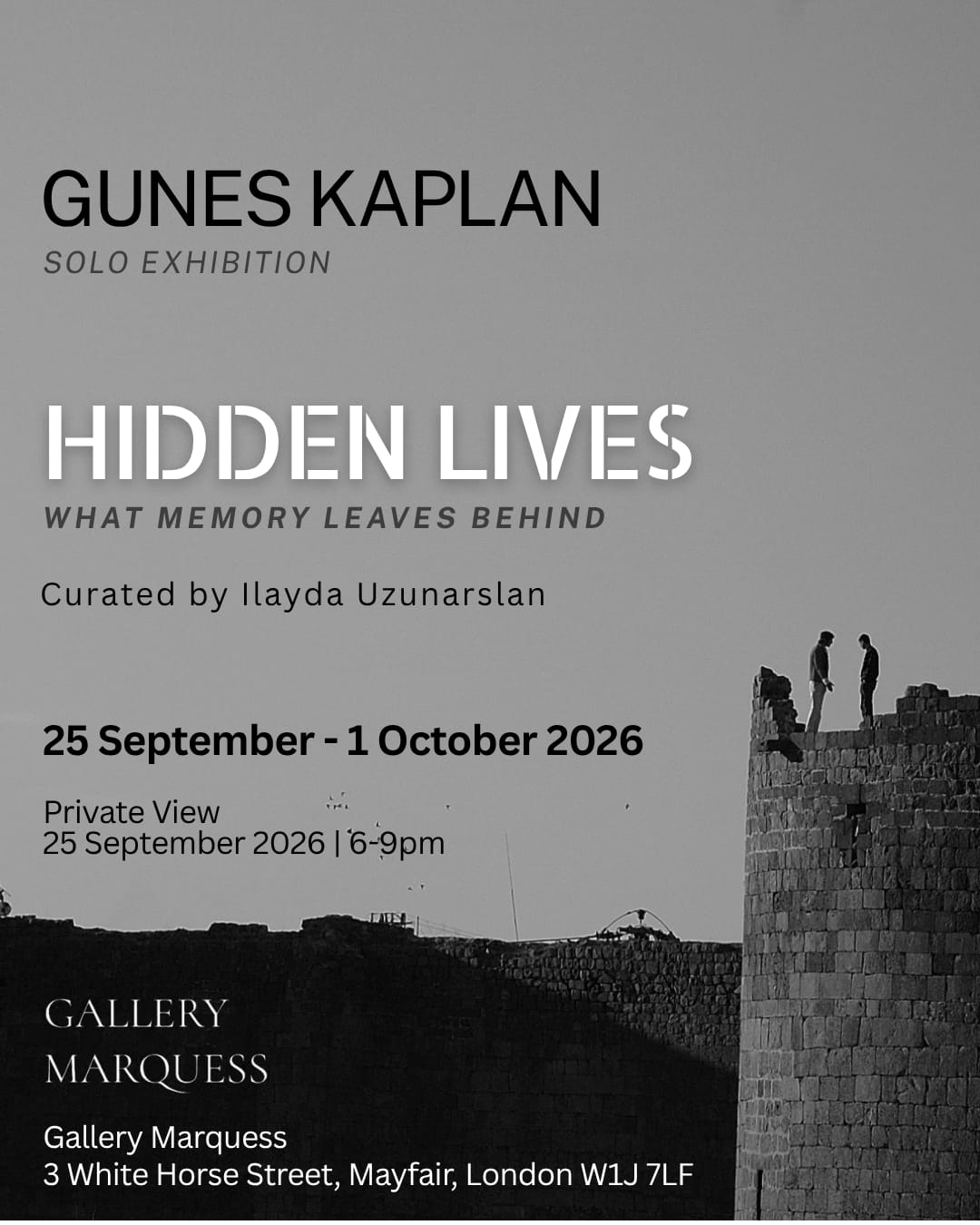
Güneş Kaplan’s first solo exhibition in London, Hidden Lives: What Memory Leaves Behind, opened on September 25 at Gallery Marquess in Mayfair and will remain on view until October 1. Curated by İlayda Uzunarslan, the exhibition brings together photographs produced by Kaplan between 2011 and 2025. At first glance, we see familiar scenes: a street, a shoreline, or a construction scaffold. Yet to read these images merely as instantaneous records would be to miss the exhibition’s central concern. Rather than presenting the image as an endpoint, the exhibition constructs it as a passage, directing the viewer’s gaze toward the lives that continue beyond the frame.
The conceptual framework draws on the approach articulated in Henri Cartier-Bresson’s influential 1952 book The Decisive Moment. Within this understanding, the decisive moment is not a perfect second captured by chance. The photographic encounter is grounded in observation, research, and waiting. The decisive moment emerges from the photographer’s attentive relationship with the world. In Kaplan’s practice, photography likewise functions less as a record than as a field of observation. This perspective bears the traces of her background in sociology: before it is a landscape, the frame is a cross-section of a network of relationships.
Roland Barthes’s Camera Lucida offers a useful point of departure for thinking about this cross-section. What Barthes calls the “that-has-been” is photography’s defining characteristic: what is seen in the photograph once genuinely existed before the camera. Yet photography can only attest to that existence; it cannot reveal what came before or after it. Barthes’s distinction between studium and punctum likewise operates within this gap. Studium refers to the cultural and informational layer a photograph presents, while punctum is the unplanned detail that pierces the viewer like an arrow (Barthes, 1996, p. 34). Hidden Lives pursues precisely such details.
Walter Benjamin serves as a second guide. In A Short History of Photography, Benjamin argues that “in photography, reproduction by technological means reveals aspects of the ‘original’ that are inaccessible to the naked eye yet accessible to the camera, whose angle can be freely adjusted and selected” (Benjamin, 2013, p. 49). In the same text, he compares Atget’s empty Paris streets to a crime scene: even when a photograph contains no human figure, it presents the traces left behind as evidence (Benjamin, 2013, p. 61). In Benjamin’s theses on the philosophy of history, the past cannot be recovered as it actually was; rather, it can only be grasped as an image that flashes up in a moment of recognition. Kaplan’s photographs do not attempt to restore the past. Instead, they allow it to briefly emerge in the viewer’s gaze.
Ancient Traces 2011
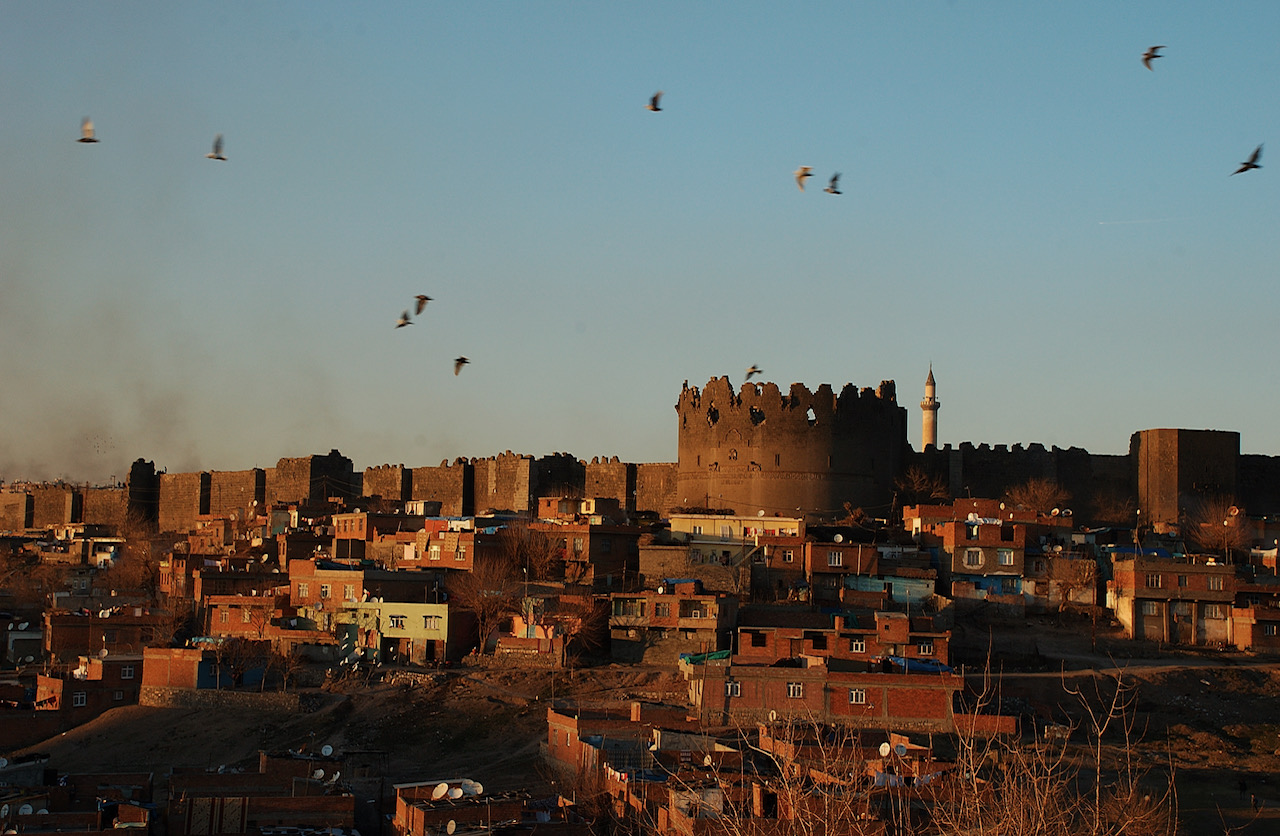
These principles are most clearly visible in her Diyarbakır works. In Ancient Traces (2011), thick, dark city walls glow with the warm light of sunset. In front of them are densely clustered houses, a distant minaret, a hazy horizon, and scattered birds crossing the sky. The wall functions as a boundary that both protects and encloses, and the photograph does not resolve this duality into a single judgment. The birds fill the frame with movement, yet they do not remain within the frozen image; in the next second, they will be elsewhere. In The Stone Remember I (2013), we see a façade built of black basalt and yellowish stone, punctuated by arched windows protected by iron grilles. The windows reflect not the interior but the sky. At the foot of the façade, a white-haired man sitting on a bench appears almost insignificant in relation to its scale, and this smallness becomes a punctum: the stone remembers, but what the man remembers remains unknown. The Stone Remember II (2014) continues the series in black and white. A roofless stone structure, its windows opening onto the sky, still stands with the columns beneath its entrance arch intact. Here, memory no longer belongs to a living subject but to an abandoned place.
 Hands Blending into Blue 2011
The human figures throughout the exhibition are often only partially visible. In Hands Blending into Blue (2011), small hands emerge through an opening in a blue embossed metal surface, while the bodies themselves remain unseen. Here, the exhibition’s title becomes almost a literal image. In Shutter (2018), two children stand before a grey metal shutter, wearing fingerless gloves and holding orange objects to their mouths as they look directly into the camera. The title carries a double meaning, referring both to a shop shutter and a camera shutter. The children standing before a closed storefront and the camera’s closing eye meet within the same word, and Cartier-Bresson’s decisive moment, grounded in waiting, becomes here a moment of reciprocal gaze. In Traces of Burden (2018), we see two women seated among animals in the back of a trailer, viewed from behind; what we encounter are their backs and hands rather than their faces. Only the driver’s face appears in the vehicle’s rear-view mirror. The burden here is expressed less through the animals being transported than through the posture of the bodies themselves.
 Shutter 2018
 Traces of Burden 2018
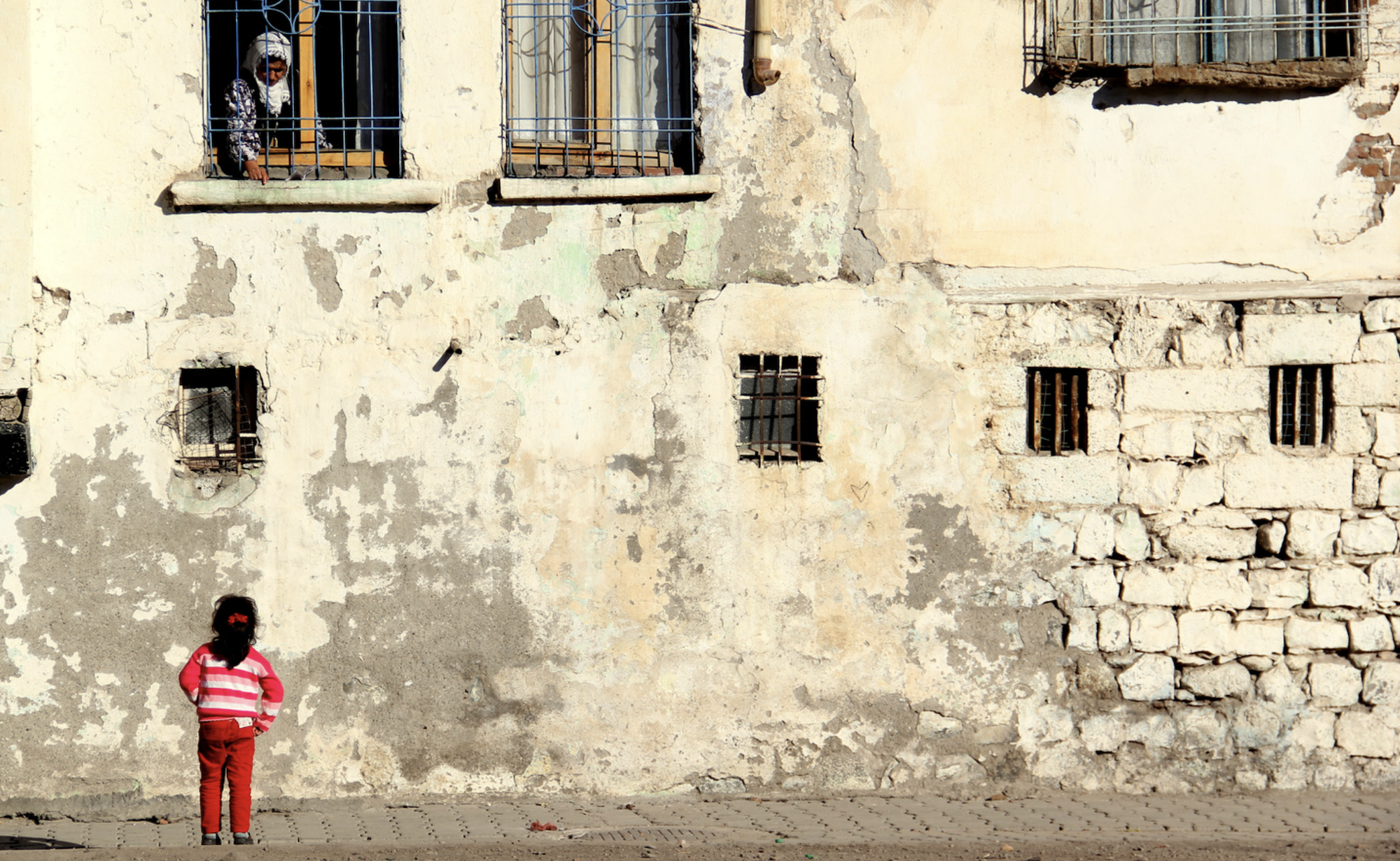
In the 2022 photograph Untitled, a young girl wearing red trousers and a pink-striped sweater stands beside a wall of peeling plaster and iron-barred windows, looking upward. In the upper window stands a woman wearing a white headscarf. The distance between the two figures forms the most charged relationship in the frame: one occupies the street, the other remains inside, while the wall between them functions both as a threshold and a barrier. In The Waiting I (2024), a woman sits within a narrow band of light surrounded by darkness, leaning over an object in her hands. Waiting itself becomes the subject of the photograph, yet what she is waiting for remains absent from the image.
 Untitled 2022
 The Waiting I 2024
The works set along the shoreline continue this quiet atmosphere. In Echoes of the Shore I (2023), a man, seen from behind, bends over inside a white boat resting on wet sand, while reflections and a rope divide the frame. In Echoes of the Shore II (2025), we see a man walking past a weathered wooden boat beneath a stormy sky. The boat’s interior, exposed through layers of peeling paint, appears like a record of years lived. In an untitled photograph produced the same year, silhouetted workers stand atop construction scaffolding against a hazy sky; one flings a cable into the air. Unlike the coastal and stone imagery that dominates the exhibition, this photograph presents a space still in the process of becoming, placing transformation alongside absence. Likewise, the concrete surface in the overhead photograph of three children riding bicycles, their elongated shadows stretching across the ground, belongs to the same visual language. Here, the shadow becomes the most elementary form of a trace.
 Echoes of the Shore I 2023
For this reason, Hidden Lives does not offer a ready interpretation. Barthes reminds us that photography testifies to the existence of what has been, while Benjamin suggests that the past can only appear as a fleeting image. At the point where these two ideas intersect, that is, at the intersection of the visible, the viewer is invited to consider not only who the people and places in these photographs are, but also what they may have lived through. The exhibition privileges reflection over certainty and imagination over evidence. Unspoken words, remembered moments, and forgotten histories continue to inhabit the silent layers of the images.

Güneş Kaplan: Born in Elbistan, Güneş Kaplan is a photographic artist and visual arts practitioner who lives and works in Manavgat, Antalya. A member of the Royal Photographic Society (RPS), Kaplan's work focuses on memory, place, and visual traces. Drawing upon urban life, architecture, everyday experience, and the marks people leave upon the spaces they inhabit, she investigates the visible and invisible layers of individual and collective memory. Combining a documentary sensibility with a poetic and intuitive visual language, the artist works not only with photography but also with painting and wood-based media. Observation, silence, and memory occupy a central place within her practice.



Comments
00