Every biennial presents itself through a promise; the promise of the seventh Mardin Biennial was “democracy.” This article takes that promise seriously and attempts to put it to the test. Does opening six exhibitions simultaneously in Mardin, expanding the list of participating artists, or extending the event beyond the historic city for the first time make a biennial democratic? Or does the Mardin Biennial still operate as part of an Istanbul-centered (that is, Mardin-external), self-reproducing “closed-circuit” network? The following paragraphs pursue this question through the biennial’s history, advisory boards, sponsorship structures, and the criticisms directed at it.
This year’s edition was curated by Çelenk Bafra, whose curatorial practice is built around production- and research-oriented group exhibitions; she is also the artistic director of Istanbul Modern. Consequently, the biennial’s perspective this year was shaped from the axis of Istanbul’s institutional contemporary art scene toward Mardin. Bafra spent time in Mardin conducting research and developing contacts on behalf of the 7th Edition. The artists she brought with her from Ordu, Athens, and elsewhere had already been selected by the curator in advance; they arrived in Mardin to “conduct research.” In other words, the question of whom the biennial would engage with had been settled before anyone had even set foot in the city. Mardin was thus positioned not as a subject in its own right, but as a site to be researched. Bafra subsequently announced the 7th Edition under the title GÖKzemin. At the same time, debates surrounding representation, visibility, and cultural belonging have remained recurring points of discussion. (1) A considerable amount of criticism has already been directed toward these issues. The disregard, dismissal, or exclusion of such criticism is closely tied to the logic of power—something all too familiar in Turkey, where those in positions of authority, from bureaucrats to other decision-makers, routinely turn a deaf ear to criticism directed at them.
“This biennial is different! This biennial is democratic!” Such claims were repeated both through the biennial’s own communication strategy and across the art media surrounding it. The curator’s emphasis on “site-specificity,” the participation of 42 artists from 20 countries, and the decision to move beyond the historic city for the first time were presented as evidence of the democratic framework constructed around the event. The Ancient City of Dara and the Ateş Beyler Bathhouse in Kızıltepe were the two locations that most clearly marked this shift. This geographical expansion was promoted as the principal proof of the edition’s “democratic” character. Yet the connection the curator established between Old Mardin, the Ancient City of Dara, and the Ateş Beyler Bathhouse drew on Farid ud-Din Attar’s Mantiq al-Tayr (The Conference of the Birds) and Aristophanes’ The Birds. In other words, the birds that populated the conceptual framework did not emerge from the region’s own historical memory, but from texts long familiar to the established art canon. Following the announcement of the curatorial framework, six additional artists were brought to Mardin from various locations to conduct research. Later, the biennial bulletin announced the venues and programme alongside the list of 42 participating artists. But is expanding the roster or adding new exhibition sites enough to justify describing all of this as “democratic”?
Closed Circuit
The Mardin Biennial, launched in 2010, has brought its own controversies with it. The institutional continuity of the biennial has largely been maintained by Döne Otyam and Hakan Irmak. Hakan Irmak did not serve as director in the first edition, however, but as its “visual director”; in subsequent editions, he assumed the role of biennial director. (2) The biennial’s managerial structure is notable for the continuity of these two figures, who have occupied leadership positions for many years. (3)
In international biennial practice, the institutionalization of directorships often solidifies the biennial’s internal power structures. Who gets invited? Which venues are selected? Who joins the advisory board? What forms of sponsorship are established? The answers to these questions—that is, the decisions themselves—risk becoming routinized over time. In this sense, the Mardin Biennial appears bound to a system that continuously reproduces itself. One of the most frequently voiced criticisms is that the biennial remains shaped through an Istanbul-centered circuit. A look at its advisory boards makes this particularly clear: Paolo Colombo (curator of the 2nd Biennial and a familiar figure within the Istanbul Biennial), Fırat Arapoğlu (art writer and academic), Esra Aliçavuşoğlu (curator and art writer), and Ayşegül Sönmez (author of the 1st Biennial’s curatorial text). While some names change with each new curator, one thing remains constant: all emerge from the familiar networks through which contemporary art legitimacy is circulated and consolidated in Istanbul.
The clearest illustration of this network can be found in the career trajectory of the 7th Biennial’s curator, Çelenk Bafra: Director of the Istanbul Biennial at İKSV (2001–2010), Curator and Director of Programmes at Istanbul Modern (2011–2017), Director of SAHA, the Supporting Contemporary Art Initiative (2018–2024), and now, once again, Artistic Director of Istanbul Modern.
Biennial, museum, fund, residency, biennial.
The circle closes.
Mardin is one of its links.
The Mardin Biennial stands as one of the spaces through which this closed circuit operates.
A closed circuit points to the continual circulation of the same names, while also suggesting that decisions concerning visibility are shaped within that circulation. Recent critiques of the biennial system have argued that, although open-call mechanisms appear to offer a pluralistic structure, the artists who ultimately gain visibility are most often those already circulating within contemporary art networks. Visibility, in this sense, becomes a regime that reproduces existing mechanisms of selection rather than challenging them. (4)
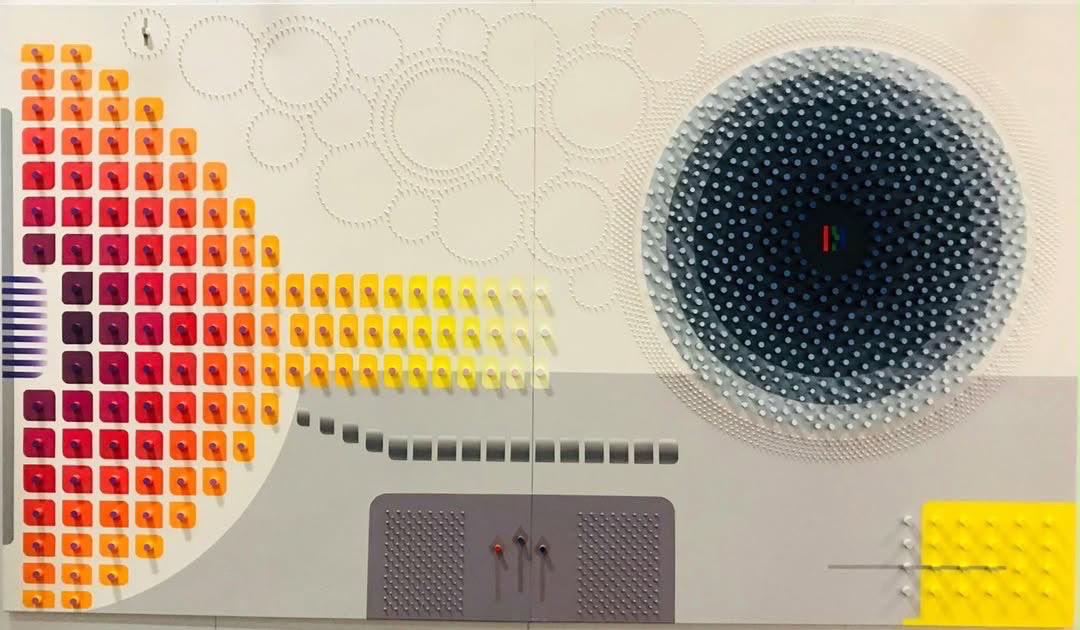
This year, rather than the biennial itself, it was the exhibitions organized under the Open Exhibition (Açık Sergi) platform that left the strongest mark on Mardin. Bringing together 160 artists across 53 venues, the Open Exhibition hosted numerous group and solo shows. Contemporary Kurdish artist Ömer Mirdemir also presented his solo exhibition, points of authority, within this platform. Covering an entire wall of the exhibition space, his work High Half curiously evokes ideas of networks, circulation, and closure. Composed of hundreds of cylindrical forms, the piece expands from the outer edge toward the interior. The cylinders at the periphery, small and pointed, gradually gain volume, forming a circular field that shifts from white to grey and from grey to deep black. At its center lies an almost complete darkness. In the very middle of that darkness, a small burst of colour appears: neon green, blue, and yellow bands. The work as a whole operates like a spiral, a whirlpool, a vortex. Everything on the outside seems to be drawn toward the center. But what is this center? What does this movement from the periphery inward describe? The work is, of course, open to multiple interpretations.
When placed alongside the list of “quota names” identified by art critic Mahsum Çiçek in his critique of a system in which the same artists are continually circulated through biennials, institutional exhibitions, residency programmes, and international funding networks, the work seems to generate its own reading. The closed circuit is not merely a list; it is a force of attraction. Those whose names are already inside the circle have moved closer to the center, while those on the outside remain at its edge—small, sharp, and waiting. There are countless artists waiting to be included. Tragically, many of them internalize their own invisibility, perceiving themselves as somehow flawed or insufficient for failing to perform the kind of gesture that might attract the attention of the center.
The decisions a curator makes in realizing a biennial are, of course, ultimately a matter of curatorial autonomy. It is precisely at this point, however, that another criticism becomes worth considering.
Who Did Çelenk Bafra Speak To?
In his article The 7th Mardin Biennial Meeting and the Nobodies!, written in response to the public presentation Bafra held in Mardin before the biennial, Fatih Tan notes that the overwhelming majority of those in attendance were Kurdish artists and members of the local art public. Despite this, he argues that Bafra was, in effect, “speaking to no one,” since this audience possessed no real legitimacy within the institutional structure of the biennial. The article closes by returning to the same question: “Who did Çelenk Bafra speak to?” (5) The question also reveals whom the discourse of “democracy” is ultimately intended to address.
In an earlier article discussing why the Mardin Biennial cannot be described as a Kurdish biennial, Tan outlined four conditions that would make such a designation possible: the aesthetic image of Kurdishness determining the biennial’s overall structure; the establishment of a permanent South Kurdistan Pavilion with a mandatory quota for Kurdish artists; the use of Kurdish alongside all biennial communications, from posters to catalogues; and the incorporation of international Kurdish intellectual, political, and economic networks into every stage of the biennial. (6) These propositions carry a deliberate maximalism. By enumerating precisely what would need to happen, Tan renders visible what is, in reality, entirely absent. The proposals for mandatory quotas or a permanent pavilion should therefore be read as political documents. They function as a remarkably effective diagnostic tool for measuring the distance between the biennial’s claim to “site-specificity” and the primary subject of that very context. Ultimately, this diagnosis concerned what Istanbul’s contemporary art establishment was unwilling to do.
The same center that determines who is invited also presents itself through the language of virtue; in this edition, the key term in that vocabulary was “polyphony.” In an edition sponsored by Peugeot Turkey, the company described its contribution as supporting “the wider dissemination of art, creativity, and polyphony.” This is the sort of phrase that sits just as comfortably in an automobile advertisement as it does in a curatorial statement. “Polyphony,” after all, is generally perceived as an unquestionable good, regardless of who invokes it. Yet polyphony has political meaning when articulated as a demand; when deployed as a branding promise, it becomes part of the spectacle of discourse itself. To understand which voices are actually included in the “many” of polyphony, one must look not at the list of artists, but at the mechanisms through which decisions are made.
Was there an open call? No.
How, and by whom, was the curator appointed? We do not know.
Are the biennial’s budget and expenditures publicly available? They are not.
As long as these questions remain unanswered, the language of “democracy” continues to function as little more than a component of the biennial’s communications strategy.
A Biennial Against the Biennial
As noted above, opposition to the Mardin Biennial is not a new phenomenon. Every biennial, in a sense, produces its own counter-form.
In 2018, alongside the 4th Mardin Biennial, 14 young artists, brought together through the initiative and leadership of Numan Erdinç, organized a Counter Biennial that drew attention to artistic practices in Mardin that had been overlooked by the official biennial. The initiative argued that the biennial failed to create sufficient space for young artists from Mardin, including those studying and producing work in the city where the event itself was being held. It criticized the way large institutions position themselves as the “center,” compelling artists outside those circles to conform to predetermined frameworks. Rather than seeking admission into an imposed elitist art circle, the project aimed to create an independent point of reference, drawing strength from flexibility and self-determination. Through an ironic reference to Beyond Words, the official theme of the 4th Mardin Biennial, it asked what the “actual reality beyond words” might be. (7)
In 2024, the Hangi Sergi Nerede (Which Exhibition, Where?) platform mapped a series of independent exhibitions running parallel to the 6th Mardin Biennial. Among them was the group exhibition Self Made 2, featuring Ömer Mirdemir, Ahmet Yeşil, Azad Yeman, Beşir Bayar, and others. What united these exhibitions was neither an international invitation nor an institutional funding mechanism; it was simply the desire to be present, to produce work in Mardin, and to establish a mode of existence independent of the biennial. As its title suggests, Self Made brought together works produced through solidarity and self-organization, without reliance on institutional funding structures, gallery systems, or the invitation mechanisms of international selection committees.
That same year, Enver Basravi made visible the language that the biennial had chosen to overlook. In response to the official biennial’s visual communications being produced exclusively in Turkish and English, he hung Kurdish, Arabic, and Armenian posters of his own making throughout Mardin and distributed multilingual materials during the biennial’s opening events. The action was titled The Memory of the Overlooked. In an accompanying statement, Basravi wrote: “The biennial, through a conscious choice, does not incorporate the languages of the peoples living in Mardin and its surrounding region into the space of the biennial.” That same week, performance artist Adem Bulut staged a public intervention opposite the German Headquarters, pointedly and ironically titling the work The 9th Mardin Biennial. In the same year, DJ Asena Hayal was removed from the stage after playing Kurdish and Arabic music. (8)
One of the most visible manifestations of the critical discourse that emerged alongside the satellite exhibitions appeared in the aftermath of the 6th Mardin Biennial in 2024. Ahmet Öğüt, one of the biennial’s participating artists, publicly criticized the limited visibility of Kurdish in the biennial’s texts and exhibition labels, as well as the nature of the relationship the biennial established with Mardin and its broader cultural fabric. These debates came to be understood not merely as the objections of a single artist, but as part of a wider discussion concerning representation, language politics, and the biennial’s engagement with the context of Mardin. Following the opening, international art media also devoted significant attention to criticisms that the biennial had “failed to show sufficient respect for the cultures and languages of the region.” (9)
In her article As Far Away from Mardin as Possible: The 6th Mardin Biennial, Gül Hür observes that the exhibition, rather than spilling out into the city, remained confined within its venues: “Far from overflowing beyond its spaces, what I encountered was an exhibition trapped within them.” According to Hür, Old Mardin—a place whose streets are themselves no less compelling than works of art—could easily have been brought into closer dialogue with the spirit of the biennial through a handful of creative interventions. Instead, the biennial failed to establish a meaningful relationship with the city and positioned itself—through an ironic inversion of the 6th Biennial’s official theme—“further away” from its spirit. Hür further argues that the signs of this distance—of a disconnect from Mardin’s defining characteristics and, above all, its multicultural character—could be discerned even in the biennial catalogue itself. (10)
Enver Basravi’s photographic work Hiperteamül Masası (Hyper-Convention Table) was among the projects exhibited alongside the 7th Biennial. The artist, who in 2024 brought the languages overlooked by the biennial into the public sphere through The Memory of the Overlooked, this time installed his work on billboards and various public thresholds on 11 May 2026—four days before the biennial’s opening. Three days later, the work was removed from a billboard on the road leading up to Old Mardin; in the days that followed, it disappeared from the other locations as well. Although a contract had been signed and the display fee fully paid, Basravi received neither a written justification nor an official decision explaining the removal of the work. According to the billboard company, the pieces were taken down following a late-night phone call and an “administrative decision.” The verbal explanation consisted of a single sentence: “This is not art; it serves a different purpose.” (11)
At first glance, it may seem surprising that no public response emerged against this act of censorship while the city was overflowing with art under the banner of the biennial. Yet this silence is precisely the pattern traced throughout this article. In 2024, it was enough simply to exclude certain languages. In 2026, what had become visible had to be removed. Erasure had shifted from its passive form to an active one—and once again, it was met with silence.
Ranging from counter-biennials to independent exhibitions, from public interventions to multilingual actions, and from critical essays to censored artworks, these examples demonstrate that the objections accumulating around the Mardin Biennial over the years converge on a common ground. The central question concerns how the biennial imagines the city: with whom, through which languages, and through what forms of engagement. While Enver Basravi has consistently made critiques of the Mardin Biennial a focal point of his provocative artistic practice, the trajectory of certain other critiques has undergone a noticeable shift.
For years, Mehmet Ali Boran and Mehmet Mahsum Oral, founders of the Mişar Art Initiative, articulated the biennial’s structural shortcomings through their Contemporary Art Talks in Mardin (Mardin’de Çağdaş Sanat Konuşmaları) series. Among their primary criticisms was the exclusion of Kurdish, Arabic, and Syriac—the languages spoken in the city—from catalogues, brochures, and posters. To this they added the absence of a permanent venue, the fact that organizational meetings were held in Istanbul or Ankara rather than Mardin, and a fair-like model that appeared every two years only to disappear again. The inaccessibility of archives from previous editions and the lack of meaningful engagement with the local faculty of fine arts further illustrated the extent of the biennial’s disconnection from the city. These criticisms were communicated to the biennial team repeatedly. (12)
Mehmet Ali Boran appeared on the main artist roster of the 7th Mardin Biennial, exhibiting works in Kızıltepe, the district where he was born. This transition from a parallel, external position to a place within the biennial’s core structure deserves closer attention. Does being “brought inside” suspend the criticisms Boran has voiced over the years? No. Yet the eventual inclusion of a figure long positioned outside the biennial—and persistently invoked by critics in Mardin—inevitably raises certain questions. Boran’s remarks in Evrim Altuğ’s article for Milliyet Sanat reveal something of this shift:
“Since 2018, we have been seeing the demands voiced by both myself and Mişar Art gradually being addressed. However, everything carries its own deficiencies (…) and we move forward with those deficiencies, talking and debating, but most importantly, feeling and learning.”
And elsewhere:
“The Biennial’s return to Kızıltepe and the Ateş Beyler Bathhouse is immensely valuable.” (13)
Boran describes the biennial’s expansion into Kızıltepe for the first time as the beginning of a “democratic biennial.” Read in reverse, however, this observation also exposes the degree to which the previous six editions failed to meet that same standard.
The author of this constructive and hopeful language is the very same Boran who, for years under the banner of Mişar Art, catalogued the biennial’s structural shortcomings—from its language politics to its institutional detachment, from the absence of a permanent venue to its inability to establish meaningful ties with the city. A biennial once characterized as far removed from democratic practice becomes, after Boran’s inclusion in the main artist list, capable of being described in his own words as the beginning of something democratic. This invites a question worth asking: what has changed—the structure of the biennial, or the position of the critic in relation to it?
When the same critique emerged from the outside, it was sharp and structural. Once voiced from within, it softened into the language of “everything carries its own deficiencies.” This tonal shift recalls the pattern traced throughout this article: a closed circuit that absorbs criticism into itself rather than leaving it at its margins. Today, under the rubric of Concurrent Exhibitions (Eş Zamanlı Sergiler), the Biennial increasingly presents independently organized exhibitions as though they were extensions of its own programme.
What Makes a Biennial a Biennial?
Finding an answer to this question in the specific case of the Mardin Biennial is becoming increasingly difficult. For a more direct response, it is enough to look at the debates that have unfolded around the Istanbul and Çanakkale biennials. The works exhibited within a biennial can, of course, remain “free” of its title, conceptual framework, and curatorial narrative. A biennial is not obliged to guarantee artists’ freedom, nor are artists obliged to represent the biennial. This is a healthy condition. Works that question the very logic of the biennial can—and should—emerge from within it. Yet one question remains unavoidable: what makes a biennial a biennial?
If multiple exhibitions open simultaneously across a city, does that constitute a biennial? Is it a matter of scale—forty-two artists, six venues, six weeks? Is it the conceptual framework? The international networks that sustain it? As long as the criteria remain unclear, the label “biennial” becomes a function of the visibility economy: what is designated as a biennial receives the treatment and legitimacy of a biennial, while exhibitions described as parallel, counter-, or open platforms are pushed outside the hierarchy of visibility. This “freedom,” in all its contingency, ultimately reinforces the closed circuit. The biennial label—and the media visibility, visitor traffic, academic attention, and sponsorship legitimacy that accompany it—remain reserved for those gathered under the biennial’s institutional umbrella. (Indeed, the 7th Mardin Biennial received little attention in international art media beyond contributions by its own commissioned writers; nevertheless, as noted above, the critiques produced around it continue to retain their relevance regardless of whether they are acknowledged.) Artists exhibiting in independent shows do not enter the catalogue, are not incorporated into institutional archives, and are excluded from international networks of correspondence and exchange. “Freedom,” in this sense, becomes a paradox. Everything may be possible, yet only certain things are recognized as visible.
Every critique written about the Mardin Biennial—including this article—positions itself within a different regime from the one that produces and sustains the biennial. When viewed from this structural perspective, Velvele’s Further Away with the White Turks (14), Mahsum Çiçek’s analysis The Regime of Repetition in Sanatatak, the commentaries in Bianet centered on Kurdish politics (15), and Fatih Tan’s The Nobodies all contribute to opening the Mardin Biennial up to debate. Even if these discussions are ignored by the institution that organizes the biennial, the critical texts they generate will remain in the archive. For this reason, critiques dismissed today may find new relevance within a different biennial logic in the future.
The Mardin Biennial continues to grow through a directorship that has remained unchanged across seven editions, through shifting discourses, through the critics it occasionally absorbs, and through the critiques that seek to redirect it. The outside defines the boundaries of the biennial, while the biennial, in turn, shapes the language of the outside.
The history of the Mardin Biennial is not merely a history of exhibitions. It is also a history of debates over how representation, visibility, and cultural belonging are produced. The trajectory extending from the counter-exhibitions of the biennial’s early years to the criticisms voiced by Ahmet Öğüt after the 6th Biennial is, in essence, the repeated reformulation of a single question:
On whose behalf does the Mardin Biennial speak, with whom does it speak, and through which cultural memory does it speak?
Today, that question deserves to be reconsidered through the lens of GÖKzemin, the conceptual framework of the 7th Mardin Biennial. For while the biennial draws an intellectual bridge between Aristophanes’ The Birds and Farid ud-Din Attar’s The Conference of the Birds, treating birds as metaphors for quest, transformation, and collective imagination, it simultaneously renders another question visible:
Where Are the Birds of This Land?
The line “The nightingale asks: where is Feqî?” from Gürsoytrak’s Loco El Taco transforms the central question of this section into an image. In the cultural memory of Mardin and its surrounding region, one of the most significant figures associated with birds is Feqiyê Teyran. This foundational figure of Kurdish literature not only placed birds at the center of his poetry; he also became inseparable from them, continuing to inhabit the region’s oral and written traditions for centuries. For this reason, the absence of Feqiyê Teyran cannot be dismissed as a simple literary preference. When considered alongside earlier criticisms concerning the invisibility of Kurdish, the limited representation of Kurdish artists, and the marginalization of Mardin’s cultural layers, this absence becomes part of a broader question of representation.
The issue here is not that Attar was chosen. The issue is that Feqiyê Teyran was not considered alongside Attar. This omission reveals a tension the biennial has carried for a long time. On the one hand, the Mardin Biennial claims to draw nourishment from the geography in which it is situated; on the other, it constructs its intellectual references largely through figures already familiar to the international contemporary art world. Which memories are remembered, which languages are heard, which intellectual traditions are recognized as legitimate—this is where the question of representation truly begins.
A similar dynamic can be observed in the Culture Route Festivals (Kültür Yolu Festivalleri), which are organized across the region as they are throughout Turkey. These public cultural events are likewise structured around figures largely disconnected from Kurdish cultural memory. One of the clearest examples is the Diyarbakır Culture Route Festival’s framing around Matrakçı Nasuh, a figure associated with the Ottoman tradition. (16)
This is also the point at which many of the criticisms directed at the biennial converge—from the counter-exhibitions of earlier years to Ahmet Öğüt’s objections following the 6th Biennial. The problem is not simply inadequate representation. The problem is the transformation of the geography that is supposedly being represented from a cultural subject in its own right into a historical-cultural abstraction.
GÖKzemin is a compelling concept. That threshold between sky and ground is indeed where art often resides. But a sky without a ground is not a sky at all; it is a promise suspended in midair. The voices, memories, and languages that belong to Mardin’s ground are not decorative elements of the biennial. They are the very conditions of its existence. In this sense, it becomes possible to draw a connection between the biennials regularly organized in the region and the Culture Route Festivals that operate through similar cultural logics.
For this reason, the most important question that can still be posed to the Mardin Biennial remains as urgent as ever:
Is Mardin merely an extension of cultural policy, or is it the speaking subject of that policy?
Şîrove
00