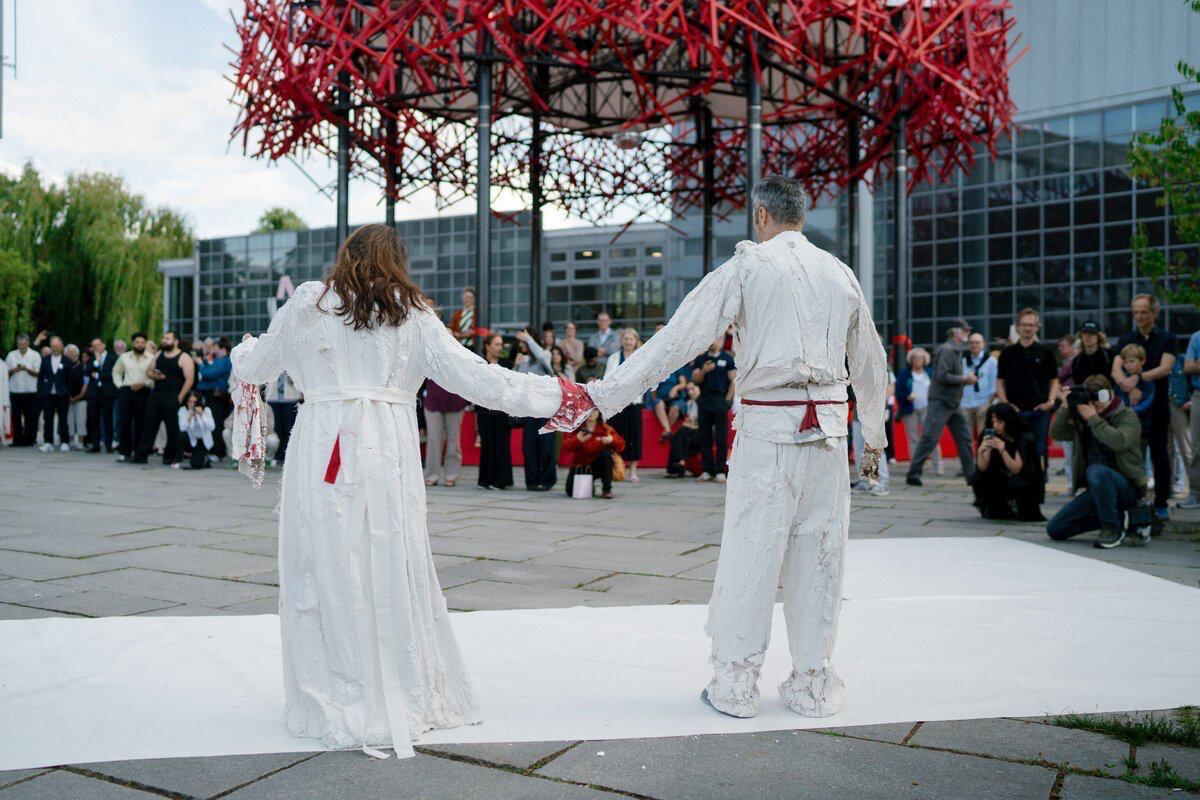
Public space today is a site where contemporary art is exhibited as much as it is a ground on which collective memory and cultural encounters are reconstituted. This reconstitution always requires a form, and the question of which form can carry memory is asked anew each time art steps out into public space. On 3 July 2026, Kunstmuseum Wolfsburg inaugurated its Open Area programme—conceived as a new site of encounter between museum and city, a third place—with the performance Kras û Fistan / Da Seve, developed from the work Kras û Fistan – Der Stoff (2021) by artist and researcher Havin Al-Sindy and under the artistic direction of Ferhat Kartal. Bringing Ferhat Kartal, Havin Al-Sindy, theatre director Mizgin Bilmen, musician Devran Amed and Kurdish students from the Braunschweig University of Art together on stage, the work was the first artistic intervention carried out within the museum's new public programme. Kartal dedicated the piece to Şengal with the words "ji bo Şengal."

Hollerplatz, the square in front of the museum, has a concrete ground. The buildings around it stand apart; the area is open. The platform built for the new programme stands close to them, but Da Seve took place not on the platform but on a wide white surface laid over the concrete. The musicians stood outside that surface, close to its edge. Dahol û zirne—drum and shawm. The museum's own text names them as follows: "Dahol: Drum. Heartbeat. Call. Gathering. Zirnê: distance within sound, a return in listening. Dance as resistance."

The performance began at 5.30 p.m. and lasted roughly twelve minutes. First the musicians, dahol û zirne, played for three or four minutes; the sound spread through the openness and filled the square, binding everyone within reach of it to a single measure. Then two participants entered and began to dance the govend. Before long the others joined them. Kartal carried a Berat inside his garment—a sacred object in Êzîdî belief. It moved with the body throughout the dance, yet was not seen. The music stopped not because a span of time had run out but because the dance had reached its fullness, and the performance was brought to a close. Plaster remained on the garments; the fragments gathered on the ground were cleared away afterwards.
The conceptual point of departure for Kras û Fistan / Da Seve is the govend. A collective dance tradition of Êzîdî Kurdish culture, it is associated with celebration and with social solidarity. Across the historical processes the Êzîdî people have lived through, this cultural element has also become a carrier of commemoration, of collective belonging and of resistance. The weakening of the govend tradition in everyday life, or its forgetting, is not something that came about of its own accord. Culture is the direct target of violence, repression and policies of assimilation. The tradition was to be weakened, drained of life. Yet as the struggle for existence continued, so did the govend; it endured because it was a source of motivation for resistance. Every govend danced today bears both the trace of an interrupted transmission and the proof that it could not be severed. To build a work upon this tradition is to summon onto the stage the tension between continuity and interruption.

Among the Êzîdî people this oscillation between continuity and interruption is carried to a more particular degree. When Ottoman centralisation imposed conscription in the nineteenth century, the Êzîdîs were especially resistant to it. Military service was not possible for a culture that apprehends the world from a place of peace; resistance therefore remained within the community's own forms. The govend is such a form: it is not merely a cultural element, and the meaning it carries answers directly, in Êzîdî culture, to resistance.
In the performance the plaster wraps the body like a shell. Where there is resistance, the plaster is the surface of a life that goes on without disturbing its ordinary course, the surface of an indifference that chooses not to look. It has been applied from outside and hardens on the surface. To remain beneath the shell is no different from remaining inside a shroud. The gesture of the govend cracks the shell; as the movement continues, fragments break from the fabric and fall. It is movement that accomplishes the breaking, and rhythm that sets the movement going. As the plaster diminishes the body grows lighter, and that lightness, becoming a kind of desire, calls for the rhythm to be sustained at speed. The red fistan is never wholly uncovered; it appears, while fragments of the shell stay fixed to the cloth. The dance's breaking of the shell is a form of refusal: it says, I am here and I go on being here.

The Berat carried beneath the shell, by contrast, is never uncovered at all. It is a pearl-shaped white pellet made in the sacred valley of Laleş from local earth mixed with several other substances; for the Êzîdîs it is the physical testimony of their bond with the holiest place on earth. It is also believed to bring protection and blessing to the household of its owner. That the sacred is carried rather than displayed makes plain that any pathetic representation and any aesthetic concern have been set aside. A coincidence may be noted here: the Berat the body conceals and the plaster that covers the body are both of earth, and both are white. One protects, the other covers. When Şengal enters circulation as an image it becomes a news item, glanced at and passed over; the dance here shows nothing, it carries, for the body is the archive of episteme, and what it carries endures because it is not consumed.
Kartal's intervention builds a further layer upon this ground. What determines this layer are the garments: Kartal develops them himself, for the performance. The garment here is not a costume but a material that carries the conceptual frame of the performance. The frame accordingly becomes specific; the work becomes one with Êzîdî identity and culture. Every element Kartal adds—from the sacred object to the braid, from the local source of the dance to the dedication—comes from a particular place within Êzîdî belief and practice. The garments developed for the men, moreover—şâl û şepik—were made in Batman by tailors of that city at Kartal's commission and taken to Germany to be worn in the performance.

The dominant colours of the performance are white and red; they come from Çarşema Sor, the New Year of the Êzîdî people, which stands for renewal and rebirth. Kartal uses them not as an aesthetic preference but as conceptual elements that constitute the visual language of the work. The garments likewise refer to Êzîdî clothing traditions far older than contemporary Kurdish dress: in place of floral motifs or coloured embroidery, what comes forward are pieced fabric surfaces formed through processes of mending and reassembly. The most distinctive element is the braiding at the waist. Kartal braided strips of red and white fabric and used them both as a belt and as the cloth held in the hand during the govend; these braids also evoke the tradition of long braided hair found among Êzîdî communities in some regions of Kurdistan. A bodily practice bound up with identity and attachment to ancestors is thereby transferred into textile. The same logic runs through all three: memory is treated less as a past to be preserved than as something sustained through care and labour.
Kartal, for whom working with younger generations has become an important part of his practice, worked with Kurdish students at the Braunschweig University of Art on the project. The performance was built on the continuity of Êzîdî cultural memory, on collective movement and on the transmission of living traditions. The source of the dance was the govend as traditionally performed by Êzîdî communities of the Hasankeyf (Hêskîf, Batman) region. The participants already knew the dance; they were then invited to Kartal's studio in Berlin. The work did not demand intensive rehearsal, because what needed repairing was not the steps. What closed was the distance between a sense of responsibility toward a cultural element in the process of being lost and the act of sustaining it. This meeting became a space of encounter and of sharing in which the performance took shape step by step, and the rehearsal process unfolded within it.
All of this took place outside the museum, on the everyday ground of the city. That Open Area was designed as a space free of charge and free of any obligation to consume lays bare how public space is besieged by the dynamics of capital and how the organic bond between place and people is being destroyed; the design is a choice that resists that siege. That the opening work was a performance dedicated to Şengal also shows what the absorbing and reflecting amount to: what is absorbed here is the memory of a threat that has not ended. And that this work was chosen to open the programme shows that Kurdish contemporary art is gaining ever greater visibility in Europe. That visibility is the result of a body of production multiplying across different geographies, different media and different generations.
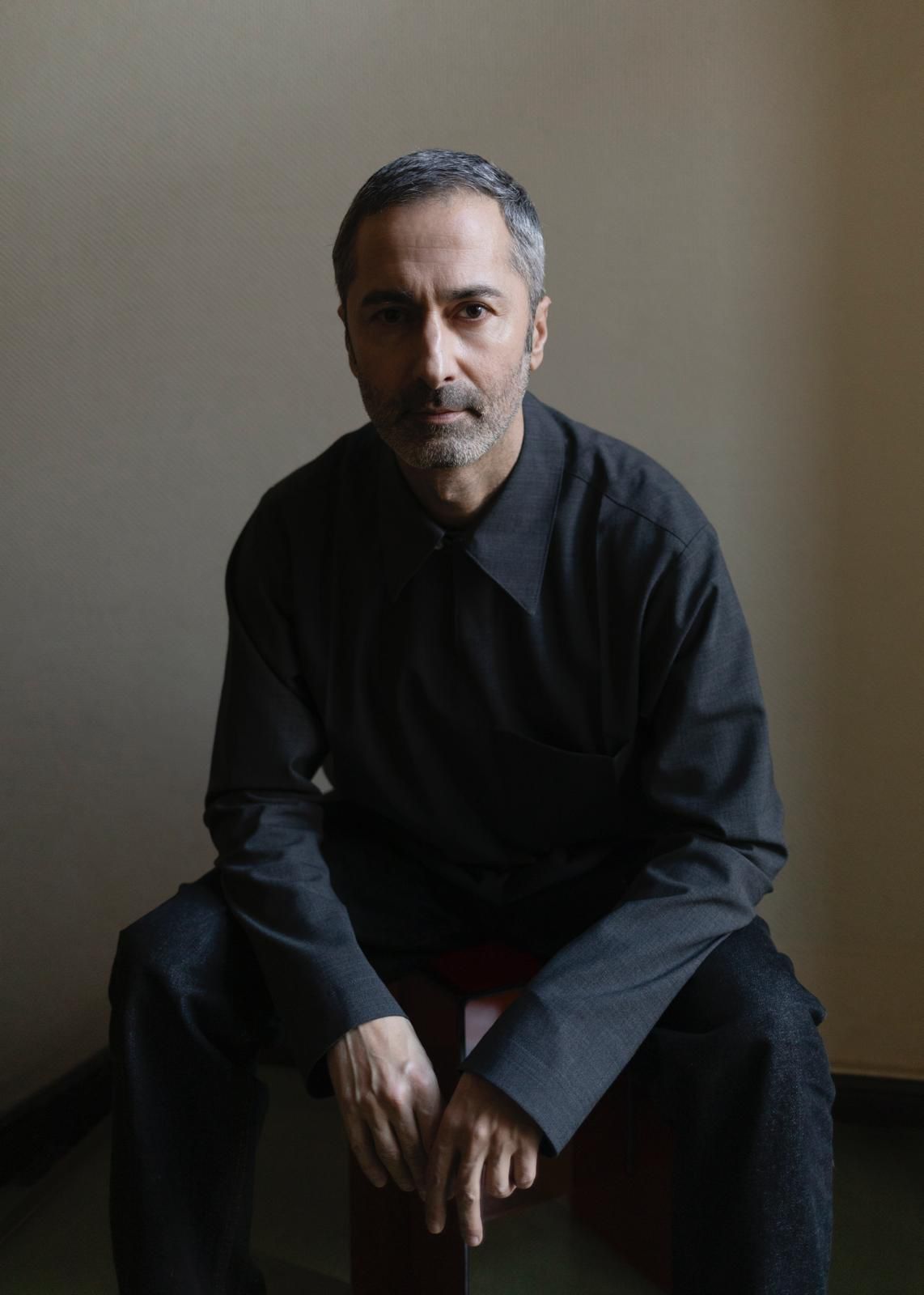
Ferhat Kartal is a designer and artist based in Berlin whose work extends across Europe and Kurdistan. After many years of international work in fashion, art and culture, he has developed an interdisciplinary approach that treats design as a living cultural language. His projects, increasingly realised in Kurdistan, bring local craft together with a contemporary and inventive visual language.
At the centre of Kartal's artistic practice stands Kurdish, as the carrier of memory, identity and cultural knowledge. For Kartal, fashion is not only a form of design but also a mode of expression that gives concrete shape to the Kurdish language and to the stories it carries. Through a fine sensitivity to material, colour and textile work, he creates pieces that translate cultural memory into contemporary forms while investigating how design can transmit stories across generations, places and communities.
NOTES
On nineteenth-century centralisation and Êzîdî resistance to conscription: NIOD Institute for War, Holocaust and Genocide Studies, "Ten years of ongoing genocide against the Yazidis," niod.nl.
On the making, form and meaning of the Berat and its bond with Laleş: Artur Rodziewicz, "The blessed handful of light: genesis and message of the Yezidi berat," British Journal of Middle Eastern Studies 51/1.
On the characterisation of the instruments: Kunstmuseum Wolfsburg, "Eröffnung Open Area – ein neuer Ort für Begegnung und Diskurs am Kunstmuseum Wolfsburg," kunstmuseum.de.

info@firezz.com

Yorumlar (0)